
 By Team THOR
Free 28-Day Fascia Reset Email Course
Get our Free 28-day email course series to help with 1 or 2 exercises per day to release your fascia. One short lesson per day. Two minutes to read each.
Acupuncture and Myofascial Release for Midlife Women: How the Two Practices Work Together (With a 5-Day Integration Program and Videos)
Acupuncture and myofascial release may seem like very different practices, but both work with fascia. Acupuncture uses needles to create mechanical and neurological input, while myofascial release uses sustained pressure and movement to help restricted tissue move more freely.
This matters in midlife because declining estrogen can affect collagen turnover, hydration, and fascial glide. The result can be more stiffness, restricted movement, and persistent tension through perimenopause and menopause.
Acupuncture can reach deeper restrictions and influence pain signaling, while myofascial release offers direct mechanical input that can also be practiced at home. Used together, they provide two complementary ways to support fascial health.
This guide covers how both practices work, what the research says, when to use each one, how to combine them safely, and a five-day program for integrating self-myofascial release alongside professional acupuncture.
Important: Acupuncture should be performed by a qualified practitioner. Avoid self-myofascial release over acute injuries, open wounds, bruising, infections, major blood vessels, or inflamed areas, and consult your healthcare provider if you have a bleeding disorder, take blood thinners, have deep vein thrombosis, advanced osteoporosis, or another condition that may affect safety.
Why Do Acupuncture and Myofascial Release Belong in the Same Conversation?
For most of the twentieth century, acupuncture and myofascial release were treated as if they came from entirely separate worlds. Acupuncture was seen as an ancient Eastern practice with mystical energy meridians, and myofascial release was seen as a modern Western bodywork technique with mechanical explanations. Recent anatomical research has shown that the two overlap far more than anyone previously realized. The meridian lines described in classical Chinese medicine correspond closely to major fascial planes described in modern connective tissue anatomy. Acupuncture points cluster along fascial junctions where multiple layers of connective tissue meet.
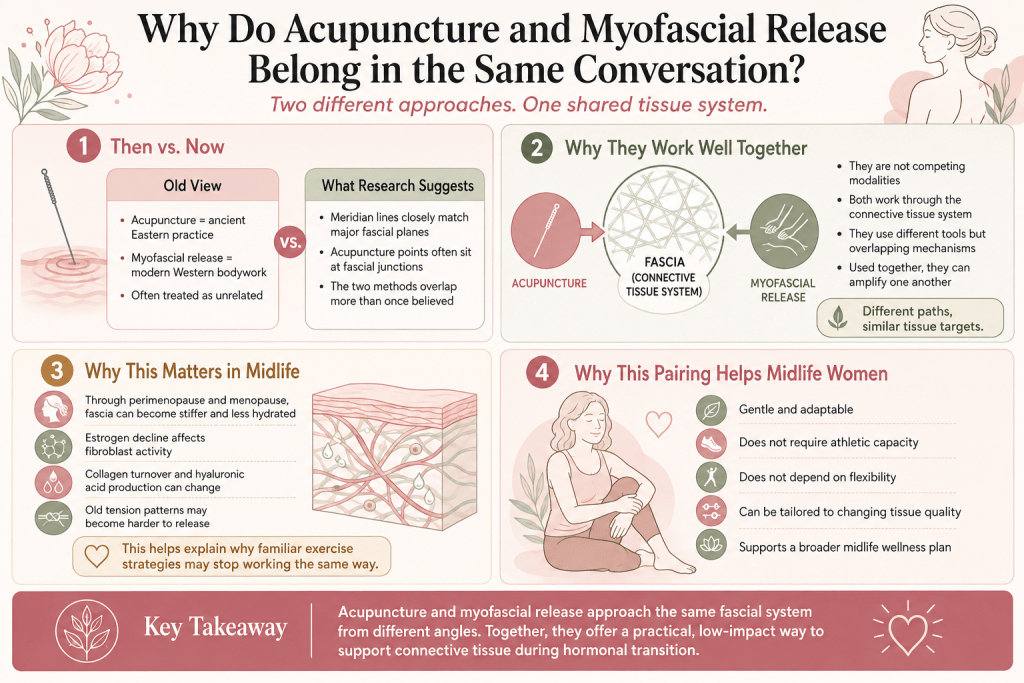
This convergence matters because it means acupuncture and myofascial release are not competing modalities. They are two approaches to the same tissue system, arrived at from different directions, using different tools, working through overlapping mechanisms. When you use them together thoughtfully, they amplify one another.
For midlife women, this pairing is particularly powerful. Fascia changes measurably through perimenopause and menopause. The connective tissue matrix becomes stiffer, less hydrated, and more prone to holding restriction patterns. Estrogen decline directly affects fibroblast activity, collagen turnover, and hyaluronic acid production. Traditional exercise that used to work often stops working. Old tension patterns become harder to shake. Both acupuncture and myofascial release offer ways to work with fascia that do not require athletic capacity, do not depend on flexibility, and can be adapted to the specific tissue quality changes that come with hormonal transition.
This article walks through the science, the practice, and the safe combination of both. By the end, you will understand what each practice does, how they influence fascia through overlapping and complementary mechanisms, when to choose one over the other, how to combine them in a weekly practice, and how they fit into the broader midlife wellness framework we teach at The House of Rose.
What Is Fascia and Why Do Midlife Changes Matter?
Fascia is the continuous connective tissue web that runs through the entire body. It surrounds every muscle fiber, every muscle group, every organ, and every blood vessel. It is one uninterrupted structure from your feet to your face. Anatomists once dismissed it as packing material. Modern anatomy recognizes fascia as a sensory organ in its own right, with more nerve endings per square centimeter than skin in some regions, and with active roles in force transmission, proprioception, and immune signaling.
Healthy fascia is hydrated, glides smoothly along adjacent layers, and adapts to load. Fibroblasts, the primary cells that build and maintain fascia, produce collagen, elastin, and the hyaluronic acid that makes fascia glide. Fasciacytes, a specialized fibroblast subtype identified relatively recently, produce most of the hyaluronic acid in the loose connective tissue between fascial layers.
In midlife women, estrogen decline directly affects each of these processes. Estrogen receptors on fibroblasts influence collagen synthesis, so falling estrogen means slower collagen turnover. Hyaluronic acid production drops, so fascia becomes drier and stickier. The result is that fascia does not glide the way it used to. Areas that used to feel loose feel dense. Old injuries flare in new places. Ranges of motion that felt effortless start to feel effortful.
You feel this as chronic tightness that stretching does not resolve, restricted range of motion in the shoulders, hips, or thoracic spine, one-sided pain that migrates around the body, and areas that feel dense or ropey when you press on them. These are all signs of fascial restriction, and they respond well to targeted mechanical or neurological input. Myofascial release provides mechanical input. Acupuncture provides both mechanical input (via the needle) and neurological input (via the response the needle triggers).
Understanding how hormonal changes affect fascia helps explain why stiffness, reduced tissue glide, and slower recovery can become more noticeable in midlife. Adding fascia-focused exercises that encourage mobility and lymphatic flow provides another part of that foundation. From there, the focus shifts to how acupuncture and myofascial release specifically interact with fascia in midlife bodies.
Free 28-Day Fascia Reset Email Course
Get our Free 28-day email course series to help with 1 or 2 exercises per day to release your fascia. One short lesson per day. Two minutes to read each.
What Are the Ancient History and Modern Science Behind Both Practices?
Acupuncture is one of the oldest continuously practiced medical systems on the planet. The Yellow Emperor’s Classic of Internal Medicine, one of the foundational Chinese medical texts, describes acupuncture in detail and dates from roughly the third century BCE. The practice traveled from China to Korea and Japan over the following centuries, then to Vietnam, and eventually to Europe through Jesuit missionaries in the seventeenth century. Modern medical acupuncture, which integrates traditional acupuncture with contemporary anatomy and physiology, developed through the twentieth century as Western physicians and physical therapists began adapting techniques for musculoskeletal medicine.
Myofascial release as a distinct named practice is much younger. The osteopathic tradition, founded in the late nineteenth century by Andrew Taylor Still, incorporated soft tissue and fascial work. Modern myofascial release techniques were developed in the 1960s and 1970s, most prominently by John Barnes, who codified an approach that spread through physical therapy education. The John Barnes technique emphasizes sustained gentle pressure held for extended durations to allow fascia to release through a viscoelastic response. Other traditions of myofascial work developed in parallel, including Rolfing, structural integration, active release techniques, and instrument assisted soft tissue mobilization.
The convergence of the two practices happened through anatomy. In 2001, Peter Deadman and colleagues, and in 2004, Helene Langevin at the University of Vermont, began publishing research showing that acupuncture points sit at fascial planes and that inserting a needle at these locations produces a measurable mechanical response in surrounding connective tissue. Langevin’s imaging studies demonstrated that when an acupuncture needle is inserted and rotated, connective tissue winds around the needle like fabric on a spindle. This mechanical winding creates tension in the surrounding fascia that persists after the needle is removed and appears to be a significant part of how acupuncture works locally.
Subsequent research by Langevin and others has demonstrated that acupuncture affects fibroblast activity, connective tissue remodeling, and the sensory nerve endings in fascia. This is not mystical. It is mechanical, biological, and reproducible. The traditional descriptions of acupuncture in terms of energy and meridians can be translated meaningfully into modern fascial anatomy and physiology.
Meanwhile, research on myofascial release has demonstrated similar effects on fibroblast activity, extracellular matrix remodeling, and pain modulation through mechanical stimulation. The two practices converge on the same tissue, influence the same cells, and produce overlapping clinical effects. They differ in how they deliver the input.
How Does Acupuncture Work on Fascia?
Acupuncture involves inserting thin sterile needles into specific points on the body. Traditional acupuncture points map to locations that modern anatomy has since shown to be fascial junctions, where multiple layers of connective tissue meet, where nerve bundles run, and where blood vessels branch. The classical meridian lines correspond closely to fascial planes.
When a needle is inserted at an acupuncture point, several things happen. First, the mechanical insertion creates a small local disruption in the connective tissue. Fibroblasts in the area respond to this mechanical stimulus by changing their behavior. They begin producing signaling molecules that affect surrounding cells and tissues. This response can persist for hours after the needle is removed.
Second, if the practitioner rotates the needle, the fascia around the needle winds up mechanically, creating a small but measurable tension load in the surrounding tissue. Langevin’s imaging studies at the University of Vermont documented this winding effect in detail. The wound fascia does not immediately unwind when the needle is removed. Instead, it slowly releases over time, providing a sustained mechanical signal to the tissue.
Third, the needle activates local sensory nerve endings. These nerve endings communicate with the central nervous system through pathways that release endogenous opioids, modulate pain signaling, and influence the autonomic nervous system. This is one of the well-documented pain-relieving mechanisms of acupuncture and has been demonstrated through functional MRI studies of brain activity during and after treatment.
Fourth, the local circulation changes. Blood flow to the treated area increases substantially and remains elevated for hours after treatment. This increased perfusion delivers oxygen and nutrients and clears metabolic waste that may have accumulated in restricted tissue.
Fifth, acupuncture appears to influence systemic inflammation. Multiple studies have documented changes in inflammatory markers including reduced levels of pro-inflammatory cytokines after acupuncture treatment. This effect is particularly notable for chronic pain conditions where low-grade inflammation contributes to symptom persistence.
For midlife women specifically, acupuncture has additional documented effects on hormone-related symptoms. The strongest evidence base is for hot flashes, night sweats, and sleep disruption during perimenopause and menopause. Multiple randomized controlled trials have shown that acupuncture produces clinically meaningful reductions in vasomotor symptoms, often comparable in effect size to certain pharmaceutical interventions and without the side effects.
Free 28-Day Fascia Reset Email Course
Get our Free 28-day email course series to help with 1 or 2 exercises per day to release your fascia. One short lesson per day. Two minutes to read each.
How Does Myofascial Release Work on Fascia?
Myofascial release covers a range of techniques that use sustained mechanical pressure, movement, or shear to influence fascial tissue. The techniques vary in tool, pressure, duration, and philosophy. What they share is direct mechanical input to fascia through the skin.
Common myofascial release approaches include:
- John Barnes myofascial release: Sustained gentle pressure held for 90 seconds to five minutes, working with the tissue’s viscoelastic response.
- Trigger point therapy: Focused pressure on specific tender points to release referred pain patterns.
- Foam rolling: Self-applied pressure using a foam cylinder to release large muscle groups and general fascia maintenance.
- Ball release: Focal self-applied pressure using a lacrosse, tennis, or specialty ball for small or hard-to-reach areas.
- Instrument assisted soft tissue mobilization: Using specialized metal or plastic tools to apply mechanical shear along the skin, similar to traditional gua sha.
- Active release techniques: Applied by trained practitioners, combines pressure with active movement of the client.
- Rolfing and structural integration: Deep systematic fascial work delivered over multiple sessions.
Each of these produces mechanical input to fascia. The specific effects vary by technique but consistently include:
- Viscoelastic response: Fascia has both elastic and viscous properties. Sustained low-load pressure produces a slow yield response, where the tissue lengthens over time. This is why John Barnes technique holds pressure for extended durations. The tissue does not release immediately. It releases over time as the viscoelastic response develops.
- Fibroblast mechanotransduction: Sustained mechanical input to fascia influences fibroblast activity. Fibroblasts sense mechanical load and respond by producing or degrading extracellular matrix components. Regular mechanical input keeps fibroblasts producing the collagen and hyaluronic acid needed for healthy fascia.
- Interstitial fluid movement: Mechanical pressure moves fluid through the loose connective tissue between fascial layers. This flushes stagnant tissue and improves the glide between layers.
- Sensory nerve activation: Mechanical pressure activates the mechanoreceptors, proprioceptors, and nociceptors embedded in fascia. This activation communicates with the central nervous system and influences pain processing, muscle tone, and autonomic function.
- Muscle tone modulation: Through connections between fascia and the neuromuscular system, myofascial release affects the resting tone of muscles. Chronically overactive muscles often reduce their baseline tone after myofascial work.
Self-myofascial release using foam rollers, balls, and simple tools is the most accessible form of this work. It is safe, effective for maintenance and mild-to-moderate restriction, and integrates well into daily practice. Professional myofascial release adds skilled assessment, precise application, and access to techniques that self-treatment cannot easily reproduce.
How Do Acupuncture and Myofascial Release Compare to Other Bodywork Methods?
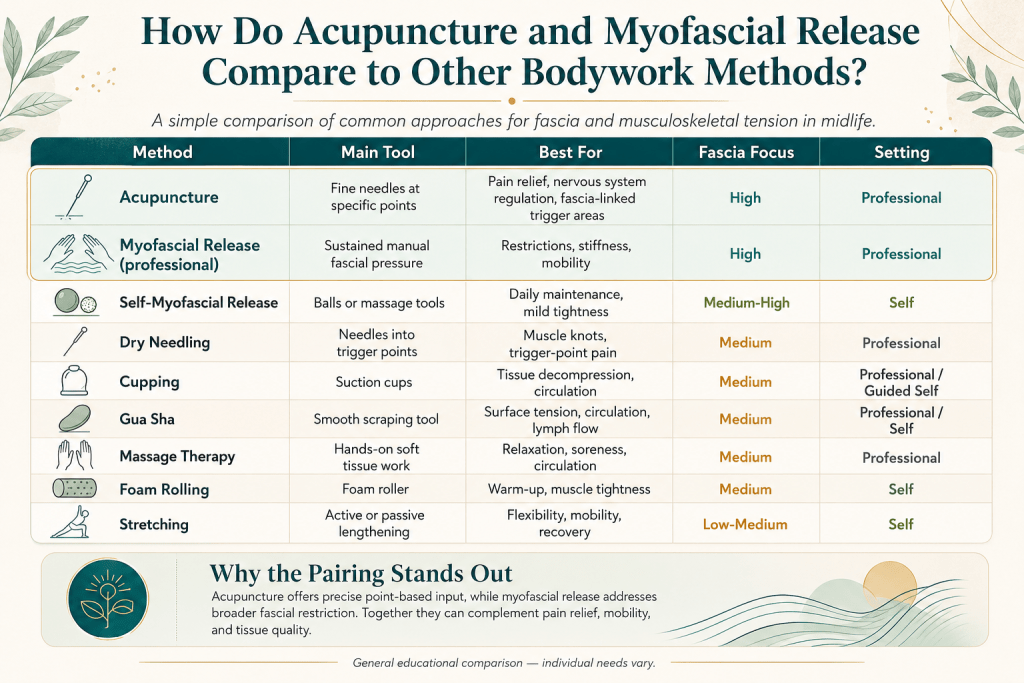
The table below compares acupuncture and myofascial release to the other common approaches for working with fascia and musculoskeletal tension in midlife.
|
Method |
Mechanism |
Best for |
Limitations |
Home practice friendly |
|
Acupuncture |
Needle insertion at fascial junctions; mechanical winding, nerve activation, increased blood flow, systemic effects |
Chronic pain, hormone-related symptoms, deep fascial restriction, systemic inflammation |
Requires licensed practitioner; needle phobia; cost |
No |
|
Myofascial Release (professional) |
Sustained mechanical pressure with skilled application |
Complex restrictions, injury recovery, structural patterns needing skilled assessment |
Requires appointments; cost; limited insurance coverage |
No |
|
Self-Myofascial Release |
Sustained mechanical pressure via foam roller, ball, or tools |
Maintenance, general fascia care, mild-to-moderate restriction |
Cannot substitute for skilled assessment of complex patterns |
Yes |
|
Dry Needling |
Needle insertion at trigger points, typically by physical therapist |
Trigger points, muscle knots, sports injury |
Not traditional acupuncture; requires trained practitioner |
No |
|
Cupping |
Negative pressure decompresses fascia and increases blood flow |
Chronically compressed tissue, deep restriction |
Leaves marks; requires practice |
Yes |
|
Gua Sha |
Mechanical shear along skin unsticks fascial layers |
Adhered fascial layers, superficial fascia |
Leaves temporary marks |
Yes |
|
Massage Therapy |
Skilled hands work all tissue layers |
Comprehensive fascial work |
Requires appointments; cost |
No |
|
Foam Rolling |
Sustained compression flattens and rehydrates fascia |
Large muscle groups, warm-up |
Cannot reach small or deep areas |
Yes |
|
Sustained low-load stretch for deep connective tissue |
Chronic tension patterns, slow fascial hydration |
Requires time and patience |
Yes |
|
|
Stretching |
Passive lengthening of muscle-fascia unit |
Range of motion improvements |
Does not directly address stuck fascial layers |
Yes |
Acupuncture and myofascial release occupy complementary positions in this list. Acupuncture is unmatched for reaching deep fascial layers, addressing systemic effects, and modulating pain through central nervous system pathways. Self-myofascial release is unmatched for daily maintenance, accessibility, and cost-effectiveness. Combining professional acupuncture with a home self-myofascial release practice gives you both the depth of skilled needle work and the consistency of daily self-care.
Worked example. A woman in her late forties has chronic low back tension that started during her second pregnancy and has been managed with sporadic massage since. As perimenopause progresses, the pattern worsens. She books a series of six acupuncture sessions with a licensed acupuncturist, scheduled weekly. Between sessions, she performs a daily 10-minute self-myofascial release routine using a foam roller on her low back and glutes, and a ball on her piriformis and hip flexors.
Over the six-week series, the professional acupuncture addresses the deep pattern that has been resistant to prior treatment. The daily self-work maintains what each session opens up and prevents the tissue from returning to its baseline restriction between visits. This combination produces sustained results in a way that either practice alone would not.
Free 28-Day Fascia Reset Email Course
Get our Free 28-day email course series to help with 1 or 2 exercises per day to release your fascia. One short lesson per day. Two minutes to read each.
What Does the Research Say?
The research bases for acupuncture and myofascial release have both grown substantially. Both have limitations in study quality and blinding, but the volume of evidence for both is now considerable.
- Acupuncture and chronic pain: A 2018 individual patient data meta-analysis by Vickers and colleagues, published in the Journal of Pain, pooled data from more than 20,000 patients across 39 trials. The analysis found that acupuncture produced clinically meaningful reductions in chronic pain (musculoskeletal, headache, and osteoarthritis) compared to both sham acupuncture and no acupuncture controls. Effect sizes persisted at one-year follow-up in a subset of studies, suggesting sustained benefit.
- Acupuncture and menopausal symptoms: Multiple systematic reviews have examined acupuncture for vasomotor symptoms. A 2019 review in BMJ Open pooled data from 15 randomized controlled trials and found that acupuncture significantly reduced the frequency and severity of hot flashes compared to controls. Effects generally persisted for at least three months after treatment ended. A separate line of research has examined acupuncture for menopausal sleep disturbance, mood changes, and sexual function, with generally positive findings though smaller evidence bases.
- Acupuncture and connective tissue: Langevin and colleagues at the University of Vermont have published extensively on the connective tissue effects of acupuncture. Their imaging studies documented mechanical winding of fascia around needles, effects on fibroblast morphology, and downstream changes in extracellular matrix components. This body of research provides a mechanistic foundation for what practitioners have observed clinically.
- Myofascial release and chronic pain: A 2015 systematic review in the Journal of Bodywork and Movement Therapies examined myofascial release for various pain conditions. Results were positive overall, with the strongest evidence for chronic low back pain and neck pain. A 2020 meta-analysis focused specifically on plantar heel pain found that myofascial release reduced pain and improved function compared to control interventions.
- Self-myofascial release with foam rollers: A large body of research has examined foam rolling. A 2019 systematic review and meta-analysis in Frontiers in Physiology found that foam rolling before exercise improved short-term flexibility without impairing performance. Foam rolling after exercise reduced perceived muscle soreness. Both effects are consistent with mechanical influence on fascia and neuromuscular function.
- Combined bodywork approaches: Fewer studies have examined combined protocols directly, but the physiological rationale for combining approaches is strong. Both acupuncture and myofascial release influence overlapping tissue and physiological systems. The mechanisms are complementary rather than redundant.
- Safety: Both practices have excellent safety profiles when performed appropriately. Serious adverse events from acupuncture are rare and typically involve non-sterile technique or contraindications that were missed. Adverse events from myofascial release are typically minor (bruising, temporary soreness) and preventable with reasonable technique.
- Limitations: Both fields struggle with blinding, standardization of technique across studies, and control group selection. Sham acupuncture is difficult to design because inserting a needle at any location produces some physiological effect. Myofascial release studies vary widely in technique used, making comparison across studies difficult. Despite these limitations, the consistent direction of findings across multiple research groups and methodologies is meaningful.
When Should You Choose Acupuncture, Myofascial Release, or Both?
Both modalities have situations where they excel.
Choose acupuncture when you have:
- Chronic pain that has not responded to other approaches
- Perimenopause or menopause symptoms including hot flashes, night sweats, sleep disruption
- Deep fascial restriction that surface work has not reached
- Systemic patterns like widespread muscle tension or fibromyalgia
- Interest in the systemic and central nervous system effects
- Access to a licensed acupuncturist and the financial capacity for a series of sessions
- Patience for a course of treatment (typically 6 to 12 sessions to assess benefit)
Choose myofascial release when you have:
- Specific mechanical restrictions you can identify and target
- Areas that respond to sustained pressure
- Interest in a daily self-care practice
- Budget constraints that make professional treatment difficult
- The desire to build fascia care into your daily routine
- Recovery needs after training or activity
Use both when you want to:
- Address chronic patterns from multiple angles
- Combine the depth of professional needle work with daily self-maintenance
- Build a sustainable long-term fascia practice
- Support recovery from significant injury
- Manage complex conditions with multiple contributing factors
- Get the most complete fascial care your resources allow
The typical protocol when combining is to schedule acupuncture sessions weekly or biweekly for a defined course (often six to twelve sessions), while maintaining a daily or near-daily self-myofascial release practice. The acupuncture addresses deep patterns. The self-work maintains progress and prevents regression between sessions.
Free 28-Day Fascia Reset Email Course
Get our Free 28-day email course series to help with 1 or 2 exercises per day to release your fascia. One short lesson per day. Two minutes to read each.
How Can Acupuncture Support Perimenopause and Menopause?
Acupuncture has one of the strongest evidence bases in integrative medicine for hormone-related symptoms during the midlife transition. This deserves specific attention.
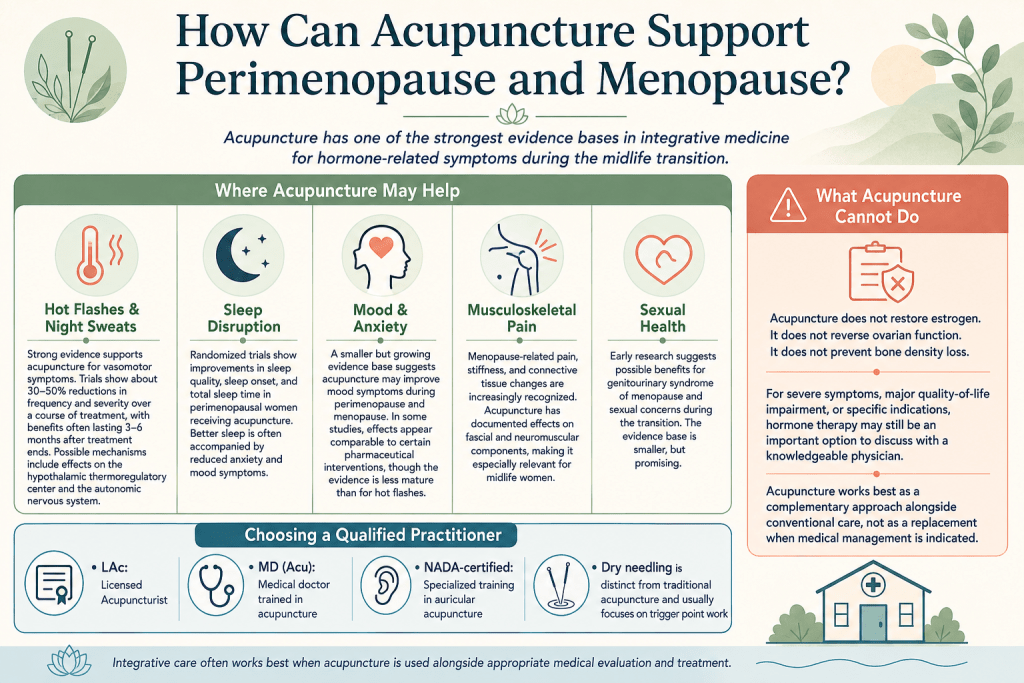
- Hot flashes and night sweats: The evidence for acupuncture in vasomotor symptoms is now substantial. Multiple randomized controlled trials have documented reductions in the frequency and severity of hot flashes ranging from 30 to 50 percent over a course of treatment, with effects often persisting three to six months after the treatment series ends. The mechanism appears to involve modulation of the hypothalamic thermoregulatory center and downstream effects on the autonomic nervous system.
- Sleep disruption: Randomized trials have shown improvements in sleep quality, sleep onset, and total sleep time in perimenopausal women receiving acupuncture. Effects are often accompanied by reductions in anxiety and mood symptoms that also affect sleep.
- Mood and anxiety: A smaller but growing body of research documents effects on mood symptoms during perimenopause and menopause. Effects appear comparable in some studies to certain pharmaceutical interventions, though the evidence base is less mature than for vasomotor symptoms.
- Musculoskeletal pain: The “musculoskeletal syndrome of menopause,” described in recent literature, includes widespread pain, stiffness, and connective tissue changes. Acupuncture has documented effects on the fascial and neuromuscular components of this syndrome. This is where the acupuncture-fascia connection becomes particularly relevant to midlife women.
- Sexual health: Some research examines acupuncture for genitourinary syndrome of menopause and sexual concerns during the transition. The evidence base is smaller but promising.
- What acupuncture cannot do: Acupuncture does not restore estrogen. It does not reverse ovarian function. It does not prevent bone density loss. For women with severe symptoms, significant menopausal effects on quality of life, or specific indications, hormone therapy remains an important option that should be discussed with a knowledgeable physician. Acupuncture is a complementary approach that works well alongside conventional care, not a substitute for medical management when medical management is indicated.
Look for practitioners with the LAc credential (Licensed Acupuncturist) or the equivalent depending on your state. Some medical doctors also practice medical acupuncture and hold the MD (Acu) credential. NADA-certified practitioners have specialized training in auricular acupuncture. In some states, chiropractors and physical therapists provide dry needling, which is technically distinct from traditional acupuncture and typically focused on trigger point work rather than the full scope of acupuncture practice.
What Tools and Setup Do You Need for Home Myofascial Release Practice?
Self-myofascial release requires minimal equipment. The following tools cover almost every need.
- Foam roller: The primary tool for large muscle groups. Options include:
- Standard density foam roller: 6-inch diameter, 36 inches long. Good starting point for most people. Under $30.
- High density foam roller: More aggressive pressure. For those who have progressed past standard density. Under $40.
- Textured foam roller: Ridges or knobs for more focal pressure. Useful once you have progressed past smooth rollers. Around $40.
- Vibrating foam roller: Adds mechanical vibration to the pressure. Some evidence suggests it may enhance effects. $80 to $200.
Balls for Focal Release
- Lacrosse ball: Firm rubber ball perfect for focal pressure on glutes, piriformis, feet. Around $5.
- Tennis ball: Softer alternative for beginners. A few dollars.
- Peanut-shaped double ball: For work along the spine without direct pressure on vertebrae. Around $15.
- Softer therapy balls: Various brands offer graduated firmness. $10 to $30.
Additional Tools
- Trigger point cane or hook: For hard-to-reach areas like upper back. $20 to $40.
- Percussion massager: Handheld device delivering rapid mechanical percussion. Range from $80 to $600.
- Yoga mat: For floor work. Around $30.
Environment
- Warm room: Cold muscles do not respond as well.
- Enough floor space to lie down and roll.
- Time: Rushing myofascial release reduces its effectiveness.
- No distractions: Attention to sensation matters.
Contraindications for Self-Myofascial Release
Do not apply myofascial release directly over:
- Acute injuries, open wounds, or active infections
- Areas of bruising or recent trauma
- Directly over the spine or joints (work adjacent tissue)
- Major blood vessels (front of neck, groin, inside of elbow)
- Areas of active inflammation from other causes
Do not use self-myofascial release if you:
- Have bleeding disorders or are on blood thinners without physician clearance
- Have advanced osteoporosis (may need modifications for pressure)
- Have deep vein thrombosis
- Have any acute infection or fever
- Are in a fragile state where excessive input could aggravate
Consult a physical therapist or licensed practitioner if you have complex conditions or are unsure whether these tools are appropriate for you.
Free 28-Day Fascia Reset Email Course
Get our Free 28-day email course series to help with 1 or 2 exercises per day to release your fascia. One short lesson per day. Two minutes to read each.
What Is the 5-Day Integration Program?
This program builds a self-myofascial release practice alongside professional acupuncture (either concurrent with a treatment series or in preparation for one). The self-work supports and extends what acupuncture achieves.
|
Day |
Focus |
Practice |
Duration |
|
Day 1 |
Foundation, back and hips |
Foam roll upper back, mid back, glutes; ball release piriformis |
12 minutes |
|
Day 2 |
Add legs |
Repeat Day 1, add foam roll IT band, quadriceps, calves |
18 minutes |
|
Day 3 |
Add feet and hands |
Repeat Day 2, add ball release plantar fascia and forearms |
22 minutes |
|
Day 4 |
Full body integration |
Full sequence from Day 3, work more slowly with attention to sensation |
25 minutes |
|
Day 5 |
Add breath and stillness |
Full sequence with sustained holds and diaphragmatic breathing during focal releases |
30 minutes |
Day 1 Detail: Foundation, Back and Hips
Lie on the foam roller with it across your upper back at the level of your shoulder blades. Support your head with your hands. Slowly roll from shoulder blade level to just below the shoulder blades. Pause on any tender area for 20 to 30 seconds. Repeat for 3 minutes. Then position the roller under your glutes and roll each side, using slow deliberate movement, for 2 minutes each side. Finally, place a lacrosse ball under your piriformis (the deep hip external rotator) and use your body weight to apply pressure. Hold for 30 to 60 seconds per side. Breathe through any tenderness.
Day 2 Detail: Add Legs
Repeat the Day 1 back and hip work. Then add the following: foam roll the outside of each thigh (IT band region) for 90 seconds each side, working slowly. Foam roll the quadriceps for 90 seconds each side. Foam roll the calves for 90 seconds each side. The IT band region often produces significant sensation the first few times. Do not force it. Reduce pressure until it is intense but manageable.
Day 3 Detail: Add Feet and Hands
Repeat Day 2 sequence. Then add ball work for the feet: stand with a lacrosse or tennis ball under one foot, using body weight to roll the ball from heel to ball of foot. Two minutes each side. Then use the ball on your forearms while seated: place the ball between your forearm and a firm surface (table edge), and apply pressure while flexing and extending the wrist. One minute per forearm. Extend if desk work leaves you tight in the forearms.
Day 4 Detail: Full Body Integration
Complete the full sequence from Day 3. Work more slowly. Instead of moving continuously along an area, pause on specific spots for 60 to 90 seconds. Notice how the tissue responds. Notice areas that are asymmetric between sides. Track this over time as a diagnostic tool.
Day 5 Detail: Add Breath and Stillness
Complete the Day 4 sequence with two additions. First, on each focal release (piriformis, IT band trigger point, forearm), hold the pressure while performing five slow diaphragmatic breaths. Inhale through the nose for a count of 4, exhale through the nose for a count of 6. Feel the tissue soften with each exhale. Second, at the end of the full sequence, rest on your mat for 5 minutes in a comfortable position while continuing slow breathing. This integrates the mechanical work with parasympathetic nervous system activation.
After completing the 5-day introduction, most women benefit from 15 to 25 minutes of self-myofascial release three to four times per week. Rotate which areas you emphasize based on need. If you are also receiving acupuncture, coordinate the self-work with your sessions. Schedule intensive self-work on non-acupuncture days and lighter maintenance on acupuncture days.
How Can You Do Self-Myofascial Release Safely?
Technique matters more than time or intensity.
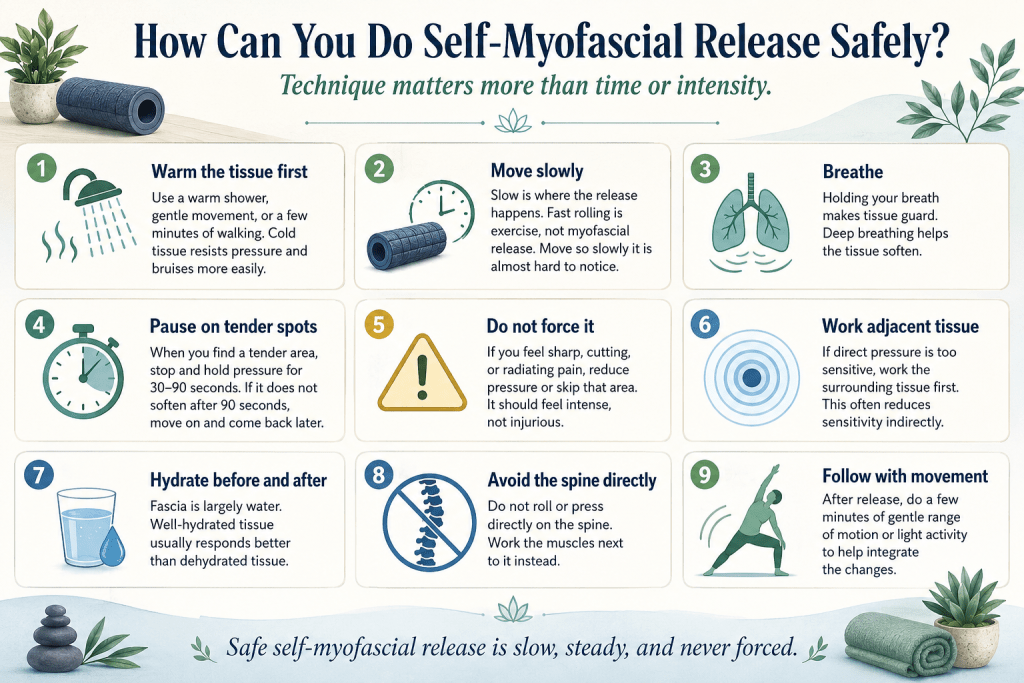
- Warm the tissue first: A warm shower, gentle movement, or a few minutes of walking prepares fascia to respond. Cold tissue resists mechanical input and can bruise more easily.
- Move slowly: Slow is where the release happens. Fast rolling is aerobic exercise for your legs, not myofascial release. Aim for movement so slow that a bystander might wonder if you are actually moving.
- Breathe: Hold your breath and the tissue guards. Breathe deeply and the tissue softens. Every session, remind yourself to breathe.
- Pause on tender spots: When you find a spot that produces significant sensation, stop. Hold pressure for 30 to 90 seconds. The tissue often softens dramatically during this hold. If it does not soften after 90 seconds, move on and return in a future session.
- Do not force it: If a spot produces sharp pain, cutting sensation, or radiating pain, reduce pressure or skip that area. Myofascial release should feel like productive intensity, not injury.
- Work adjacent tissue when direct pressure is problematic: For sensitive areas, work the tissue around and beyond the sensitive area first. This often reduces the sensitivity of the target area indirectly.
- Hydrate before and after: Fascia is largely water. Working on well-hydrated tissue produces better results than working on dehydrated tissue.
- Avoid the spine directly: Do not roll or press directly on your spine. Work the muscles adjacent to the spine (paraspinals) instead.
- Follow with movement: After myofascial release, do a few minutes of gentle range of motion or light activity. This helps integrate the changes.
Free 28-Day Fascia Reset Email Course
Get our Free 28-day email course series to help with 1 or 2 exercises per day to release your fascia. One short lesson per day. Two minutes to read each.
How Should You Prepare for an Acupuncture Session?
Preparation improves the experience and the results.
Before the Session
- Eat a light meal 1 to 2 hours before: Do not arrive on an empty stomach or immediately after a large meal.
- Wear loose comfortable clothing that provides access to arms, legs, and back.
- Avoid alcohol for at least 24 hours before.
- Bring a list of medications and supplements.
- Bring notes on your specific concerns, including how long you have had them and what has helped or not helped.
- Arrive 10 to 15 minutes early: Rushing sets the wrong autonomic tone.
During the Session
- Communicate openly: Tell the practitioner what you are feeling. If a needle placement is uncomfortable, say so.
- Relax as much as you can: Deep breathing helps.
- Some sensations are normal: dull ache, heaviness, warmth, tingling: Sharp pain is not normal. Report it.
- Rest on the table for the duration the practitioner specifies: Do not remove needles yourself.
After the Session
- Move slowly for the first 30 minutes: Some people feel briefly light-headed or emotionally open.
- Hydrate
- Rest if possible
- Avoid alcohol and intense exercise for the rest of the day.
- Notice how you feel over the next 24 to 72 hours: Effects often continue to unfold after the session.
Between Sessions
- Track symptoms: Note improvements, regressions, or shifts in the pattern.
- Maintain your self-myofascial release practice if you have one.
- Follow any lifestyle guidance the practitioner provided.
- Attend scheduled follow-up sessions: Acupuncture typically produces the best results with a series (often six to twelve sessions).
What Are Common Mistakes and How Can You Avoid Them?
- Treating acupuncture as a one-and-done treatment: Acupuncture typically requires a series of sessions to produce meaningful benefit for chronic conditions. Judging acupuncture by a single session is like judging strength training by a single workout. Commit to a course of treatment before deciding whether it works for you.
- Rolling fast on the foam roller: Fast rolling does not work. It reduces the technique to something between a warm-up and a cardio session. Slow, deliberate movement with attention to sensation is what produces fascial change.
- Only working the sore spots: Restrictions often refer sensation elsewhere. The spot that hurts may not be the spot that needs work. Work broadly across major fascial regions rather than only on the specific place that feels tight.
- Skipping self-work between acupuncture sessions: The tissue changes acupuncture produces can regress between sessions if the tissue returns to its baseline patterns. Daily or near-daily self-myofascial release maintains progress and often accelerates cumulative benefit.
- Comparing acupuncture and dry needling as if they were the same: Dry needling and acupuncture use similar tools but come from different traditions and typically address different problems. Dry needling is focused on trigger point release for muscular pain, usually performed by physical therapists with specialized training. Acupuncture involves a broader diagnostic and treatment approach based on traditional Chinese medicine and modern acupuncture research. Both are valid. They are not interchangeable.
- Assuming needle discomfort means it is not working: Sensation during acupuncture is often part of the response, not a sign of poor technique. The dull ache, heaviness, or warmth that some points produce is called “de qi” in traditional practice and is thought to indicate an effective response. Sharp pain is different and should be communicated. Learn to distinguish sensation from pain.
- Working through injuries with self-myofascial release: Fresh injuries need different care than chronic patterns. Do not roll or press directly on recent sprains, strains, or bruising. Wait until the acute phase resolves, then work adjacent tissue before returning to the injury site.
- Doing it all yourself when you would benefit from professional guidance: Self-myofascial release is powerful for maintenance. It is not a substitute for skilled assessment of complex patterns. If a restriction has not responded to consistent self-work over four to eight weeks, work with a professional.
Free 28-Day Fascia Reset Email Course
Get our Free 28-day email course series to help with 1 or 2 exercises per day to release your fascia. One short lesson per day. Two minutes to read each.
What Should You Expect From Sensations, Marks, and Timelines?
- During acupuncture: Initial needle insertion is often barely felt. Once needles are in place, sensations include mild ache, heaviness, warmth, tingling, or a spreading feeling. These sensations are normal parts of the response. Sharp pain is not.
- During self-myofascial release: You feel pressure. Some areas feel smooth. Others feel dense, ropey, or tender. Tender areas often become less tender as you hold pressure and breathe. This is the release.
- Immediately after acupuncture: Deep relaxation is common. Some people feel briefly tired or emotionally open. Sensations from the treatment may continue for hours.
- Immediately after myofascial release: Increased warmth and looseness in the treated area. Improved range of motion. Sometimes brief lightheadedness, particularly after long sessions.
- First 24 to 72 hours: Effects of acupuncture often continue unfolding for two to three days. Effects of myofascial release typically peak in the first day and gradually return partially over subsequent days. Both are normal.
- First few weeks: For chronic patterns, both practices produce cumulative benefit over multiple sessions or weeks of consistent practice. Individual sessions may feel modestly different, but the trend line over weeks is what matters.
- Longer term: Structural changes take months of consistent practice. Chronic pain patterns often reduce substantially over a six-to-twelve week course of combined work. This is normal timing for tissue-level change.
- When to be concerned: Increased pain that persists beyond 48 hours, new symptoms that appear after treatment, bruising that seems excessive for the pressure applied, or any signs of infection at needle sites. These are unusual and warrant contacting your practitioner.
When Should You See a Licensed Practitioner?
Self-care has limits. Professional guidance matters when the problem exceeds those limits.
See a Licensed Acupuncturist When You Have
- Chronic pain that has not responded to self-care and conventional treatment
- Significant perimenopause or menopause symptoms
- Complex conditions requiring skilled assessment
- Interest in a complete course of treatment
- Access and financial capacity for regular sessions
See a Physical Therapist or Myofascial Release Specialist When You Have
- Post-injury restrictions requiring skilled hands-on work
- Complex scar tissue or adhesion patterns
- Rehabilitation from surgery
- Conditions where self-work has not produced adequate progress
- A specific movement dysfunction requiring assessment
What To Look For in an Acupuncturist
Licensed Acupuncturist (LAc) credential or equivalent for your state. Formal training from an accredited school (typically 3 to 4 years of graduate education for LAcs). Clean office and appropriate sterile technique. Willingness to discuss your specific concerns. Communication with your other healthcare providers. Reasonable treatment plan and clear pricing.
What To Look For in a Myofascial Release Specialist
Licensed physical therapist (DPT), certified massage therapist (LMT), or equivalent professional credential. Specific training in myofascial release (John Barnes certification is a common credential). Experience with midlife women’s tissue quality if that is relevant to you. Willingness to teach you techniques you can use between sessions.
Cost Expectations
Acupuncture sessions typically range from $75 to $200 in the United States. Some insurance plans cover acupuncture for specific diagnoses (usually chronic pain). Physical therapy is generally covered by insurance with appropriate diagnosis. Standalone myofascial release from a licensed massage therapist typically costs $80 to $180 per session.
Free 28-Day Fascia Reset Email Course
Get our Free 28-day email course series to help with 1 or 2 exercises per day to release your fascia. One short lesson per day. Two minutes to read each.
Frequently Asked Questions
Does acupuncture actually release fascia?
Yes, based on modern research. Helene Langevin’s imaging studies at the University of Vermont demonstrated that acupuncture needles mechanically wind fascia around themselves when rotated, producing sustained tension in the surrounding tissue. Subsequent research has shown effects on fibroblasts, extracellular matrix components, and connective tissue remodeling. This mechanical effect on fascia is one of the well-documented mechanisms of acupuncture, alongside its effects on nerves, blood flow, and systemic inflammation.
Is dry needling the same as acupuncture?
No. Dry needling uses similar tools (thin filiform needles) but comes from a different tradition and is typically focused on trigger point release for muscular pain. It is usually performed by physical therapists with specialized training. Acupuncture involves a broader diagnostic and treatment approach based on both traditional Chinese medicine and modern acupuncture research, performed by licensed acupuncturists. Both can be useful. They are distinct practices with different scopes.
How many acupuncture sessions do I need?
For chronic conditions, a typical initial course is six to twelve sessions, often scheduled weekly or biweekly. For acute conditions, fewer sessions may be needed. Maintenance schedules vary from monthly to quarterly depending on the condition and individual response. Discuss expectations with your practitioner.
Can I do acupuncture and myofascial release on the same day?
Yes, but sequence matters. Gentle myofascial release before acupuncture can prepare tissue to respond well. Aggressive myofascial release immediately after acupuncture may reduce some of the mechanical effects the needles produced. If you want to combine them same-day, do lighter self-work before the session and save any deeper self-work for the following day.
Does acupuncture help hot flashes?
The evidence base is now substantial. Multiple randomized controlled trials show reductions in hot flash frequency and severity, often persisting three to six months after a treatment series ends. Effects vary between individuals, but the overall pattern of evidence supports acupuncture as a legitimate option for perimenopausal and menopausal vasomotor symptoms.
Can I use a percussion massager instead of a foam roller?
Percussion massagers deliver rapid mechanical percussion that produces some effects similar to foam rolling. Research on percussion devices is less extensive than research on foam rolling, but early studies suggest they can be effective for warm-up, recovery, and some myofascial applications. They do not fully replace sustained pressure techniques for deeper fascial work.
Is acupuncture safe during perimenopause?
Yes, when performed by a licensed practitioner. Acupuncture is one of the more thoroughly studied complementary therapies for perimenopausal symptoms, and the safety profile is excellent. Discuss any medications you are taking with your practitioner, particularly anticoagulants.
How do I know if a self-myofascial release technique is right for me?
Start with the most conservative version of any technique. Use less pressure, less time, and gentler tools than you think you need. Notice how your body responds over the following 24 to 48 hours. Progress gradually as your tissue tolerates more input. If pain increases or persists, back off and consult a professional.
Can acupuncture help with sleep?
Multiple studies have documented improvements in sleep quality with acupuncture, particularly in perimenopausal women. Effects appear related to reduced vasomotor symptoms, reduced anxiety, and direct autonomic nervous system modulation. If sleep is a specific concern, mention it to your practitioner so they can adjust the treatment approach.
What about acupuncture for weight and metabolism?
Some research examines acupuncture for weight-related concerns, particularly in perimenopausal women where hormonal changes affect metabolism. The evidence is smaller and less consistent than for pain or vasomotor symptoms. Acupuncture is not a substitute for the fundamentals of protein intake, resistance training, and sleep. It may support these efforts in some individuals as one component of a broader plan.
How do I find a good acupuncturist?
Look for licensed practitioners with formal training from accredited schools. Check credentials with your state’s licensing board. Ask about experience with your specific concerns. Read reviews. Have an initial consultation before committing to a series. A good acupuncturist will discuss your history in depth, explain their approach, and set realistic expectations.
Does acupuncture hurt?
The needles used in acupuncture are much thinner than injection needles. Initial insertion is often barely felt. Once needles are in place, sensations include dull ache, heaviness, warmth, or tingling. These sensations are typically not painful, though they can be unusual. Sharp pain is not normal and should be reported to the practitioner immediately.
Can I do self-myofascial release every day?
Yes, most people benefit from daily self-myofascial release once they have adjusted to it. Session length should be modest (10 to 25 minutes) if you are working daily. Longer sessions (30 to 45 minutes) with rest days between them work well for those who prefer that pattern. Rotate which areas you emphasize.
Is myofascial release safe during pregnancy?
Gentle self-myofascial release is generally safe during pregnancy for areas away from the abdomen and low back. Consult your obstetric provider for individual guidance, particularly for the second and third trimesters. Professional myofascial release specifically trained in prenatal work is a safer option than self-work during pregnancy.
Can I do these instead of exercise?
No. Acupuncture and myofascial release support movement and recovery. They do not replace the mechanical loading, cardiovascular work, and neuromuscular training that regular exercise provides. Use them as complements to your movement practice, not as substitutes.
References
- Vickers, A. J., Vertosick, E. A., Lewith, G., MacPherson, H., Foster, N. E., Sherman, K. J., Irnich, D., Witt, C. M., Linde, K., & Acupuncture Trialists’ Collaboration. (2018). Acupuncture for chronic pain: Update of an individual patient data meta-analysis. Journal of Pain, 19(5), 455-474.
- Langevin, H. M., & Yandow, J. A. (2002). Relationship of acupuncture points and meridians to connective tissue planes. Anatomical Record, 269(6), 257-265.
- Langevin, H. M., Churchill, D. L., Wu, J., Badger, G. J., Yandow, J. A., Fox, J. R., & Krag, M. H. (2002). Evidence of connective tissue involvement in acupuncture. FASEB Journal, 16(8), 872-874.
- Langevin, H. M., Bouffard, N. A., Badger, G. J., Iatridis, J. C., & Howe, A. K. (2005). Dynamic fibroblast cytoskeletal response to subcutaneous tissue stretch ex vivo and in vivo. American Journal of Physiology: Cell Physiology, 288(3), C747-C756.
- Ee, C., French, S. D., Xue, C. C., Pirotta, M., & Teede, H. (2017). Acupuncture for menopausal hot flashes: Clinical evidence update and its relevance to decision making. Menopause, 24(8), 980-987.
- Lund, K. S., Siersma, V., Brodersen, J., & Waldorff, F. B. (2019). Efficacy of a standardised acupuncture approach for women with bothersome menopausal symptoms: A pragmatic randomised study in primary care. BMJ Open, 9(1), e023637.
- Avis, N. E., Coeytaux, R. R., Isom, S., Prevette, K., & Morgan, T. (2016). Acupuncture in menopause (AIM) study: A pragmatic, randomized controlled trial. Menopause, 23(6), 626-637.
- Ajimsha, M. S., Al-Mudahka, N. R., & Al-Madzhar, J. A. (2015). Effectiveness of myofascial release: Systematic review of randomized controlled trials. Journal of Bodywork and Movement Therapies, 19(1), 102-112.
- Wilke, J., Müller, A. L., Giesche, F., Power, G., Ahmedi, H., & Behm, D. G. (2020). Acute effects of foam rolling on range of motion in healthy adults: A systematic review with multilevel meta-analysis. Sports Medicine, 50(2), 387-402.
- Cheatham, S. W., Kolber, M. J., Cain, M., & Lee, M. (2015). The effects of self-myofascial release using a foam roll or roller massager on joint range of motion, muscle recovery, and performance: A systematic review. International Journal of Sports Physical Therapy, 10(6), 827-838.
- Wiech, K., Ploner, M., & Tracey, I. (2008). Neurocognitive aspects of pain perception. Trends in Cognitive Sciences, 12(8), 306-313.
- MacPherson, H., Vertosick, E. A., Foster, N. E., Lewith, G., Linde, K., Sherman, K. J., Witt, C. M., & Vickers, A. J. (2017). The persistence of the effects of acupuncture after a course of treatment: A meta-analysis of patients with chronic pain. Pain, 158(5), 784-793.
- Stecco, C., Stern, R., Porzionato, A., Macchi, V., Masiero, S., Stecco, A., & De Caro, R. (2011). Hyaluronan within fascia in the etiology of myofascial pain. Surgical and Radiologic Anatomy, 33(10), 891-896.
- Schleip, R., Gabbiani, G., Wilke, J., Naylor, I., Hinz, B., Zorn, A., Jäger, H., Breul, R., Schreiner, S., & Klingler, W. (2019). Fascia is able to actively contract and may thereby influence musculoskeletal dynamics. Frontiers in Physiology, 10, 336.
- Wright, K. E., Skinner, S., & Zhu, S. (2023). The musculoskeletal syndrome of menopause. Climacteric, 26(4), 366-371.
- Wilke, J., Schleip, R., Yucesoy, C. A., & Banzer, W. (2018). Not merely a protective packing organ? A review of fascia and its force transmission capacity. Journal of Applied Physiology, 124(1), 234-244.
- Dong, H., & Zhang, X. (2017). The efficacy and safety of acupuncture for menopausal hot flashes: A systematic review and meta-analysis. BJOG, 124(1), 22-30.
- Zhao, F. Y., Fu, Q. Q., Kennedy, G. A., Conduit, R., Zhang, W. J., & Zheng, Z. (2021). Acupuncture as an independent or adjuvant management to standard care for perimenopausal depression: A systematic review and meta-analysis. Frontiers in Psychiatry, 12, 666988.
- Vas, J., Modesto, M., Aguilar, I., Gonçalo, C. S., & Rivas-Ruiz, F. (2013). Efficacy and safety of auriculopressure for primary care patients with chronic non-specific spinal pain: A multicentre randomised controlled trial. Acupuncture in Medicine, 32(3), 227-235.
- Yeh, C. H., Kwai-Ping Suen, L., Chien, L. C., Margolis, L., Liang, Z., Glick, R. M., & Morone, N. E. (2015). Day-to-day changes of auricular point acupressure to manage chronic low back pain: A 29-day randomized controlled study. Pain Medicine, 16(10), 1857-1869.
Disclaimer: This article is for educational purposes only and does not constitute medical advice, diagnosis, or treatment. Acupuncture should be performed by a qualified or licensed practitioner, and self-myofascial release should be practiced with appropriate technique and pressure. Avoid myofascial release over acute injuries, open wounds, bruising, infections, inflamed areas, major blood vessels, or directly over the spine. Consult a healthcare provider before beginning these practices if you take blood thinners, have a bleeding disorder, deep vein thrombosis, advanced osteoporosis, an acute medical condition, or any health concern that may affect your safety.
Free 28-Day Fascia Reset Email Course
Get our Free 28-day email course series to help with 1 or 2 exercises per day to release your fascia. One short lesson per day. Two minutes to read each.

Terry Tateossian is a Menopause Lifestyle Medicine Coach, Certified Personal Trainer & Nutritionist and the Founder of THOR: The House of Rose, a wellness brand serving women over 40 through retreats, coaching, macro-nutrition and community. As 25-year founder and entrepreneur, Terry spent two and a half decades building and running successful start-up businesses, an experience that put her on the front line of founder burnout long before she could name it. After facing serious health challenges, early onset menopause, and emotional eating while running her agency and raising two children, Terry rebuilt her health in her 40s and lost more than 80 pounds through evidence-based nutrition, training, and mindset work. Today, she helps women get strong, improve confidence, support hormone health, and create a stronger second half of life. Terry has been featured in major media outlets and is available for podcasts, expert commentary, brand collaborations, and speaking engagements on midlife health, reinvention, emotional eating, menopause wellness, and strength training for longevity. Get her free macro calculator (her cookbook companion) to start your journey to back to health.