
 By Team THOR
Our Summer Flash Sale is On!
Get the discount code below:
The Secret History of the Rose: How a Flower Became the Universal Symbol of Love
I wrote a longer founder note recently on what The House of Rose actually means, which covered the philosophy behind the brand and why I chose the rose as the central symbol of our retreat program. The conversation I had with readers afterward made me realize the deeper history of the rose deserves its own piece. The flower has been at the center of human culture for at least 5,000 years, and the story of how it became the universal symbol of love is older and stranger than most people realize.
I am Terry Tateossian, founder of THOR. This article is the companion to the brand pillar piece. If you are curious about why the rose has carried the meaning it does for so long across so many different civilizations, this is the deep dive. By the end you will understand why the rose was the right choice for our brand, and why I believe the symbolism is more relevant for women in midlife than at any point in recent memory.
The Wild Rose: 70 Million Years Older Than Humanity
Before any human being cultivated a flower, the rose was already here. Fossil records place the rose family at somewhere between 35 and 70 million years old, with native species emerging across the temperate northern hemisphere long before our species existed. Today there are more than 200 species of wild rose across temperate Asia, Europe, and North America, from the Rosa rugosa of coastal Japan to the prairie roses of the American Midwest to the Rosa canina (the dog rose) that has covered European hedgerows for thousands of years.
The wild rose has five petals, a single ring of stamens, and a strong scent. The double-flowered, many-petaled, deeply layered rose most people picture today is the product of thousands of years of selective breeding. The wild form is what every cultivated rose descends from, and most wild roses bloom for a brief window each year and then disappear back into the hedge.
The detail that matters for what comes later is that wild roses were always there, native to the regions where human civilization first formed. The earliest humans in Mesopotamia, Persia, China, and the Mediterranean did not need to invent the rose. They simply noticed it, smelled it, and started keeping it.
The First Cultivated Rose: Sumer, 2200 B.C.
The earliest written evidence of rose cultivation comes from the cuneiform tablets of Sumer in Mesopotamia, dated to roughly 2200 B.C. By this point Sumerian society had developed agriculture, writing, urban planning, and a complex pantheon of gods, and they were also growing roses for use in temple offerings, ritual oils, and royal gardens. The rose appears alongside other early cultivated flowers like the lily, but it is one of the very first plants that humans grew for symbolic and aromatic purposes rather than for food.
Sumer is also where many of the building blocks of later Mediterranean and Middle Eastern civilization originated. The rose moved outward from there as trade routes opened, eventually finding its way into Egyptian rituals, Persian gardens, Greek poetry, and Roman feasts.
What is worth pausing on is that the rose has been cultivated as a symbol, not just as a plant, for as long as we have had writing. The continuity is unusual. Most cultural symbols rise and fall with empires. The rose has outlasted Sumer, Babylon, Persia, Greece, Rome, the Byzantine empire, the medieval church, the British monarchy, and every other civilization it ever passed through.
The Chinese Parents of the Modern Rose
China has more native species of roses than anywhere else on earth. The Chinese cultivated their own roses for thousands of years, selecting for traits that European and Middle Eastern roses did not have. The Chinese rose blooms repeatedly through the summer rather than once in late spring, which most Western roses originally did. The Chinese rose also produces the teacup-shaped bud that became iconic in Western floral arrangement, and contributed many of the soft pink and yellow tones that European varieties did not historically carry.
When Chinese roses moved west along the Silk Road, they crossed with European and Middle Eastern varieties to produce most of the roses we recognize today. The breeding work happened over centuries, but the result is that almost every modern garden rose has Chinese ancestry. The classic dozen red roses that show up on Valentine’s Day are themselves a relatively recent invention, only made possible after Chinese genetics were introduced into European rose stock.
Simon Morley, who wrote the cultural history I have leaned on heavily for this article, makes a point that the rose has always been a globalized flower. Before international trade was a household concept, the rose was moving along trade routes between China, Persia, the Middle East, and Europe. The Western image of the rose as a quintessentially European symbol is incomplete without the Chinese half of the lineage.
The Damask Rose, Persia, and the Beginning of Rose Water
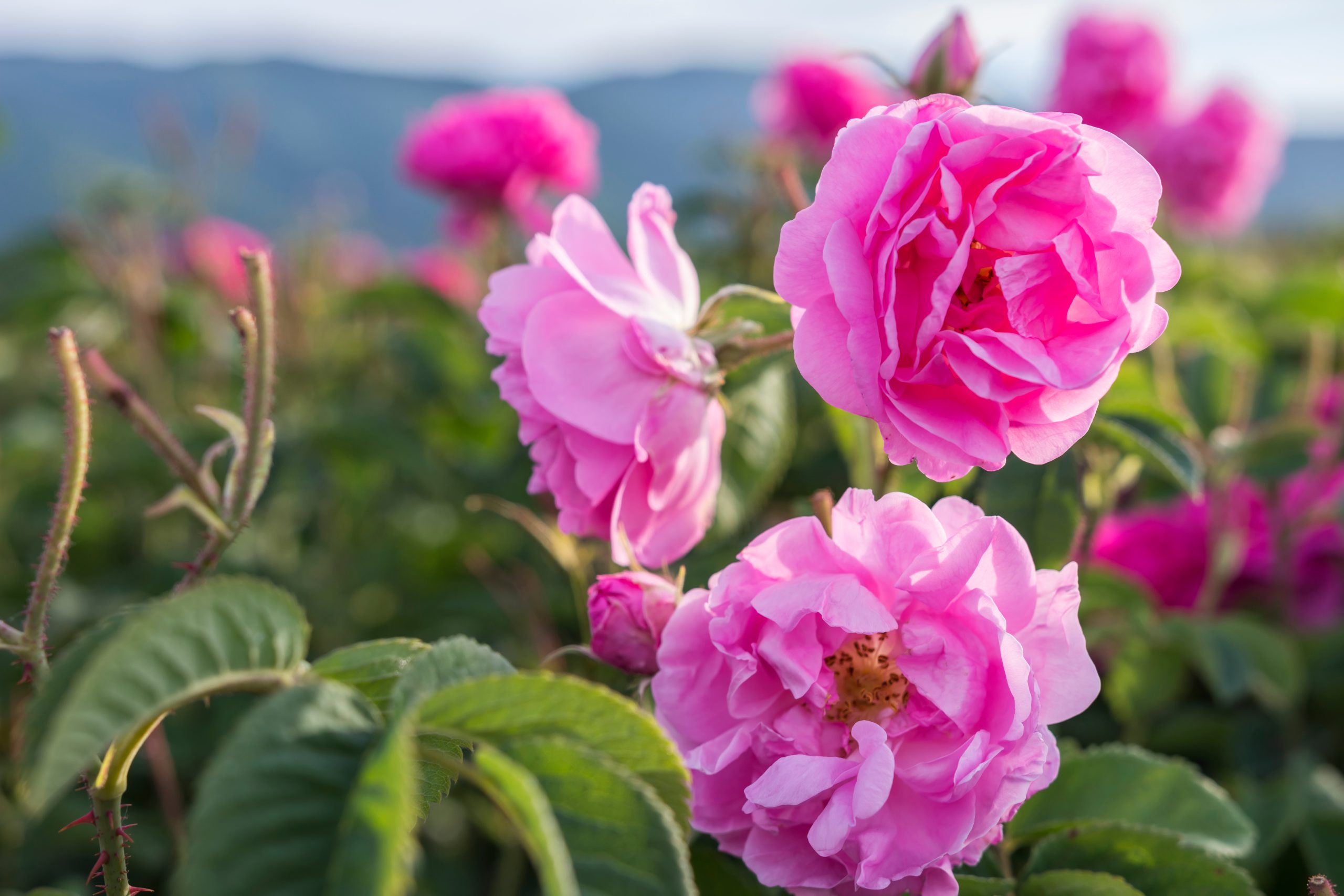
The Damask rose is the deeply aromatic variety that defines almost every traditional rose product, from rose water to rose oil to rose absolute. The name is thought to come from Damascus, Syria, although the variety likely originated somewhere in the broader region of Persia and the Middle East. By Roman times, Persia (modern Iran) had become the global epicenter of rose production, with vast fields of Damask roses stretching across the countryside and a sophisticated distillation tradition that produced rose water for cooking, perfumery, ritual, and medicine.
The roses that became culturally dominant historically were the most aromatic ones, not the most visually striking. The Damask rose won out because its scent was overwhelming, distinctive, and stable when distilled. The Persian skill at extracting rose water and rose oil set a standard that the rest of the world studied. A first-century recipe for rose oil perfume called for the petals of 7,000 fresh roses, which gives a sense of how concentrated and how labor-intensive traditional rose product was.
Rose water remains an integral part of Persian and Middle Eastern cuisine today. It flavors desserts, perfumes saffron rice, scents weddings, and is used in religious and burial rituals. The Damask rose itself is still grown in commercial quantities in Iran, Turkey, and Bulgaria, where the Valley of Roses outside Kazanlak produces a significant share of the world’s rose oil for the perfume industry.
Our Summer Flash Sale is On!
Get the discount code below:
The Rose in the Islamic World: Symbol of the Prophet Muhammad
In the Islamic tradition, the Damask rose carries one of the highest possible symbolic associations. The rose is considered the symbol of the Prophet Muhammad, and its scent is understood as both a blessing in this life and a preview of the gardens of paradise in the next. Many hadith and Sufi poetic traditions return to the rose as the central image of divine love, spiritual longing, and the felt presence of the sacred.
This is one of the reasons the rose has remained central to Persian culture across the long shifts from pre-Islamic Zoroastrian Persia through the Islamic Golden Age to the modern Iranian state. The rose carries continuity in a way few other cultural symbols do. The Persian poets, from Rumi to Hafez to Saadi, used the rose constantly as the symbol of love, both human and divine, and the figure of the rose and the nightingale (gul-o-bulbul) is one of the most enduring images in Persian literature.
For a brand built around the meaning of love, drawing on a symbol that holds this kind of cross-religious weight is meaningful. The rose was a symbol of love in Persian Zoroastrianism, then in Islamic mysticism, then in Greek and Roman paganism, then in Christianity. It has carried the same essential meaning across religions that have otherwise disagreed about almost everything.
The Greek and Roman Rose: Aphrodite, Venus, and the Flower of Love
The Greeks tied the rose to Aphrodite, the goddess of love, beauty, fertility, and sexual desire. The Roman pantheon inherited this association and gave the rose to Venus, who occupied the same role in the Roman religious imagination. Roman poets, especially Ovid, returned to the rose as the symbol of Venus, the symbol of fleeting beauty, and the symbol of mortal love.
Roman taste for the rose ran toward excess. Wealthy Romans during the spring rose blossom season (May and June) would stage elaborate floral banquets that ended with cascades of rose blossoms falling from the ceiling. The Damask rose was prized for its scent, and the Gallica rose (one of the earliest European cultivated varieties) was prized for retaining its fragrance even when its petals were dried and crushed into powder. Romans used the Gallica to scent rose oil, to flavor rose wine (a sweet drink called rosatum), and to make rose jellies, rose puddings, and various rose-flavored desserts that we would still recognize today.
The most infamous example of Roman rose excess is the painting The Roses of Heliogabalus by Sir Lawrence Alma-Tadema, completed in 1888. The painting depicts an alleged event from around 220 A.D. in which the young Roman emperor Marcus Aurelius Antoninus (nicknamed Heliogabalus and remembered as one of Rome’s most depraved rulers) reportedly killed several of his banquet guests by smothering them under an avalanche of rose petals dropped from a false ceiling. Whether the event actually happened is debated. The painting itself has become one of the most famous images of Roman decadence in Western art.
The emperor Nero was reportedly even more obsessive about roses. He spent four million Roman sesterces on rose petals for a single banquet. Converting Roman currency into modern dollars is nearly impossible, but four million of anything in ancient Rome was an extraordinary amount of money. The rose, for the Roman elite, was a luxury good and a status symbol on the same scale as exotic spices and precious metals.
Sub Rosa: The Roman Origin of “Under the Rose”
One of the most interesting cultural legacies of the Roman rose is the phrase sub rosa, which translates to “under the rose” and is still used today to mean a conversation that is confidential or kept private.
The origin of the phrase comes from Roman mythology. Cupid, the son of Venus, gave a rose to the god Harpocrates (the Greek and Roman god of silence) in exchange for keeping quiet about Venus’s many love affairs. From this story emerged a Roman custom of hanging a rose from the ceiling of a private meeting room to signal that everything spoken beneath the rose was to remain confidential. The custom persisted through the medieval period in Europe, and the phrase sub rosa survived into modern English as a remnant of the older symbolic system.
It is one of those small linguistic fossils that carries the weight of an entire mythology in three words. The Roman rose was the flower of love, the flower of beauty, the flower of mortality, and the flower of held intimacy. The phrase sub rosa is what is left when the rest of the mythology has faded.
Rosalia: The Roman Funerary Festival of Roses
The Romans also celebrated a funerary festival called Rosalia (sometimes called Rosaria), held each May at the peak of the rose blooming season. Families gathered at the graves of loved ones, laying garlands of roses on the tombs and remembering the dead with offerings of rose petals, rose wine, and ritual meals.
The festival captures something important about how the Romans understood the rose. The rose was the symbol of beauty and love, and at the same time it was the symbol of life’s brevity. A rose blooms for a short window and then falls. The Roman religious imagination saw this not as sadness but as continuity. The dead were remembered with the most beautiful and most fleeting flower because the love between the living and the dead was understood to be just as real, just as concentrated, and just as worthy of ritual care.
Rosalia is one of those festivals that quietly survived into the early Christian church, where it was eventually absorbed into the cycle of saints’ days and Marian devotions. The custom of laying flowers on graves, which most Western cultures still practice, traces back in part to the Roman Rosalia and the much older Mediterranean traditions it grew out of.
The Christian Transformation: From Venus to the Virgin Mary
When Christianity became the state religion of the Roman Empire in the fourth century, the rose presented a problem. The flower was so heavily associated with Venus (the goddess of love, beauty, fertility, and sexual desire) that early Christian thinkers initially treated it as a symbol of pagan hedonism. For a brief period, the rose fell out of favor with church authorities because of its erotic associations.
The transformation came through theological reframing. Ambrose of Milan, writing in the fourth century, taught that the rose grew without thorns in the Garden of Eden. According to Ambrose, only after Adam and Eve introduced sin into the world did the rose develop its thorns. Mary, the mother of Jesus, was then identified as the “rose without thorns,” a flower of pure spiritual love and chaste beauty, free from the sexual associations that the rose had carried under Venus.
This rebranding was theological genius. It allowed the rose to remain a central cultural symbol while transferring its meaning from the goddess of sexual love to the figure of the virgin mother. The rose retained its position as the most beautiful and most symbolically charged flower in the Christian imagination, and the new association with Mary gave the church a way to incorporate the rose into devotional life without abandoning its meaning entirely.
Simon Morley describes this process as a sanitization, where the church took the goddess of love and de-thorned the rose to turn it into a virginal symbol. The transformation worked, and through the spread of Christianity across Europe and eventually the Americas, the rose carried on being one of the most important symbols in Western religious and cultural life.
Our Summer Flash Sale is On!
Get the discount code below:
The Medieval Rose: Cathedrals, the Rosary, and Notre Dame
By the twelfth century, the rose had blossomed as a central Christian symbol, particularly tied to Marian devotion. The great Gothic cathedrals of Europe (Notre Dame in Paris, Chartres, Reims, and many others) were built with rose windows, the circular stained-glass masterpieces that filtered the morning light into prisms of color above the altar. Many of these rose windows featured images of the Madonna and Child at the center, with the radiating geometry of the rose serving as a meditation on divine love spreading outward.
The Catholic rosary takes its name from the Latin rosarium, meaning a bouquet or garland of roses. The practice of counting and reciting specific prayers using a string of beads emerged in the thirteenth century, and the imagery was that each completed cycle of prayers offered to Mary was equivalent to giving her a garland of spiritual roses. The rosary remains one of the central devotional practices in Catholicism today, and the etymology preserves the older imagery of the rose as the supreme floral offering of love.
The medieval period also gave us the rose-bordered manuscripts, the rose-themed mystical poetry of writers like Dante (whose Paradiso ends with a vision of the celestial rose), and the persistent association of the rose with both spiritual love and the highest expressions of art.
The Wars of the Roses and the Birth of the Tudor Rose
The fifteenth century brought the rose into English political history in a way few flowers ever entered any nation’s political life. The Wars of the Roses (1455 to 1485) were a series of bloody civil wars between two competing branches of the English royal family: the House of York and the House of Lancaster.
The House of York traditionally used a white rose (Rosa alba) as its heraldic emblem. The House of Lancaster, in deliberate provocation, chose the red rose as its symbol. For thirty years the two sides battled across England in a conflict so destabilizing that it gave its name (the Wars of the Roses) to the entire period.
The war ended at the Battle of Bosworth Field in 1485, when King Richard III of the House of York was defeated by Henry Tudor, who had Lancastrian ancestry. Henry was crowned King Henry VII and married Elizabeth of York, uniting the two rival houses through marriage. As a new royal symbol, he commissioned the Tudor rose, an artistic combination showing a white rose layered inside a red rose, representing the unification of the two warring families.
The Tudor rose remains the national rose of England today, though it is an imaginary, symbolic flower rather than a botanical variety. The choice was politically brilliant. By taking the symbols of both sides and combining them, Henry VII used the rose to communicate that the civil war was over and a unified kingdom had begun.
The Victorian Language of Flowers: Floriography and the Coded Rose
The Victorian era added another layer of rose symbolism that still influences how we exchange flowers today. In Victorian England, outward expressions of romantic feeling were socially taboo, especially among the upper classes. Flowers offered a workaround. By giving a specific flower with a specific symbolic meaning, a Victorian woman could communicate emotions she was not permitted to speak aloud.
The practice was called floriography, the language of flowers. Charlotte de La Tour published Le Langage Des Fleurs (The Language of Flowers) in 1819, and it set off a craze that lasted decades and spread across Europe and the United States. The book cited the letters of an eighteenth-century Englishwoman named Mary Wortley Montagu, who claimed that floriography originated in Turkey, where members of the sultan’s harem used the hidden language of flowers to send coded messages out of seclusion.
Whether the Turkish origin story is accurate is debated by historians, but the Victorian floriography craze was a real phenomenon and produced an entire taxonomy of flower meanings. Roses, with their existing depth of symbolic association, became the most coded flower of all. The color of the rose became a precise vocabulary of love.
In Victorian floriography, the color meanings were:
A red rose signified passionate love.
A pink rose signified admiration, gentle affection, or grace.
A yellow rose signified joy and friendship (later sometimes also jealousy).
A white rose signified innocence, purity, and secrecy.
A dark crimson rose signified mourning, deep grief, or the loss of a beloved.
The vocabulary has carried through to modern florists. Most contemporary rose color associations trace directly back to Victorian floriography, even though almost no one buying a dozen red roses for Valentine’s Day knows the lineage.
There is also a small revival of floriography happening among contemporary florists, gardeners, and brides who want their bouquets to carry intentional meaning. The Victorian language of flowers is being rediscovered as a way of restoring some of the older symbolic depth to modern flower-giving.
The Red Rose Is Newer Than Shakespeare
One of the most counterintuitive facts in the history of the rose is that the classic deep crimson red rose, the one we picture as the prototypical Valentine’s Day rose, is a relatively modern creation. Simon Morley argues that Shakespeare almost certainly never saw what we would call a true red rose. The deep crimson that became the standard romantic rose only emerged after Chinese rose varieties were crossbred with European stock in the nineteenth century.
What Shakespeare would have called a red rose was probably what we would call pink. In nearly every European language besides English, the word for rose refers to both the plant and a specific color (usually translated into English as pink) that is lighter than what we call red. The Spanish word rosa, the Italian rosa, the French rose, and the German rosa all share this double meaning.
The history of the rose is partly a history of color. The deep red rose we recognize today is the product of centuries of breeding work, much of it done in nineteenth-century French and English gardens, and most of the genetic material came from China. The flower that has carried the symbolic weight of love for 5,000 years has been changing shape, color, and bloom pattern the entire time.
Reagan and the American National Flower
The American chapter of the rose’s story has a specific date. In 1986, President Ronald Reagan signed Proclamation 5574, designating the rose as the National Floral Emblem of the United States. The rose joined a small group of national rose symbols, including the Tudor rose of England and the Damask rose of Iran, as one of the most internationally recognized national flowers in the world.
The choice was popular but not uncontested. The marigold had been a contender, championed by the senator Everett Dirksen, who argued for years that the marigold should be the national flower because it grew everywhere in the United States, in every state, in every soil. The rose ultimately won because of its deeper symbolic associations and because the cultivated rose had become so iconic in American gardens, weddings, funerals, and political imagery.
The 1986 designation made official something that had been culturally true for a long time. The rose is the American flower of romance, mourning, celebration, and politics, the same way it has been across most of the cultures it has passed through for the last five millennia.
Our Summer Flash Sale is On!
Get the discount code below:
Why the Rose Lives at the Heart of The House of Rose
When I chose the rose as the symbol of the retreat property I was building in the Smoky Mountains, I was choosing a flower with the longest continuous symbolic record of love in human history. The rose has carried some version of the same meaning across cultures that have otherwise had almost nothing in common. Sumer, Persia, China, Greece, Rome, Christian Europe, Tudor England, Victorian England, the modern United States. Across five thousand years of human civilization, the rose has been the symbol of love.
That continuity matters because the work I am doing at THOR is itself ancient. Teaching women to love their bodies, to inhabit the place where their inner life lives, and to come back home to themselves in midlife is not a new project. The rose tradition has been carrying that meaning forward through every culture that produced it. When a Persian poet wrote about the rose and the nightingale, when a Roman family laid roses on a grave, when a medieval mystic meditated on the rose window of a cathedral, and when a Victorian woman gave a pink rose to her sister, the symbol was doing the same essential work of making love tangible, physical, and visible in the form of a flower.
That is what The House of Rose draws from. The retreat property in the Smoky Mountains is a contemporary expression of a 5,000-year tradition. The five practices we built into the program (slow arrival, real nourishment, body work that actually changes the tissue, community without performance, and integration after the retreat ends) are the modern translation of what the older traditions were trying to teach women about how to inhabit their own bodies with love.
If the philosophy resonates and you want to come spend five days inside the practice, the Deeply Restorative Yoga and Nature Retreat is the place where the rose tradition gets made daily.
If you want to begin from where you are, the free Macro Calculator is the entry point, the Macro Miracle Mediterranean Cookbook is the kitchen-side follow-on, and the foundational supplement collection is the layer underneath the nutrition.
The rose has carried the meaning of love across thousands of years for a reason.
The work we are doing with it at THOR is the latest chapter in a very long story.
FAQs – Women’s Restorative Retreats
What is the oldest record of rose cultivation?
The earliest written evidence of rose cultivation comes from cuneiform tablets in Sumer, in ancient Mesopotamia, dated to roughly 2200 B.C. By this point Sumerian society was already growing roses for use in temple offerings, ritual oils, and royal gardens. Wild roses themselves are far older, with fossil records placing the rose family at somewhere between 35 and 70 million years old.
Where did the Damask rose come from?
The Damask rose is thought to have originated in the region of Persia (modern Iran) and the broader Middle East. The name may come from Damascus, Syria, though the exact origin is debated. The Damask rose became the global standard for aromatic rose production because of its powerful and stable scent, and it remains the dominant variety used in rose water, rose oil, and traditional Persian cuisine today.
Why is the rose a symbol of love?
The rose has been associated with love across thousands of years and dozens of cultures because of its scent, its beauty, its brief bloom, and its capacity for symbolism. In Greek and Roman religion, it was the flower of Aphrodite and Venus, the goddesses of love. In Christianity it was reframed as the flower of the Virgin Mary, representing pure spiritual love. In Islamic tradition it became the symbol of the Prophet Muhammad and divine love. In Persian poetry it became the symbol of human and mystical love combined. Across Victorian floriography it carried the precise color vocabulary of romantic feeling. No other flower has carried this kind of continuous symbolic record of love.
What does “sub rosa” actually mean?
The Latin phrase sub rosa translates to “under the rose” and means a conversation that is confidential or kept private. The phrase comes from a Roman mythological tradition in which Cupid gave a rose to Harpocrates, the god of silence, in exchange for keeping quiet about Venus’s love affairs. From this came the ancient custom of hanging a rose from the ceiling of a private meeting room to signal that everything spoken beneath the rose was confidential. The phrase survives in modern English as a small linguistic fossil of the older Roman mythology.
What was Rosalia in ancient Rome?
Rosalia (sometimes called Rosaria) was an annual Roman funerary festival held each May, at the peak of the rose blooming season. Families gathered at the graves of loved ones, laying garlands of roses on the tombs and remembering the dead with offerings of rose petals and rose wine. The festival captured the Roman understanding of the rose as both the flower of love and the flower of life’s brief duration. Many modern Western traditions of laying flowers on graves trace back in part to Rosalia.
Why did the rose become a Christian symbol after being associated with Venus?
When Christianity became the state religion of Rome in the fourth century, early church authorities initially viewed the rose with suspicion because of its strong association with Venus, the goddess of sexual love. Ambrose of Milan offered a theological reframing in the fourth century, teaching that the rose grew without thorns in the Garden of Eden and only developed its thorns after the fall. Mary, the mother of Jesus, was then identified as the “rose without thorns,” a flower of pure spiritual love. The rebranding allowed the rose to remain a central cultural symbol while transferring its association from the goddess of sexual love to the figure of the virgin mother.
Our Summer Flash Sale is On!
Get the discount code below:
What is the Tudor rose?
The Tudor rose is the heraldic symbol of England, created by King Henry VII in 1485 after the end of the Wars of the Roses. It depicts a white rose (the symbol of the House of York) layered inside a red rose (the symbol of the House of Lancaster). The combined rose represented the unification of the two warring royal houses through Henry’s marriage to Elizabeth of York. The Tudor rose remains the national rose of England today, though it is a symbolic rather than botanical variety.
What was the Wars of the Roses about?
The Wars of the Roses were a series of civil wars in fifteenth-century England (1455 to 1485) between two competing branches of the royal family. The House of Lancaster used a red rose as its emblem. The House of York used a white rose. The two houses fought for the English crown over a thirty-year period, ending with the defeat of Richard III at the Battle of Bosworth Field and the rise of Henry Tudor as King Henry VII. The conflict took its name from the rose emblems of the two sides.
What is Victorian floriography?
Floriography was the Victorian-era practice of assigning specific symbolic meanings to specific flowers, so that bouquets and floral arrangements could communicate messages that social convention prohibited speaking aloud. Charlotte de La Tour’s 1819 book Le Langage Des Fleurs ignited a floriography craze that spread across England and the United States and lasted decades. Roses became the most coded flower, with each color carrying a precise meaning in the romantic vocabulary.
What do the different rose colors mean in floriography?
In Victorian floriography, red roses signified passionate love. Pink roses signified admiration and gentle affection. Yellow roses signified joy and friendship (later sometimes also jealousy). White roses signified innocence, purity, and secrecy. Dark crimson roses signified mourning and deep grief. Most modern rose color associations trace directly back to this Victorian taxonomy.
When did the deep red rose become standard?
The classic deep crimson red rose is a relatively modern creation, only emerging after Chinese rose varieties were crossbred with European stock in the nineteenth century. Before that, what people across Europe called a “red rose” was usually what we would now call pink. In most European languages besides English, the word for rose still refers to both the flower and a color closer to pink than red.
When did the rose become the national flower of the United States?
Ronald Reagan signed Proclamation 5574 in 1986, designating the rose as the National Floral Emblem of the United States. The rose joined the Tudor rose of England and the Damask rose of Iran as one of the most internationally recognized national rose symbols. The marigold had been the main competing candidate, championed for decades by Senator Everett Dirksen.
Is the rose really the highest vibrational flower?
In the bioenergetic and aromatherapy traditions associated with Bruce Tainio and David Hawkins, rose essential oil is often cited as one of the highest measured vibrational frequencies of any plant essence, typically around 320 MHz on the Tainio scale. That framework is rooted in energy medicine rather than mainstream biochemistry. What can be verified through peer-reviewed research is that rose oil contains over 300 aromatic compounds and has measurable effects on cortisol, anxiety, and mood through olfactory pathways. The energy medicine tradition gives the older intuition a vocabulary. The peer-reviewed research gives it another.
How does the rose connect to The House of Rose retreat in the Smoky Mountains?
The House of Rose draws its name from a synthesis of two ideas: the rose as the universal symbol of love across 5,000 years of cultural history, and the house as the body across nearly every wisdom tradition. The retreat program is designed to teach women in midlife to inhabit their own bodies with the same depth of care and beauty the rose has carried as a symbol.
I write 3 essays per week on Lifestyle Medicine for women in midlife on what is happening in the body and what to do about it. No fluff, no hype. Free.
References
- Morley, S. (2024). By Any Other Name: A Cultural History of the Rose. Oneworld Publications.
- Roos, D. (2026, May 29). The secret history of roses. History.com. https://www.history.com/
- Reagan, R. (1986). Proclamation 5574: Designation of the Rose as the National Floral Emblem of the United States of America. The Ronald Reagan Presidential Library. https://www.reaganlibrary.gov/archives/speech/proclamation-5574-designation-rose-national-floral-emblem-united-states-america
- Mahboubi, M. (2016). Rosa damascena as holy ancient herb with novel applications. Journal of Traditional and Complementary Medicine, 6(1), 10–16.
- Boskabady, M. H., Shafei, M. N., Saberi, Z., & Amini, S. (2011). Pharmacological effects of Rosa damascena. Iranian Journal of Basic Medical Sciences, 14(4), 295–307.
- Hongratanaworakit, T. (2009). Relaxing effect of rose oil on humans. Natural Product Communications, 4(2), 291–296.
- Igarashi, M., Song, C., Ikei, H., & Miyazaki, Y. (2014). Effect of olfactory stimulation by fresh rose flowers on autonomic nervous activity. Journal of Alternative and Complementary Medicine, 20(9), 727–731.
- Ambrose of Milan. (4th century). De Institutione Virginis. Referenced in Duke University’s Stroll in the Garden archive on Christian rose symbolism. https://arts.duke.edu/stroll-in-the-garden/
- Friends of Notre Dame de Paris. The rose windows of Notre-Dame Cathedral. https://www.friendsofnotredamedeparis.org/cathedral/artifacts/rose-windows/
- de La Tour, C. (1819). Le Langage des Fleurs. (Original French publication; English translations available through Cornell University Library exhibits on floriography). https://exhibits.library.cornell.edu/written-in-petals/feature/le-langage-des-fleurs-charlotte-de-la-tour
- World Sensorium / Conservancy. The Damask rose of Iran. https://worldsensorium.com/iran/
- BBC Culture. (2020, September 14). The mysterious, double-edged beauty of the rose. https://www.bbc.com/culture/article/20200914-the-mysterious-double-edged-beauty-of-the-rose
- Rosapedia. The empire of petals: Rome and roses. https://rosapedia.com/the-empire-of-petals-rome-and-roses/
- Hawkins, D. R. (2002). Power vs. Force: The Hidden Determinants of Human Behavior. Hay House.
- Cramer, H., Lauche, R., Langhorst, J., & Dobos, G. (2018). Yoga for menopausal symptoms: a systematic review and meta-analysis. Maturitas, 109, 13–25.
- Antonelli, M., Donelli, D., & Barbieri, G. (2019). Effects of forest bathing (shinrin-yoku) on levels of cortisol as a stress biomarker: a systematic review and meta-analysis. International Journal of Biometeorology, 63(8), 1117–1134.
- Persian Cultural Heritage Foundation. (Various). The rose and the nightingale in Persian poetry: from Rumi to Hafez. (Cited within Persian literary scholarship on the gul-o-bulbul tradition.)
- Cornell University Library Exhibits. Written in Petals: The Language of Flowers. https://exhibits.library.cornell.edu/written-in-petals/
- ArtNet News. (2024). The Roses of Heliogabalus by Sir Lawrence Alma-Tadema. https://news.artnet.com/art-world/roses-of-heliogabalus-alma-tadema-2673695

Terry Tateossian is a Menopause Lifestyle Medicine Coach, Certified Personal Trainer & Nutritionist and the Founder of THOR: The House of Rose, a wellness brand serving women over 40 through retreats, coaching, macro-nutrition and community. As 25-year founder and entrepreneur, Terry spent two and a half decades building and running successful start-up businesses, an experience that put her on the front line of founder burnout long before she could name it. After facing serious health challenges, early onset menopause, and emotional eating while running her agency and raising two children, Terry rebuilt her health in her 40s and lost more than 80 pounds through evidence-based nutrition, training, and mindset work. Today, she helps women get strong, improve confidence, support hormone health, and create a stronger second half of life. Terry has been featured in major media outlets and is available for podcasts, expert commentary, brand collaborations, and speaking engagements on midlife health, reinvention, emotional eating, menopause wellness, and strength training for longevity. Get her free macro calculator (her cookbook companion) to start your journey to back to health.