Free 28-Day Fascia Reset Email Course

Get our Free 28-day email course series to help with 1 or 2 exercises per day to release your fascia. One short lesson per day. Two minutes to read each.

The 7 Best Standing Ab Exercises for Women Over 40 (No Floor Required)

Standing ab exercises are one of the most practical core-training options for women over 40. Crunches, sit-ups, and long planks may work well earlier in life, but neck strain, wrist pressure, pelvic floor stress, and the hassle of getting on and off the floor can make traditional core workouts harder to maintain in midlife.

Standing exercises remove many of those barriers. They train the same core muscles while improving balance, coordination, and the full-body control used in everyday movement. They also require little space and can be done in a hallway, bedroom, kitchen, or the corner of a gym.

This guide covers seven effective standing ab exercises, the muscles they target, proper form, and how to build them into a sustainable weekly routine.

I am Terry Tateossian, founder of The House of Rose and a certified lifestyle medicine coach who works with women in perimenopause, menopause, and post-menopause through coaching and nutrition-focused wellness retreats.

Important: Consult your healthcare provider before starting a new exercise program, especially if you have diastasis recti, pelvic organ prolapse, active back pain, or a history of abdominal or spinal surgery. Some exercises may require modification.

Why Are Standing Ab Exercises Ideal for Women Over 40?

Standing core work is not just a more comfortable alternative to floor exercises. It produces training effects that floor exercises cannot fully replicate, and it addresses several specific vulnerabilities of the midlife body.

  • Neck and shoulder stress is reduced. Sit-ups and crunches load the neck in ways that many midlife women find intolerable, particularly women dealing with the forward head posture that decades of desk work has produced. Long planks similarly load the wrists and shoulders. Standing exercises eliminate these stress points.
  • Pelvic floor pressure is managed. The pelvic floor changes throughout perimenopause and menopause become more sensitive to the intra-abdominal pressure spikes that traditional crunching produces. Standing core exercises generally distribute pressure more evenly and are less likely to worsen pelvic floor issues.
  • Balance training is built in. Every standing exercise requires the whole-body coordination that keeps the body upright while the core is working. This dual-tasking (core work plus balance) produces the neuromuscular integration that catches you during a stumble, which floor exercises cannot train.
  • Whole-body engagement is greater. Standing core exercises recruit the glutes, quadriceps, calves, and stabilizing muscles throughout the body in addition to the target abdominal muscles. This makes each exercise a more efficient use of training time.
  • Real-world function translates directly. The core patterns trained standing (twisting, bending, resisting rotation, coordinating the upper and lower body) map directly onto the movements of daily life, including lifting groceries, getting into and out of a car, and reaching for something on a high shelf.
  • Time efficiency is higher. A complete standing core workout of 15 to 20 minutes can produce more functional benefit than 30 to 45 minutes of floor-based work because of the compound engagement.
  • Accessibility is dramatically better. Standing exercises work in almost any space. No floor mat required. No changing into workout clothes. No need to get down to and up from the floor. This accessibility is what allows the practice to become genuinely daily rather than occasional.
  • Diastasis recti considerations. Women with diastasis recti (the abdominal separation common after pregnancy that can persist for years) often need to avoid traditional crunches that increase intra-abdominal pressure and stress the linea alba. Standing exercises are usually more appropriate for this population.

“The coaching clients who complete their weekly core work most consistently are almost always the ones doing standing exercises rather than floor-based routines. The barrier is not motivation. The barrier is the accumulated small resistance to lying on the floor multiple times a week. When you remove that barrier and give women a fifteen-minute standing routine they can do anywhere, adherence climbs dramatically. And within six weeks the functional results start showing up in ways that floor-based programs often do not produce. Better balance. Easier daily movement. Confidence in the body’s ability to handle unpredictable situations.”

Terry Tateossian, Founder of The House of Rose

Free 28-Day Fascia Reset Email Course

Get our Free 28-day email course series to help with 1 or 2 exercises per day to release your fascia. One short lesson per day. Two minutes to read each.

Which Muscles Does Standing Core Training Target?

The core includes several muscles that work together to stabilize the spine, control movement, and manage pressure throughout the trunk. Knowing what each muscle does makes it easier to choose exercises that support your specific goals.
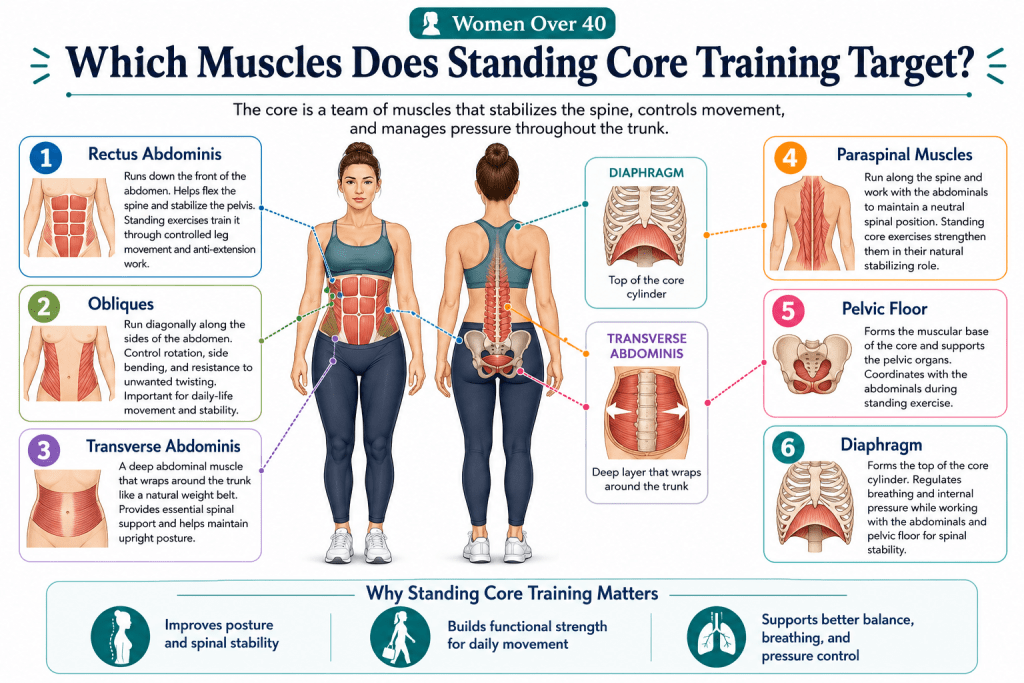
Infographic showing the main muscles
  • Rectus Abdominis: This muscle runs vertically down the front of the abdomen and helps flex the spine and stabilize the pelvis. Standing exercises train it through controlled leg movements and anti-extension patterns that prevent the lower back from arching.
  • Obliques: The internal and external obliques run diagonally along the sides of the abdomen and control rotation, side bending, and resistance to unwanted twisting. Standing exercises engage them during functional movements that closely reflect how the body rotates and stabilizes in daily life.
  • Transverse Abdominis: This deep abdominal muscle wraps around the trunk like a natural weight belt and provides essential spinal support. It remains active during standing exercises because it must continuously stabilize the body and maintain upright posture.
  • Paraspinal Muscles: These muscles run along the spine and work with the abdominals to maintain a neutral spinal position. Standing core exercises strengthen them through their natural stabilizing role rather than allowing them to relax against the floor.
  • Pelvic Floor: The pelvic floor forms the muscular base of the core and supports the organs within the abdominal cavity. Standing exercises encourage it to coordinate with the abdominals while avoiding some of the pressure spikes created by traditional crunches.
  • Diaphragm: The diaphragm forms the top of the core cylinder and regulates breathing and internal abdominal pressure. Coordinated breathing during standing exercises trains it to work with the abdominal muscles and pelvic floor to support spinal stability.

A well-designed standing core routine trains all six components together. This creates functional strength that supports posture, balance, lifting, walking, and other everyday movements.

What Does Research Say About Functional Core Training?

Core training research has changed significantly over the last two decades. Current findings generally support standing, functional exercises over isolated floor work for most healthy adults, especially during midlife and older age.

  • Spinal Stability: Stuart McGill’s research found that the core’s ability to resist unwanted movement is more important for spinal health than raw abdominal strength alone. Anti-extension, anti-rotation, and anti-lateral-flexion exercises build this stability and can be trained effectively in a standing position.
  • Functional Movement: Research involving older adults shows that exercises based on real-life positions and movement patterns produce better everyday outcomes than isolated muscle exercises. Standing core work prepares the body for walking, lifting, reaching, turning, and other daily activities.
  • Fall Prevention: Core strength plays an important role in balance and fall prevention among older adults. Standing exercises train core stability, coordination, and balance together, making them more practical than strength work performed only on the floor.
  • Pelvic Floor Support: Postpartum and pelvic health research has moved recommendations away from traditional crunches for women with diastasis recti or pelvic floor concerns. Standing and stability-focused exercises can strengthen the core while reducing unnecessary pressure through the abdomen and pelvic floor.
  • Coordinated Breathing: Diaphragmatic breathing during core exercise supports better intra-abdominal pressure, spinal control, and pelvic floor coordination. Standing exercises often make it easier to connect breathing with natural posture and movement.

Overall, standing core training is a strong first-line approach for most midlife women. Floor-based exercises can still be useful, but they work best as a complement rather than the foundation of the routine.

Free 28-Day Fascia Reset Email Course

Get our Free 28-day email course series to help with 1 or 2 exercises per day to release your fascia. One short lesson per day. Two minutes to read each.

What Should You Know Before Starting?

Several principles apply to all seven standing ab exercises and are worth internalizing before starting.

  • Neutral spine throughout: Maintain the natural curves of your spine during every exercise. Do not force yourself into flatness, and do not exaggerate the arch. Neutral is where the body handles load most safely.
  • Diaphragmatic breathing: Breathe into the belly rather than the chest throughout the exercises. Generally exhale during the exertion phase of each rep and inhale during the return. Never hold your breath during core work.
  • Braced but not clenched: The core should feel engaged (imagine bracing for a light punch to the abdomen) but not squeezed tight. Rigid clenching increases intra-abdominal pressure and stresses the pelvic floor and lower back. Gentle continuous engagement is the target.
  • Feet in stable position: Most exercises are performed with feet hip-width apart. Some exercises use a staggered stance or single-leg position. Keep the weight distributed across the whole foot rather than shifting to the heels or the toes.
  • Slow controlled movement: Every exercise is performed slowly with attention to form rather than fast for repetition count. Two to three seconds up, one to two second pause, two to three seconds down.
  • Full range of motion: Move through the complete available range of each exercise rather than truncating the movement to squeeze in more reps.
  • Progressive overload: Start with lighter weights or bodyweight versions and progress over weeks. The body adapts to what you consistently ask of it.
  • Equipment needed: Most exercises require nothing. A few benefit from a light dumbbell (5 to 15 pounds), a resistance band, or a wall for stability. A total equipment investment of under $50 covers everything you need for the full seven-exercise routine.
  • When to stop: Any exercise that produces sharp pain, joint discomfort, dizziness, or pelvic floor sensation should be stopped immediately. Modify the exercise or replace it with a different one that works for your body.

What Are the 7 Best Standing Ab Exercises for Women Over 40?

These 7 standing core exercises help strengthen the abs, hips, and lower back. They can also improve balance, posture, and control during everyday movement. Each exercise works the core in a slightly different way.
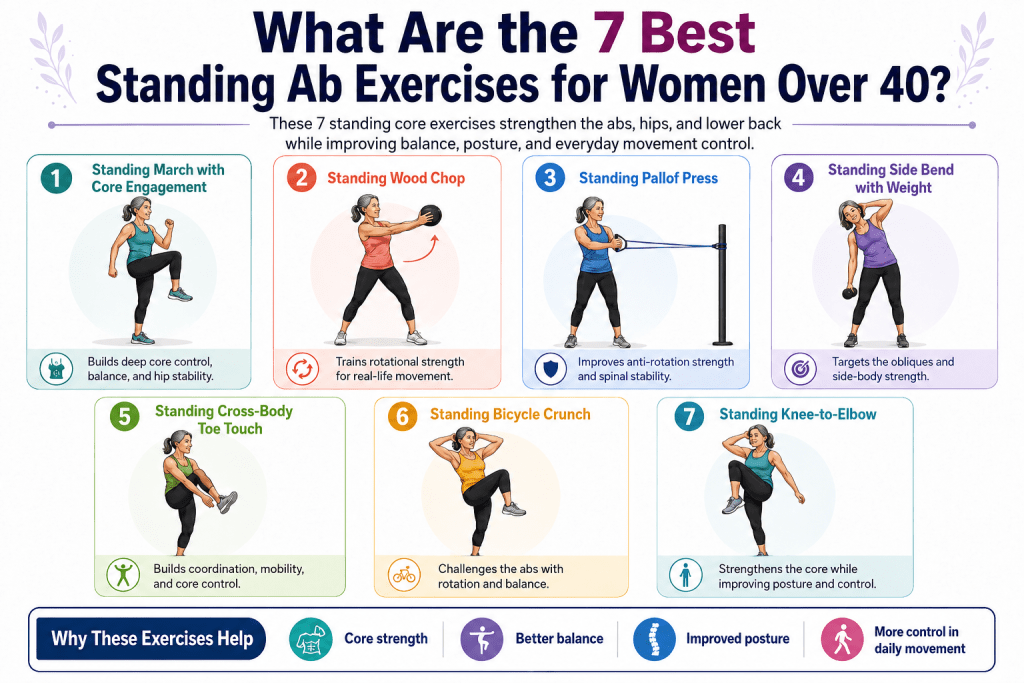
Infographic showing 7 best standing ab exercises

Exercise 1: The Standing March with Core Engagement

The standing march is the entry point to the practice. It trains the connection between the deep core and the hip flexors while building the neuromuscular pattern that every other exercise depends on.

  1. To begin, stand tall with your feet hip-width apart and your weight evenly balanced across both feet.
  2. Next, relax your shoulders and place your hands on your hips or bend your elbows as if you are walking.
  3. From this position, slowly lift your right knee toward your chest until your thigh is roughly parallel to the floor.
  4. Once your knee reaches the top, engage your core and hold the position for one second.
  5. Then, slowly lower your right foot back to the floor.
  6. Finally, repeat the same movement with your left leg. One march on each side counts as one repetition.

The standing march is a simple but effective exercise that strengthens the core while improving balance and hip control. The details below explain which muscles it works, how many repetitions to perform, and how to progress safely over time.

  • Muscles targeted: Transverse abdominis, rectus abdominis, hip flexors, deep spinal stabilizers.
  • Sets and reps: 3 sets of 12 to 15 marches per side.
  • Common mistake to avoid: Leaning backward as the knee lifts. Keep the torso upright throughout the movement. If you cannot lift the knee high without leaning back, reduce the height of the knee lift.
  • Why this exercise for midlife women: The connection between the hip flexors and the deep core weakens with prolonged sitting. This exercise directly rebuilds that connection.
  • Progression: Once 3 sets of 15 per side feels easy, progress by adding an ankle weight (2 to 5 pounds), or by holding the lifted position for longer, or by combining the knee lift with an opposing arm drive.

Free 28-Day Fascia Reset Email Course

Get our Free 28-day email course series to help with 1 or 2 exercises per day to release your fascia. One short lesson per day. Two minutes to read each.

Exercise 2: The Standing Wood Chop

The wood chop is one of the most functional standing core exercises available. It trains rotational strength through diagonal patterns that map onto real-life movements like lifting a bag off the floor, twisting to grab a seatbelt, or picking up a grandchild.

  1. Stand with your feet hip-width apart.
  2. Hold a dumbbell weighing 5 to 15 pounds with both hands near your right hip.
  3. Extend your arms toward the floor while keeping a slight bend in your elbows.
  4. From this position, slowly move the dumbbell diagonally across your body and toward your left shoulder, as if chopping wood upward.
  5. Rotate through your trunk and pivot on your back foot as you reach across your body.
  6. Pause briefly at the top with your arms extended above your left shoulder.
  7. Slowly reverse the movement and return the dumbbell to your right hip.
  8. Complete all repetitions on one side before repeating the movement in the opposite direction. One full diagonal movement counts as one repetition.

The standing wood chop strengthens the core, hips, and shoulders while improving the rotational control needed for everyday movement. The details below cover the muscles involved, recommended sets and repetitions, common mistakes, and ways to progress safely.

  • Muscles targeted: Obliques (internal and external), rectus abdominis, transverse abdominis, glutes, shoulders, and hips.
  • Sets and reps: 3 sets of 8 to 12 repetitions per side.
  • Common mistake to avoid: Using the arms to swing the weight rather than driving the rotation through the trunk. The arms are along for the ride. The rotation comes from the core.
  • Why this exercise for midlife women: The diagonal rotational patterns of daily life are often untrained, and rotational core strength declines noticeably in midlife. This exercise addresses both.
  • Progression: Start with a lighter weight (5 to 8 pounds) and progress the weight as the pattern feels stable. Advanced practitioners can add a slight squat at the bottom or a slight lunge to increase the whole-body demand.

Exercise 3: The Standing Pallof Press

The Pallof press trains anti-rotation, one of the most important core capacities and one that traditional core exercises rarely reach. Anti-rotation is what stabilizes the spine during any unpredictable movement, and it is one of the strongest predictors of low back pain resistance in midlife adults.

  1. Attach a resistance band to a stable anchor at chest height, such as a door frame, squat rack, or sturdy pole.
  2. Stand sideways to the anchor with your feet hip-width apart.
  3. Hold the band with both hands close to the center of your chest.
  4. Step sideways away from the anchor until you feel steady tension in the band.
  5. From this position, slowly press your hands straight out in front of your chest until your arms are fully extended.
  6. As the band pulls you toward the anchor, engage your core and keep your torso facing straight ahead.
  7. Pause with your arms extended for one to two seconds while resisting any rotation.
  8. Slowly bring your hands back toward your chest. This completes one repetition.
  9. Complete all repetitions on one side, then turn around and repeat the exercise on the opposite side.

The standing Pallof press builds deep core stability by teaching the body to resist unwanted rotation. The details below explain which muscles it targets, how to perform it effectively, and how to increase the challenge as your strength improves.

  • Muscles targeted: Obliques (particularly the internal obliques), transverse abdominis, deep spinal stabilizers, hip stabilizers.
  • Sets and reps: 3 sets of 8 to 12 repetitions per side.
  • Common mistake to avoid: Rotating toward the anchor as the arms extend. The whole point of the exercise is to resist that rotation. If you cannot resist, step closer to the anchor to reduce the band tension.
  • Why this exercise for midlife women: Anti-rotation strength is what protects the spine during the unpredictable rotational forces of daily life (twisting to look behind you, catching yourself as you slip, carrying an uneven load). It is one of the highest-impact core capacities for midlife women.
  • Progression: Increase band tension by stepping further from the anchor or using a stiffer band. Hold the extended position longer. Perform the exercise in a slight split stance or lunge position for additional stability demand.

Free 28-Day Fascia Reset Email Course

Get our Free 28-day email course series to help with 1 or 2 exercises per day to release your fascia. One short lesson per day. Two minutes to read each.

Exercise 4: The Standing Side Bend with Weight

The side bend trains the lateral fascial line and the obliques through a direct pattern of lateral flexion. This exercise is often overlooked because it looks simple, but it produces significant functional benefit when done consistently.

  1. Stand tall with your feet hip-width apart and your weight evenly distributed.
  2. Hold a dumbbell weighing 5 to 15 pounds in your right hand, allowing your arm to hang naturally at your side.
  3. Place your left hand on your head or shoulder for stability, or let it hang at your side.
  4. Keep your chest and torso facing forward throughout the movement.
  5. Slowly bend toward your right side while lowering the dumbbell along the outside of your right leg.
  6. Avoid leaning forward, leaning backward, or rotating your torso. The movement should stay directly to the side.
  7. Pause at the bottom of the movement for one second.
  8. Engage your left obliques to slowly pull your torso back to the upright position. This completes one repetition.
  9. Complete all repetitions on the right side, then switch the dumbbell to your left hand and repeat on the opposite side.

The standing side bend strengthens the muscles along the sides of the core while improving control during lateral movement. The details below explain the muscles involved, recommended sets and repetitions, common mistakes, and ways to progress safely.

  • Muscles targeted: Obliques (both internal and external), quadratus lumborum, lateral core.
  • Sets and reps: 3 sets of 10 to 12 repetitions per side.
  • Common mistake to avoid: Rotating the torso as you bend, which converts the exercise from a lateral flexion to a rotation. Keep the shoulders facing forward and the movement purely to the side.
  • Why this exercise for midlife women: The lateral core and quadratus lumborum weaken with prolonged sitting and asymmetric daily loading (carrying bags on one shoulder, holding a child on one hip). Direct lateral training rebuilds this capacity.
  • Progression: Increase weight gradually over weeks. Add a small pulse at the bottom of each repetition. Perform the exercise in a slight lunge position for additional demand.

Exercise 5: The Standing Cross-Body Toe Touch

The cross-body toe touch is a dynamic rotational exercise that trains coordination between the upper and lower body while also working the obliques and hip flexors. It is one of the most efficient exercises for building the diagonal patterns of core function.

  1. Stand tall with your feet slightly wider than hip-width apart.
  2. Extend both arms overhead in a wide Y position.
  3. From this position, lift your right leg out to the side and slightly forward.
  4. At the same time, rotate through your core and bring your left hand down toward your right foot.
  5. Touch your foot or reach as close to it as your flexibility comfortably allows.
  6. Next, return to the upright starting position with both arms extended overhead.
  7. Repeat the movement on the opposite side by lifting your left leg and reaching your right hand toward your left foot.
  8. One touch on each side counts as one repetition.

The standing cross-body toe touch strengthens the core and lower body while improving coordination, flexibility, and rotational control. The details below explain the muscles it targets, recommended repetitions, common mistakes, modifications, and ways to make the exercise more challenging.

  • Muscles targeted: Obliques, rectus abdominis, hip flexors, hamstrings, calves.
  • Sets and reps: 3 sets of 10 to 12 touches per side.
  • Common mistake to avoid: Bending forward at the hips rather than rotating through the core. The reach comes from twisting, not from bowing.
  • Why this exercise for midlife women: The dynamic coordination between the upper and lower body deteriorates with age. This exercise directly trains that coordination in a functional pattern.
  • Modification for limited flexibility: If you cannot reach your foot, reach for your shin or knee instead. Progress toward the foot over weeks as flexibility improves.
  • Progression: Add a light weight in each hand (2 to 5 pounds) once the pattern feels stable. Increase the pace slightly for a cardiovascular component. Perform in a slight lunge position.

Free 28-Day Fascia Reset Email Course

Get our Free 28-day email course series to help with 1 or 2 exercises per day to release your fascia. One short lesson per day. Two minutes to read each.

Exercise 6: The Standing Bicycle Crunch

The standing bicycle is a standing analog of the traditional floor bicycle crunch, delivering similar oblique training without the neck strain or floor requirement. It is one of the most versatile exercises in the standing core toolkit.

  1. Stand tall with your feet hip-width apart.
  2. Place your hands lightly behind your head or beside your ears, keeping your elbows pointed out to the sides.
  3. Slowly lift your right knee toward your chest.
  4. At the same time, rotate your torso and bring your left elbow toward your right knee.
  5. Focus on lifting the knee and rotating through your core. Your elbow and knee do not need to touch.
  6. Return to the upright starting position with control.
  7. Repeat the movement on the opposite side by lifting your left knee and bringing your right elbow toward it.
  8. One crunch on each side counts as one repetition.

The standing bicycle crunch strengthens the obliques and hip flexors while improving balance and rotational control. The details below explain the muscles it targets, recommended repetitions, common mistakes, and ways to increase the challenge safely.

  • Muscles targeted: Obliques (primary), rectus abdominis, hip flexors.
  • Sets and reps: 3 sets of 12 to 15 repetitions per side.
  • Common mistake to avoid: Pulling on the head with the hands to increase the twist. The hands rest lightly on the head or ears. The rotation comes from the core, not from arm force.
  • Why this exercise for midlife women: The standing bicycle produces the same oblique training as the floor version without the neck strain that makes floor bicycles unpleasant or unsafe for many midlife women.
  • Progression: Slow the tempo further and add a two-second hold at the top of each rep. Add a light weight in each hand.

Exercise 7: The Standing Knee-to-Elbow

The standing knee-to-elbow finishes the routine with a direct hip-flexor and rectus abdominis pattern. It builds the strength that supports the lifted-leg motions of daily life (climbing stairs, stepping over curbs, getting into cars).

  1. Stand tall with your feet hip-width apart.
  2. Bend your arms to approximately 90 degrees, keeping your hands in loose fists near head height and your elbows pointed out to the sides.
  3. Slowly lift your right knee toward your chest.
  4. At the same time, bring your right elbow down toward your right knee.
  5. Allow your elbow and knee to meet around hip height and slightly in front of your body.
  6. Pause in this position for one second while keeping your core engaged.
  7. Slowly return to the upright starting position.
  8. Repeat the movement on the opposite side by bringing your left knee and left elbow together.
  9. One lift on each side counts as one repetition.

The standing knee-to-elbow strengthens the core and hip flexors while supporting the leg-lifting movements used in daily life. The details below explain the muscles it targets, recommended repetitions, common mistakes, and ways to increase the challenge safely.

  • Muscles targeted: Rectus abdominis, hip flexors, obliques (secondary), quadriceps.
  • Sets and reps: 3 sets of 10 to 15 repetitions per side.
  • Common mistake to avoid: Leaning forward significantly to bring the elbow to the knee. Some slight forward crunch is fine, but the majority of the movement should come from the knee lifting to meet a relatively stable upper body.
  • Why this exercise for midlife women: The pattern trained by this exercise directly maps to the daily-life movements that become harder in midlife (stepping up onto curbs, climbing stairs, getting out of low chairs). Training the pattern preserves the function.
  • Progression: Add an ankle weight (2 to 5 pounds). Add a light dumbbell in each hand. Perform on a slightly unstable surface (a folded towel or thin balance pad) for additional demand.

Free 28-Day Fascia Reset Email Course

Get our Free 28-day email course series to help with 1 or 2 exercises per day to release your fascia. One short lesson per day. Two minutes to read each.

How Can You Build a Weekly Standing Core Routine?

The seven exercises can be arranged into a sustainable weekly routine in several ways.

The 15-minute daily routine is ideal for beginners or busy women who prefer a shorter session. Complete five of the seven exercises each day, rotating the two exercises you leave out so that all movements are covered throughout the week. Each session takes approximately 15 minutes and can be performed five to six days per week.

The full weekly program is recommended for most midlife women. It includes two dedicated core sessions per week that cover all seven exercises, along with one shorter maintenance session. Each full session takes approximately 20 to 25 minutes.

Day

Session Focus

Duration

Monday

Full 7-exercise routine

25 min

Tuesday

Strength training

45 to 60 min

Wednesday

Rest or gentle movement

15 to 30 min

Thursday

Full 7-exercise routine

25 min

Friday

Strength training

45 to 60 min

Saturday

Shorter core maintenance (any 3 to 4 of the 7 exercises)

15 min

Sunday

Rest or gentle movement

15 to 30 min

For women who already have a strength training routine, add 10 to 15 minutes of standing core work as a finisher to two of the weekly strength sessions. This produces meaningful core development without requiring separate core-only sessions.

Weeks 1 to 4 focus on learning the movement patterns and establishing consistency. Weeks 5 to 12 focus on progressive overload (adding weights, increasing reps, holding positions longer). By month 4 to 6, the standing core routine is fully installed as a background habit and produces the balance, functional strength, and postural benefits at their full magnitude.

“By week six of consistent standing core work, coaching clients start reporting the same things I hear at the retreat. They stand more upright without thinking about it. Their balance during transitions (getting out of a car, climbing stairs, reaching for things) feels different in a way they can describe. The low back tightness many of them had been living with quietly starts to fade. These are not aesthetic changes. They are functional changes that show up in daily life within a month and a half of consistent practice. That is the reward for showing up two or three times a week for fifteen to twenty-five minutes of standing core work.”

Terry Tateossian, Founder of The House of Rose

Which Mistakes Can Undermine Your Core Training?

These mistakes consistently reduce the effectiveness of standing core training for midlife women.
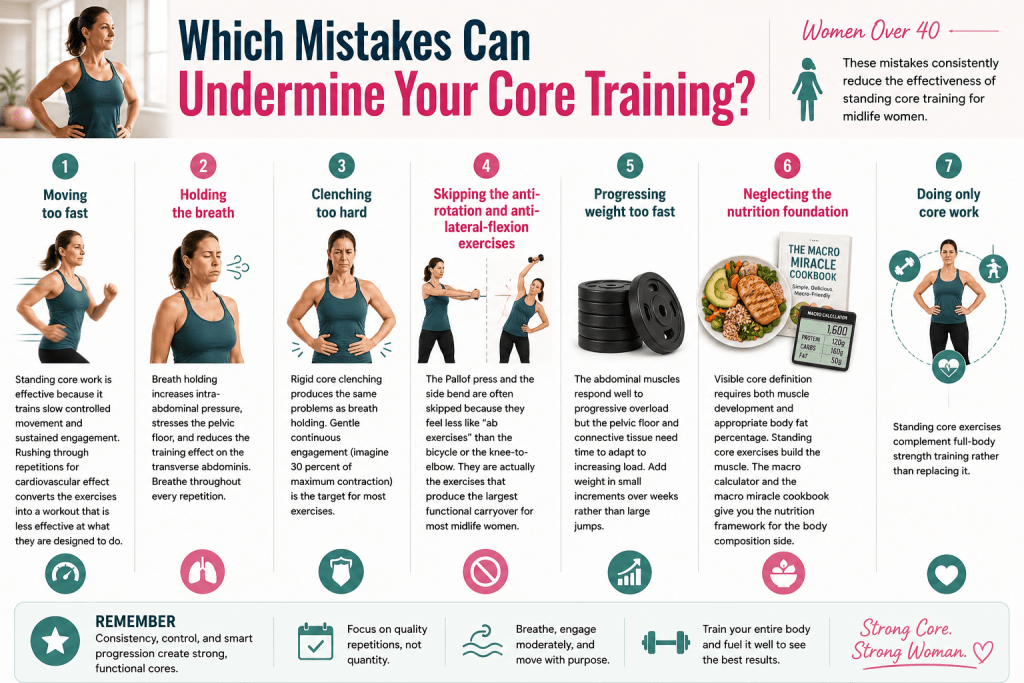
Infographic showing seven core training mistakes
  • Moving too fast: Standing core work is effective because it trains slow controlled movement and sustained engagement. Rushing through repetitions for cardiovascular effect converts the exercises into a workout that is less effective at what they are designed to do.
  • Holding the breath: Breath holding increases intra-abdominal pressure, stresses the pelvic floor, and reduces the training effect on the transverse abdominis. Breathe throughout every repetition.
  • Clenching too hard: Rigid core clenching produces the same problems as breath holding. Gentle continuous engagement (imagine 30 percent of maximum contraction) is the target for most exercises.
  • Skipping the anti-rotation and anti-lateral-flexion exercises: The Pallof press and the side bend are often skipped because they feel less like “ab exercises” than the bicycle or the knee-to-elbow. They are actually the exercises that produce the largest functional carryover for most midlife women.
  • Progressing weight too fast: The abdominal muscles respond well to progressive overload but the pelvic floor and connective tissue need time to adapt to increasing load. Add weight in small increments over weeks rather than large jumps.
  • Neglecting the nutrition foundation: Visible core definition requires both muscle development and appropriate body fat percentage. Standing core exercises build the muscle. The macro calculator and the macro miracle cookbook give you the nutrition framework for the body composition side.
  • Doing only core work: Standing core exercises complement full-body strength training rather than replacing it.

Free 28-Day Fascia Reset Email Course

Get our Free 28-day email course series to help with 1 or 2 exercises per day to release your fascia. One short lesson per day. Two minutes to read each.
How Does Standing Core Training Fit the THOR Framework?

Standing core training is one component of the five-part lifestyle medicine framework I teach at THOR.

  • Nutrition: Adequate protein supports the muscle building that core training stimulates. The free Macro Calculator gives you your protein target. The Macro Miracle Mediterranean Cookbook is the kitchen-side companion.
  • Daily movement: Standing core work is one component of the movement layer, alongside strength training, micro walks, and yin yoga.
  • Sleep: Core recovery happens during sleep. Consistent sleep supports the adaptation that produces visible and functional core changes.
  • Nervous system regulation: The breath coordination in standing core work is itself a parasympathetic activation practice. It pairs with the broader nervous system work covered in our parasympathetic aging article.
  • Supplement foundation: Vitamin D, magnesium, omega-3, and adequate protein all support the connective tissue that core training develops. The foundational supplement collection covers the priorities.

For women who want sustained 1:1 support on the full framework including form review and personalized progression, the Monthly Personal Training and Nutrition Coaching Program is the primary CTA. For the immersive version, the Deeply Restorative Yoga and Nature Retreat at our Smoky Mountains property includes standing core work in the daily movement programming.

When Should You See a Healthcare Professional?

Most midlife women can complete the seven-exercise routine safely with appropriate modification. Some situations require professional evaluation first.

  • Diastasis recti: Work with a pelvic floor physical therapist for individualized guidance on which exercises are appropriate and how to modify them.
  • Pelvic organ prolapse: Same recommendation. Standing exercises are often more appropriate than floor exercises, but individualized guidance from a pelvic floor PT is important.
  • Active lower back pain: Any acute back pain should be evaluated before starting a new core program.
  • Recent abdominal or spinal surgery: Wait for surgical clearance before adding new core work.
  • Osteoporosis: Some exercises may need modification to reduce spinal load.
  • Balance concerns: Use a wall or countertop for stability, or work with a physical therapist to develop a program appropriate for your baseline.

Free 28-Day Fascia Reset Email Course

Get our Free 28-day email course series to help with 1 or 2 exercises per day to release your fascia. One short lesson per day. Two minutes to read each.
What Are Your Next Steps?

If the framework in this article resonates and you want to install standing core training into your routine, here are the four next steps in order of friction.

  1. Complete one full 25-minute session this week. Do not wait for perfect equipment or ideal conditions. Start with the bodyweight versions of every exercise using no equipment beyond a wall for stability if needed.
  2. Add a second session in week two. Twice-weekly practice is the target for meaningful adaptation.
  3. Build the nutrition foundation underneath. The free Macro Calculator gives you your personalized starting numbers.
  4. Consider personalized coaching. The Monthly Personal Training and Nutrition Coaching Program is where I work with midlife women on form review, progression, and integration with the broader framework. For the immersive version, the Deeply Restorative Yoga and Nature Retreat at our Smoky Mountains property installs the full framework in five days.

Frequently Asked Questions

Are standing ab exercises as effective as floor exercises?

Standing exercises produce different training effects than floor exercises. For most midlife women, standing exercises produce better functional outcomes because they train the whole-body coordination that daily-life movement requires. For pure muscle isolation, floor exercises can produce slightly stronger localized muscle activation. Most midlife women benefit more from the functional carryover of standing work.

How often should I do standing ab exercises?

Two to three sessions per week produces meaningful results. Daily practice is fine but not necessary. Two dedicated 20 to 25 minute sessions plus one shorter maintenance session per week is the target for most midlife women who want steady progress.

How long before I see results?

Functional improvements (better balance, easier daily movement, reduced low back tightness) typically show up within four to six weeks of consistent practice. Visible core definition, when combined with adequate protein intake and appropriate body composition work, becomes noticeable at three to six months.

Can I get visible abs from standing exercises alone?

Visible abdominal definition requires both muscle development and low enough body fat to see the muscle. Standing exercises build the muscle effectively. The body fat side comes from the nutrition foundation (adequate protein, appropriate calorie balance) and overall training program. Both pieces have to be in place for visible definition.

Are standing ab exercises safe during pregnancy?

Most standing core exercises can be modified for pregnancy, but the specific modifications depend on trimester and individual situation. Work with a prenatal-certified trainer or physical therapist for personalized guidance. Avoid deep rotational movements after the first trimester.

What if I have diastasis recti?

Standing exercises are generally more appropriate than floor crunches for women with diastasis recti, particularly the anti-rotation and anti-lateral-flexion exercises. Avoid exercises that produce visible abdominal doming during the movement. A pelvic floor physical therapist can provide personalized recommendations.

Free 28-Day Fascia Reset Email Course

Get our Free 28-day email course series to help with 1 or 2 exercises per day to release your fascia. One short lesson per day. Two minutes to read each.
Do I need any equipment?

Most exercises can be done with no equipment. A light dumbbell (5 to 15 pounds), a resistance band, and a wall for stability are helpful but not essential. Total equipment investment is under $50 for everything you need.

Can I do this workout every day?

Daily practice is safe and often beneficial once the pattern is established. The muscles recover quickly and can handle daily gentle work. For the first four weeks while learning the patterns, alternating days with rest days is a good approach.

What if I cannot balance well?

Start with the exercises that require the least balance (the standing march, the side bend, and the Pallof press with wall support). Progress to the more dynamic exercises as balance improves. Working near a wall or countertop for light support is always fine.

Are standing ab exercises appropriate for postpartum women?

Standing exercises are generally more appropriate than floor exercises for postpartum women, particularly during the first year after birth when the pelvic floor and abdominal wall are still healing. Work with a pelvic floor physical therapist for individualized postpartum recommendations. Avoid intense rotational work in the first six weeks postpartum.

How does this compare to Pilates or yoga for core work?

Pilates and yoga both include excellent core training. Standing ab exercises complement rather than replace these practices. Women who do Pilates or yoga regularly can add 10 to 15 minutes of standing core work as a supplement. Women who prefer a more concise stand-alone core practice can use standing exercises as their primary approach.

Can standing ab exercises help with lower back pain?

The anti-rotation and anti-lateral-flexion exercises in the seven-exercise routine (particularly the Pallof press and the side bend) are specifically supportive for spine health. Many women with chronic low back tightness see reduced symptoms within four to eight weeks of consistent practice. Any acute back pain should be evaluated by a healthcare provider before starting a new exercise program.

What about menopause belly fat?

Standing core exercises build core muscle but do not directly reduce abdominal fat. The visceral fat accumulation many midlife women experience during perimenopause and menopause responds better to the combination of adequate protein, strength training, sleep optimization, and stress management covered in our menopause diet plan article. Standing core work is part of the picture but is not the primary intervention for abdominal fat.

Do I need to warm up before standing ab exercises?

A brief warm-up of five to seven minutes of gentle movement (walking, light mobility work) before starting the routine is helpful, particularly in cooler weather or first thing in the morning. This does not need to be elaborate. Getting the body slightly warm and the joints moving is enough.

Free 28-Day Fascia Reset Email Course

Get our Free 28-day email course series to help with 1 or 2 exercises per day to release your fascia. One short lesson per day. Two minutes to read each.
How does this fit with strength training and cardio?

Standing core work complements both. A typical week for a midlife woman might include two strength training sessions targeting the four longevity muscle groups, two dedicated standing core sessions, daily walking including some micro walks, and one or two yin yoga sessions. This complete framework produces the strongest aging-well outcomes.

References

  • McGill, S. (2015). Back Mechanic: The Step-by-Step McGill Method to Fix Back Pain. Backfitpro Inc.
  • McGill, S. (2016). Ultimate Back Fitness and Performance (6th ed.). Backfitpro Inc.
  • Behm, D. G., Drinkwater, E. J., Willardson, J. M., & Cowley, P. M. (2010). The use of instability to train the core musculature. Applied Physiology, Nutrition, and Metabolism, 35(1), 91–108.
  • Hibbs, A. E., Thompson, K. G., French, D., et al. (2008). Optimizing performance by improving core stability and core strength. Sports Medicine, 38(12), 995–1008.
  • Willson, J. D., Dougherty, C. P., Ireland, M. L., & Davis, I. M. (2005). Core stability and its relationship to lower extremity function and injury. Journal of the American Academy of Orthopaedic Surgeons, 13(5), 316–325.
  • Kibler, W. B., Press, J., & Sciascia, A. (2006). The role of core stability in athletic function. Sports Medicine, 36(3), 189–198.
  • Bø, K., Berghmans, B., Mørkved, S., & Van Kampen, M. (Eds.). (2015). Evidence-Based Physical Therapy for the Pelvic Floor: Bridging Science and Clinical Practice (2nd ed.). Churchill Livingstone.
  • Sperstad, J. B., Tennfjord, M. K., Hilde, G., et al. (2016). Diastasis recti abdominis during pregnancy and 12 months after childbirth: prevalence, risk factors and report of lumbopelvic pain. British Journal of Sports Medicine, 50(17), 1092–1096.
  • Hodges, P. W., & Richardson, C. A. (1996). Inefficient muscular stabilization of the lumbar spine associated with low back pain. A motor control evaluation of transversus abdominis. Spine, 21(22), 2640–2650.
  • Panjabi, M. M. (2003). Clinical spinal instability and low back pain. Journal of Electromyography and Kinesiology, 13(4), 371–379.
  • Maltais, M. L., Desroches, J., & Dionne, I. J. (2009). Changes in muscle mass and strength after menopause. Journal of Musculoskeletal and Neuronal Interactions, 9(4), 186–197.
  • Sipilä, S., Törmäkangas, T., Sillanpää, E., et al. (2020). Muscle and bone mass in middle-aged women: role of menopausal status and physical activity. Journal of Cachexia, Sarcopenia and Muscle, 11(3), 698–709.
  • Bauer, J., Biolo, G., Cederholm, T., et al. (2013). Evidence-based recommendations for optimal dietary protein intake in older people: a position paper from the PROT-AGE Study Group. Journal of the American Medical Directors Association, 14(8), 542–559.
  • Boyle, N. B., Lawton, C., & Dye, L. (2017). The effects of magnesium supplementation on subjective anxiety and stress: a systematic review. Nutrients, 9(5), 429.
  • Hopper, S. I., Murray, S. L., Ferrara, L. R., & Singleton, J. K. (2019). Effectiveness of diaphragmatic breathing for reducing physiological and psychological stress in adults. JBI Database of Systematic Reviews and Implementation Reports, 17(9), 1855–1876.
  • Peterson, M. D., Rhea, M. R., Sen, A., & Gordon, P. M. (2010). Resistance exercise for muscular strength in older adults: a meta-analysis. Ageing Research Reviews, 9(3), 226–237.
  • Fragala, M. S., Cadore, E. L., Dorgo, S., et al. (2019). Resistance training for older adults: position statement from the National Strength and Conditioning Association. Journal of Strength and Conditioning Research, 33(8), 2019–2052.

Disclaimer: Always consult with a healthcare professional before starting any new routines, programs, or nutrition plans to ensure you receive the best medical advice and strategy for your specific individual needs.

Free 28-Day Fascia Reset Email Course

Get our Free 28-day email course series to help with 1 or 2 exercises per day to release your fascia. One short lesson per day. Two minutes to read each.
Free Macro Calculator

Personalized to your body, goals, and measurements. You will receive detailed macros for meals, sample day of eating, food selection guidance, hydration + daily supplement suggestions, and more.

Loaded Big Mac Cheeseburger Protein Bowl (450 Calories, 30g Protein)

Macros per serving: 450 calories | 30g protein | 10g fat | 60g carbs
Servings: 4

When I am craving a burger and grilling season has not started yet (which is most of the year if you live anywhere with a real winter), nine times out of ten I make this Loaded Big Mac Cheeseburger Protein Bowl. It tastes like a deconstructed Big Mac—all the flavors, none of the guilt.

This is the version I serve at my midlife women’s yoga and wellness retreats when guests want comfort food and the version I include in the Macro Miracle Mediterranean Cookbook. Each serving lands at approximately 450 calories with 30 grams of protein, 10 grams of fat, and 60 grams of carbohydrates. That is a macro shape that actually supports a midlife metabolism rather than fighting it.

The full recipe, the homemade Big Mac sauce, the full ingredient breakdown by weight, the substitutions, the storage notes for meal prep, and the answers to the questions I get asked most often about this protein bowl are all below.

Get the full cookbook with more recipes here → Macro Miracle Mediterranean Cookbook

Why This Recipe Works (Especially for Women in Midlife)

A traditional fast-food Big Mac runs around 540 to 590 calories with roughly 25 grams of protein, 33 grams of fat, and 44 grams of carbohydrates. The macros are the wrong shape for a midlife body. Too much fat, not enough protein, and the carbohydrates come from a refined-flour bun that spikes blood sugar and drops it fast.

This bowl reverses the shape. The protein climbs to 30 grams. The fat drops to 10 grams. The carbohydrates move into the slow-digesting range from a measured grain or rice base rather than the rapid spike of a white flour bun. The result is a meal that satisfies a burger craving without creating the blood sugar roller coaster that makes menopausal weight management harder than it needs to be.

Big Mac vs. This Protein Bowl: The Nutrition Comparison

Here is a direct comparison of a McDonald’s Big Mac versus one serving of this Loaded Big Mac Protein Bowl. Same craveable flavors—dramatically different nutritional profile.

Nutrient

McDonald’s Big Mac

THOR Protein Bowl

Difference

Calories

590

450

−140 (24% less)

Protein

25g

30g

+5g (20% more)

Total Fat

33g

10g

−23g (70% less)

Saturated Fat

11g

4g

−7g (64% less)

Carbohydrates

44g

60g

+16g (slow-digesting rice vs. white flour bun)

Fiber

3g

6–8g

+3–5g (2x more)

Sodium

1,010mg

600–750mg

−260mg (26% less)

Added Sugar

9g

<2g

−7g

Protein-to-Calorie Ratio

1g per 24 cal

1g per 15 cal

60% more protein-efficient

The protein-to-calorie ratio is the number that matters most for women in midlife. At 1 gram of protein for every 15 calories, this bowl is 60 percent more protein-efficient than a Big Mac. That means more muscle-preserving fuel per calorie which is exactly what a menopausal metabolism needs.

Free Macro Calculator

Personalized to your body, goals, and measurements. You will receive detailed macros for meals, sample day of eating, food selection guidance, hydration + daily supplement suggestions, and more.

The Macro Breakdown Per Serving

The recipe yields four servings. Each serving is built to land at approximately:

Macro

Amount per Serving

% of Daily Value*

Calories

450

22%

Protein

30g

60%

Total Fat

10g

13%

Saturated Fat

4g

20%

Carbohydrates

60g

22%

Fiber

6–8g

24–29%

Sodium

600–750mg

26–33%

Iron

4.5mg

25%

Calcium

120mg

9%

*Based on a 2,000-calorie diet. Your individual needs may vary. Use our THOR Macro Calculator to find your personalized targets.

Adjust portions up or down based on your specific macro target. Doubling the lean ground beef portion brings the protein toward 50 grams per serving for women who want more. Cutting the rice base in half and using cauliflower rice for the other half drops the meal to roughly 350 calories while keeping the protein at 30 grams.

What You Need

The ingredient list is short and the substitutions are flexible. Here is what each component does in the bowl.

Ingredient

Amount (4 servings)

Role in the Bowl

96% lean ground beef

1 pound

Protein foundation. This hits 30g target w/out excess fat

Cooked basmati or jasmine rice

4 cups (1 cup uncooked)

Slow-carb base. Lower glycemic than white flour bun

Sharp cheddar cheese

2 oz, shredded

Cheeseburger flavor. Sharp = more flavor per gram

Napa cabbage, chopped

4 cups

Crunch + mild sweetness; subs: romaine, iceberg

Romaine lettuce, chopped

4 cups

Volume + fiber without extra calories

Cherry tomatoes, halved

2 cups

Juicy, sweet. Classic cheeseburger partner

Red onion, diced fine

½ cup

Sharp bite that distinguishes this from a generic salad

Dill pickles, chopped

½ cup

Tang + crunch. The Big Mac flavor anchor

Sesame seeds

2 tsp

Burger bun visual cue. Small detail that matters

For the Big Mac Sauce:

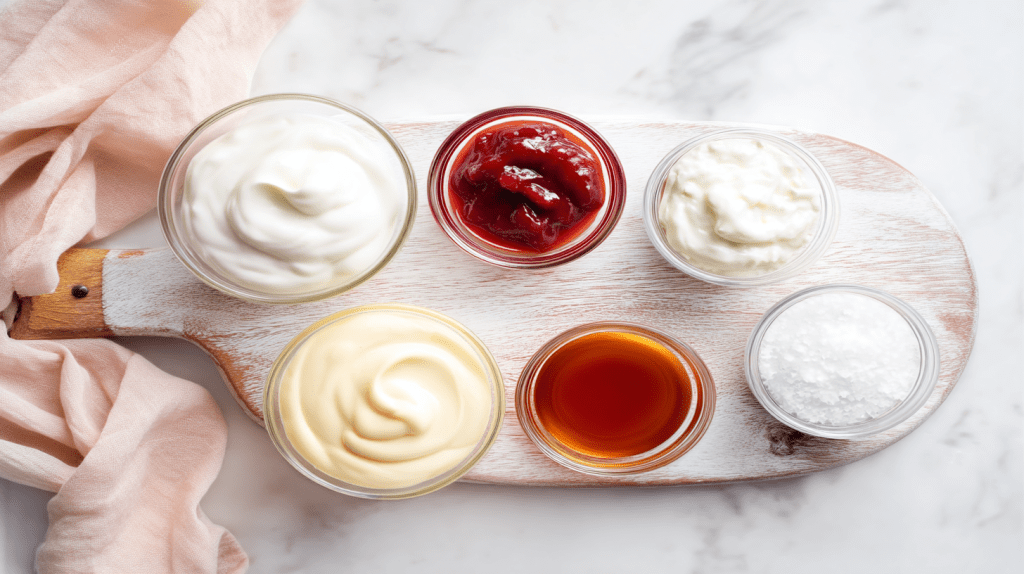
Big Mac Sauce Recipe Ingredients - Low Calorie Macro-Friendly

Ingredient

Amount

Purpose

Non-fat plain Greek yogurt

½ cup

Creamy base — cuts fat by 50% vs. all-mayo

Light mayonnaise

4 tsp

Richness without fat bomb

Ketchup

¼ cup

Sweet-tomato note that defines Big Mac sauce

Sweet pickle relish

4 tsp

THE detail that makes it Big Mac, not Thousand Island

Apple cider vinegar (or mirin)

4 tsp

Acidity that balances sweetness

Salt

Pinch

Seasoning

Kitchen Equipment & Tools

  • Large skillet for the ground beef
  • Small mixing bowl for the sauce
  • Large mixing bowl for the salad components
  • Chef’s knife and cutting board
  • Measuring cups and spoons
  • Four serving bowls (for plating)

Free Macro Calculator

Personalized to your body, goals, and measurements. You will receive detailed macros for meals, sample day of eating, food selection guidance, hydration + daily supplement suggestions, and more.

How to Make the Loaded Big Mac Cheeseburger Protein Bowl

The total active time is about 20 minutes, plus the time to cook the rice if you have not already done it. The directions below assume the rice is already cooked.

Step 1: Cook the Ground Beef

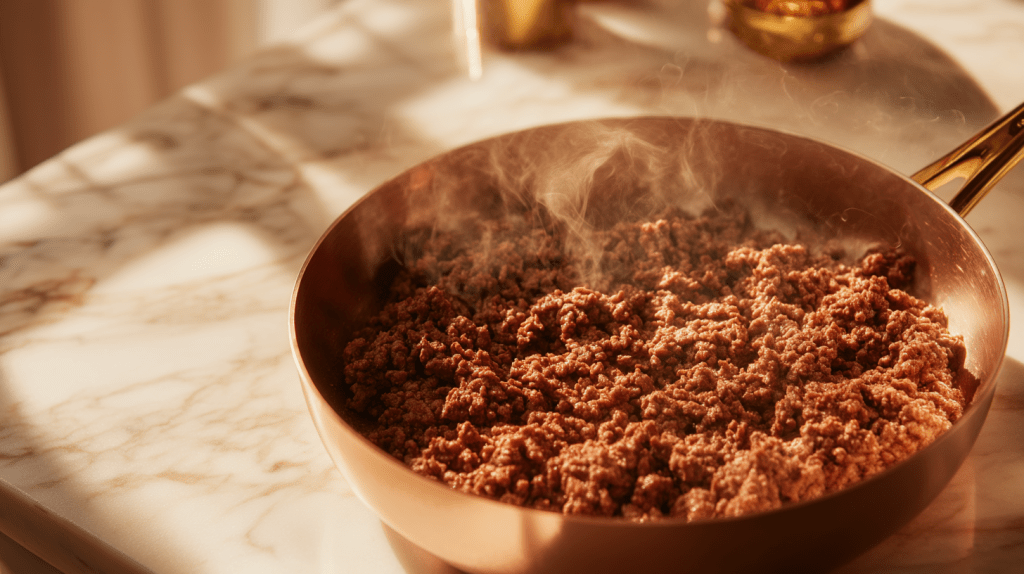
Big Mac Protein Bowl Recipe - Ground Beef in Skillet

Heat a large skillet over medium-high heat. Add the ground beef and break it apart with a wooden spoon. Cook for 8 to 10 minutes, stirring occasionally, until the beef is fully browned and no pink remains. Season with salt and pepper. Drain any excess liquid.

Step 2: Make the Big Mac Sauce

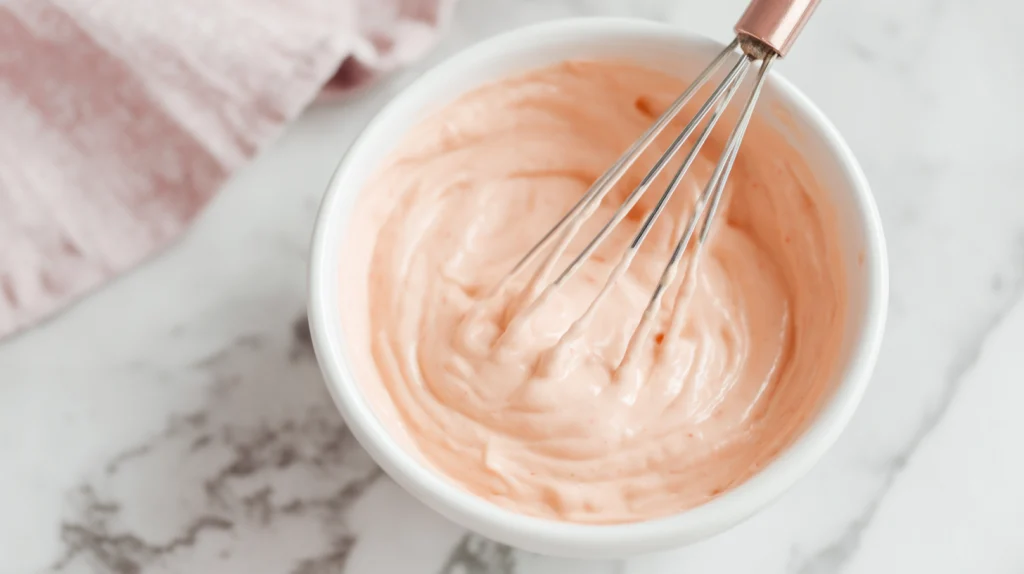
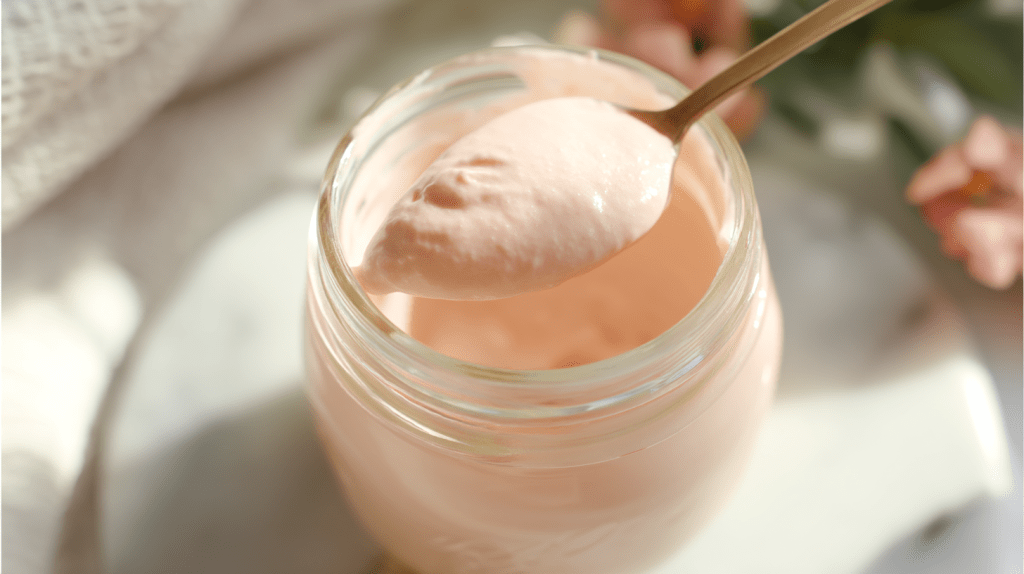
Big Mac Protein Bowl - Low Calories - Big Mac Sauce

While the beef cooks, combine the Greek yogurt, light mayonnaise, ketchup, sweet pickle relish, apple cider vinegar, and salt in a small bowl. Whisk together until smooth and creamy. Taste and adjust the acidity (add more vinegar if you want more tang) or sweetness (add a touch more ketchup). Set aside.

Step 3: Assemble the Bowls

In each serving bowl, layer the components in this order:

  1. One cup of cooked basmati rice as the base.
  2. One cup chopped Napa cabbage and one cup chopped romaine lettuce.
  3. ½ cup cherry tomatoes, 2 tablespoons diced red onion, and 2 tablespoons chopped pickles.
  4. A heaping portion of the cooked ground beef (about 4 ounces per serving).
  5. ½ ounce shredded sharp cheddar cheese.

Step 4: Dress and Finish

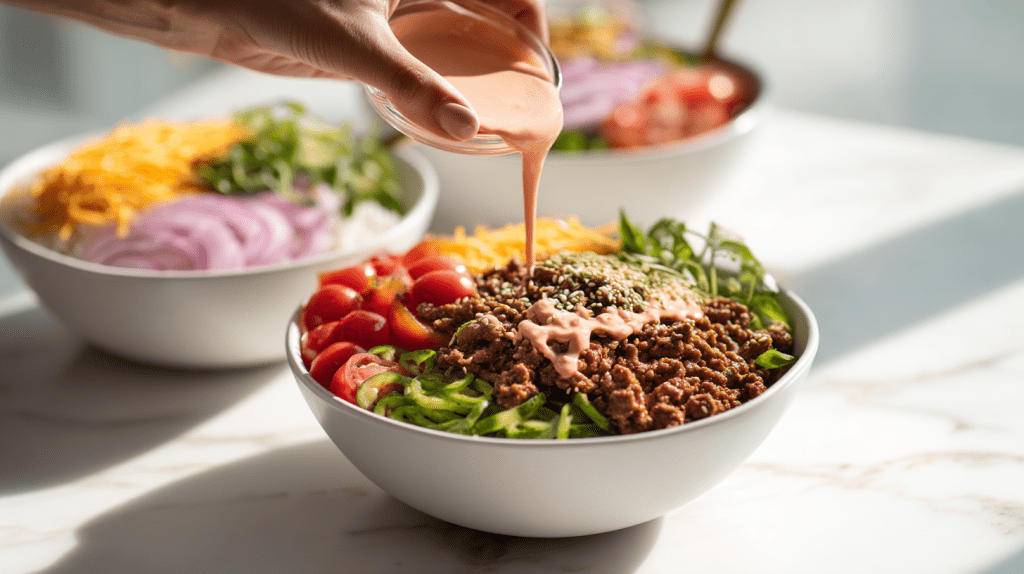
High Protein Ground Beef Big Mac Bowl

Drizzle 3 to 4 tablespoons of the Big Mac sauce over each bowl. Sprinkle with a generous pinch of sesame seeds. Toss lightly if you want everything mixed, or leave it composed for the visual cue of a deconstructed burger.

Serve immediately while the beef is still warm and the lettuce is crisp.

The Big Mac Sauce Recipe (Healthy, Low Calorie, Macro-Friendly Version)

Best Big Mac Sauce Recipe Low Calorie Macro Friendly

The sauce is what makes this bowl taste like an actual Big Mac rather than a generic salad. This healthier version uses Greek yogurt as the base instead of all mayonnaise, cutting the fat content in half while keeping the creamy mouthfeel that defines the sauce.

What Makes Big Mac Sauce Different from Thousand Island?

The sweet pickle relish. That is the small detail that pushes the sauce into Big Mac territory. Without it, the sauce is closer to Thousand Island. With it, the sauce becomes specifically cheeseburger-flavored. The relish brings a sweet-sour crunch that you cannot replicate with other ingredients.

Free Macro Calculator

Personalized to your body, goals, and measurements. You will receive detailed macros for meals, sample day of eating, food selection guidance, hydration + daily supplement suggestions, and more.

Macro-Friendly Low Calorie Big Mac Sauce Nutrition

Per 3-Tablespoon Serving

This Recipe

Traditional Big Mac Sauce

Savings

Calories

45

90

−45 (50% less)

Fat

1.5g

8g

−6.5g (81% less)

Protein

3g

0g

+3g (from Greek yogurt)

Sugar

4g

6g

−2g


Tips and Variations for the Sauce

  • 100% Greek yogurt version: Skip the mayo entirely. The sauce becomes even leaner, though slightly tangier. Add 1 teaspoon of honey to balance if needed.
  • No-sugar-added ketchup: Works well if you are tracking added sugars closely. The taste difference is minimal in this sauce.
  • Apple cider vinegar vs. mirin: ACV adds sharp acidity. Mirin adds a sweeter, more rounded acidity. White wine vinegar or rice vinegar are both fine substitutes.
  • Smoky variation: Add ¼ teaspoon smoked paprika for a deeper, more complex flavor without changing the macro profile.
  • Spicy variation: Add 1 teaspoon sriracha or ½ teaspoon cayenne for a spicy Big Mac sauce. Popular with the coaching community.
  • Storage: Keeps in a sealed jar in the refrigerator for up to 7 days. The flavor actually improves after a day or two as the ingredients meld together.

Love this sauce? → It’s one of dozens of macro-friendly dressings and sauces in our Macro Miracle Mediterranean Cookbook 

Substitutions & Variations

Swap

Change

Macro Impact

Best For

Ground turkey (93–99% lean)

Replace ground beef

Similar protein; fat ±2g

Leaner option, milder flavor

Cauliflower rice

Replace basmati rice

Carbs drop from 60g → 15g; cal ~300

Low-carb / keto version

Quinoa

Replace basmati rice

+4-5g protein, slightly more fiber

Extra protein boost

Romaine only

Replace Napa cabbage

No macro change

Crispier texture preference

Reduced-fat cheddar

Replace sharp cheddar

Fat −2g per serving

Lower fat target

Pepper jack cheese

Replace sharp cheddar

No macro change

Heat lovers

Add avocado (¼)

Add to bowl

+60–80 cal, +5-7g healthy fat

Lower-carb days with fat room

Add crispy bacon (1 tbsp)

Add to bowl

+30 cal, +3g fat

Weekend indulgence

Add jalapeño slices

Add to bowl

Zero macro impact

Spice lovers

Add fried egg

Top the bowl

+70 cal, +5g fat, +6g protein

Brunch version

BBQ sauce swap

Replace Big Mac sauce

Slightly higher sugar

BBQ burger variation

Chipotle ranch swap

Replace Big Mac sauce

Slightly higher fat

Smoky-spicy variation

Free Macro Calculator

Personalized to your body, goals, and measurements. You will receive detailed macros for meals, sample day of eating, food selection guidance, hydration + daily supplement suggestions, and more.

Add-Ons for Different Macro Days

The bowl is built around a base macro profile and can be adjusted up or down depending on your training day, goals, or hunger level.

Goal

What to Change

New Macros (approx.)

When to Use

Higher protein

Add 2 oz more cooked beef (or use 6 oz total)

~50g protein, ~520 cal

Strength training days

Higher carb

Add ½ cup more cooked rice

~80g carbs, ~530 cal

High-activity days

Higher fat

Add ¼ avocado + full-fat cheese

~18g fat, ~530 cal

Low-carb, higher-fat days

Lower calorie

Halve rice + cauliflower rice the other half

~350 cal, 30g protein

Rest days or cutting phase

Maximum protein

Double beef + add egg

~56g protein, ~590 cal

Heavy lifting days

How to Meal Prep This Big Mac Bowl

The components of this bowl are perfect for meal prep, with one rule: store the components separately rather than as assembled bowls. The dressing on the lettuce overnight produces wilted, soggy greens that ruin the texture.

Meal Prep Storage Guide

Component

Container

Fridge Life

Reheat Method

Cooked ground beef (seasoned)

Airtight container

4 days

30 sec microwave or 2 min skillet

Cooked rice

Airtight container

5 days

Splash of water + 1 min microwave

Big Mac sauce

Sealed glass jar

7 days

No reheat needed (serve cold)

Chopped cabbage/lettuce

Container + paper towel

5 days

No reheat (serve fresh)

Cherry tomatoes (halved)

Separate small container

4 days

No reheat

Diced onion + pickles

Separate small container

5 days

No reheat

Shredded cheese

Original bag or sealed bag

2 weeks

No reheat


Free Macro Calculator

Personalized to your body, goals, and measurements. You will receive detailed macros for meals, sample day of eating, food selection guidance, hydration + daily supplement suggestions, and more.

Sunday Prep → Monday to Wednesday Rotation

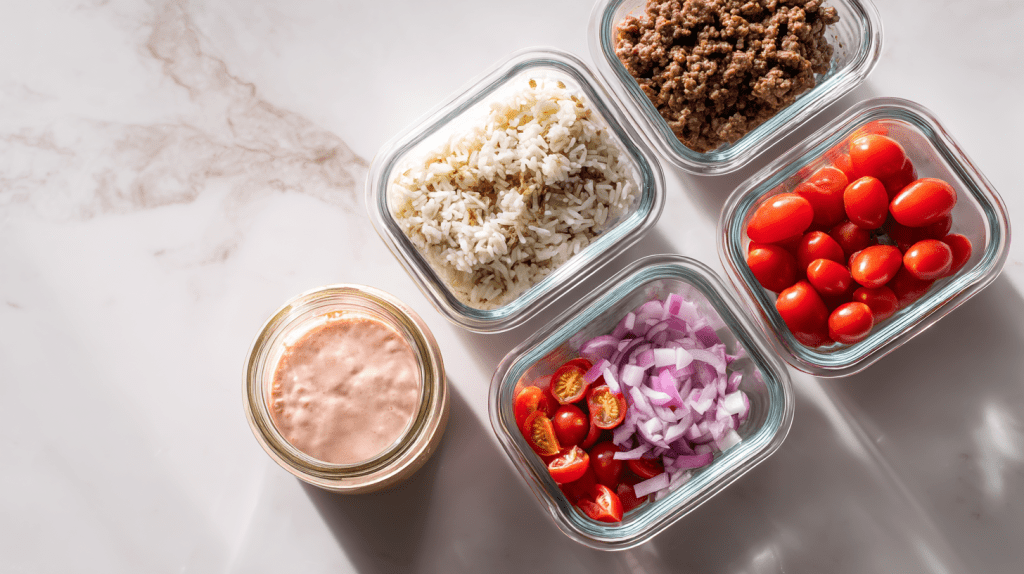
Big Mac Protein Ground Beef Meal Prep

For meal prep, divide everything into separate containers on Sunday for a Monday through Wednesday lunch rotation. Each bowl takes 90 seconds to assemble at lunch time. Here is the workflow:

Step 1: Cook 1 pound ground beef and season. Let cool, divide into 4 containers.

Step 2: Cook 1 cup dry rice. Let cool, divide into 4 containers.

Step 3: Make the Big Mac sauce (one batch = 4 servings). Store in a glass jar.

Step 4: Chop all vegetables. Store each type separately with paper towels.

Step 5: Shred cheese and store in a sealed bag.

Step 6: At lunch: warm beef + rice (90 seconds), add cold vegetables, drizzle sauce, sprinkle sesame seeds.

How This Recipe Fits the Our THOR Methodology

This bowl is one of dozens of recipes that fit the macro framework I teach at THOR. The fundamentals are consistent across all of them: 30 to 40 grams of protein per meal, slow carbohydrates in measured amounts, fat kept intentionally low to leave room for flavor without exceeding the daily target, and built-in flexibility for customization.

Ready to build a full week of meals like this? → Get our Macro Miracle Mediterranean Cookbook 

Frequently Asked Questions

What goes in a Big Mac bowl?

A Big Mac bowl typically contains seasoned ground beef, shredded lettuce, diced onion, chopped pickles, shredded cheddar cheese, cherry tomatoes, and Big Mac sauce. In this version, the bowl sits on a base of cooked basmati rice for slow-digesting carbohydrates and uses a macro-friendly sauce made with Greek yogurt instead of full-fat mayonnaise. The sesame seed garnish provides the bun cue without the refined carbs.

Can I make this recipe ahead of time?

Yes, with the storage approach above. Store all components separately and assemble each bowl just before eating. Stored this way, the components hold for 4 to 5 days. Pre-assembled bowls only last about 24 hours before the lettuce wilts under the weight of the warm components and the dressing.

Is this a keto cheeseburger bowl?

The recipe as written is not strictly keto because of the rice base and the ketchup in the sauce. To make it keto, swap the rice for cauliflower rice and use a no-sugar-added ketchup or skip the ketchup entirely and add 1 teaspoon of mustard plus 1 teaspoon of tomato paste. The macro profile with cauliflower rice comes in around 300 calories, 30 grams of protein, 10 grams of fat, and roughly 12 grams of net carbs per serving.

What is the difference between a Big Mac bowl and a Big Mac salad?

A Big Mac bowl typically includes a carbohydrate base like rice, quinoa, or potatoes, making it a complete meal with balanced macros. A Big Mac salad uses only lettuce as the base, making it lower in carbohydrates and calories but less filling. This recipe is a bowl, with the rice base providing 60 grams of slow-digesting carbs per serving. You can easily convert it to a Big Mac salad by removing the rice and adding extra lettuce.

What can I swap for the Napa cabbage?

Napa cabbage can be replaced with romaine lettuce, butter lettuce, iceberg lettuce, baby kale, or a spring mix. The texture is slightly different with each, but all of them work. Arugula is the one leafy green I avoid here because its peppery flavor fights the sweet-tangy Big Mac sauce profile.

Can I use a different type of cheese?

A different cheese works perfectly well. Colby Jack, pepper jack, Swiss, and reduced-fat sharp cheddar all hold up in this bowl. Avoid soft cheeses like brie or fresh mozzarella because they do not give you the melty-shredded texture that makes the bowl feel like a cheeseburger.

Free Macro Calculator

Personalized to your body, goals, and measurements. You will receive detailed macros for meals, sample day of eating, food selection guidance, hydration + daily supplement suggestions, and more.

What’s the secret sauce on a Big Mac?

McDonald’s Big Mac special sauce is essentially a variation of Thousand Island dressing: mayonnaise, sweet pickle relish, yellow mustard, white wine vinegar, garlic powder, onion powder, and paprika. Our version replaces the heavy mayonnaise base with non-fat Greek yogurt and light mayonnaise, cutting the fat by 81% while keeping the same signature flavor profile. The key ingredient that makes it taste specifically like a Big Mac is the sweet pickle relish—without it, it’s just Thousand Island.

How do I know my serving size is right?

The recipe yields four servings at approximately 450 calories per serving. If you cook the full pound of ground beef and the full pot of rice, then divide the cooked components evenly across four bowls, each bowl will land close to the macro target. For precision, weigh the cooked beef on a food scale (4 ounces per bowl) and measure the rice (1 cup cooked per bowl).

Is this recipe appropriate during perimenopause and menopause?

Yes, and it was designed specifically for this audience. The macro profile—high protein, moderate carbohydrates from slow sources, low fat from lean meat and a small amount of cheese—is the exact profile that supports muscle preservation, blood sugar stability, and sustained energy during hormonal transitions. The recipe is also anti-inflammatory, fiber-rich, and free of common menopause symptom triggers like excess sugar and refined carbs.

Can children eat this recipe?

The bowl scales down well for kids and is family-friendly as written. Reduce the portion size and consider leaving the dressing on the side so children can add their own. The flavors are familiar enough that most kids who like cheeseburgers will eat this without complaint.

Why use 96 percent lean ground beef instead of regular?

The leanness drives the fat macro target. Regular 80 percent lean ground beef would push the fat per serving from 10 grams to roughly 18 grams. Both versions taste excellent, and if you have room in your daily fat target, 90 or 93 percent lean is a reasonable middle ground. The 96 percent lean version is included because it produces the leanest macro profile and allows you to add fat selectively through cheese, avocado, or sauce rather than through the beef itself.

Can I make this dairy free?

The recipe converts to dairy free cleanly. Skip the cheese, use a dairy-free Greek yogurt alternative (coconut or almond-based unsweetened) in the sauce, and the recipe still holds together. The macro profile shifts by roughly 2 grams of fat and 2 grams of protein per serving.

I write 3 essays per week on Lifestyle Medicine for women in midlife on what is happening in the body and what to do about it. No fluff, no hype. Free.


References

  1. Phillips, S. M., & Van Loon, L. J. C. (2011). Dietary protein for athletes: from requirements to optimum adaptation. Journal of Sports Sciences, 29(Suppl 1), S29–S38.
  2. Bauer, J., Biolo, G., Cederholm, T., et al. (2013). Evidence-based recommendations for optimal dietary protein intake in older people. JAMDA, 14(8), 542–559.
  3. Leidy, H. J., Clifton, P. M., Astrup, A., et al. (2015). The role of protein in weight loss and maintenance. American Journal of Clinical Nutrition, 101(6), 1320S–1329S.
  4. Westerterp-Plantenga, M. S., et al. (2012). Dietary protein, weight loss, and weight maintenance. Annual Review of Nutrition, 32, 31–51.
  5. Maltais, M. L., Desroches, J., & Dionne, I. J. (2009). Changes in muscle mass and strength after menopause. JMNI, 9(4), 186–197.
  6. Lovejoy, J. C., et al. (2008). Increased visceral fat and decreased energy expenditure during the menopausal transition. Int J Obesity, 32(6), 949–958.
  7. Estruch, R., et al. (2018). Primary prevention of cardiovascular disease with a Mediterranean diet. NEJM, 378(25), e34.
  8. Atkinson, F. S., et al. (2008). International tables of glycemic index and glycemic load values. Diabetes Care, 31(12), 2281–2283.

Disclaimer: Always consult with a healthcare professional before starting any new routines, programs, or nutrition plans to ensure you receive the best medical advice and strategy for your specific individual needs.

───────────────────────────────────────────────────────────────────

Download Your 7-Day Menopause Diet Plan

Instant download a nutritionist-approved 7-day menopause diet meal plan to balance hormones, ease hot flashes, and support bone health. These downloadable guides provide daily menus, macro-tracking, and grocery lists to take the guesswork out of your nutrition.

The Menopause Diet Plan: A 7-Day Meal Plan, Expert Nutrition Guide & Foods That Help

If you’re navigating menopause and feel like your body is suddenly playing by different rules, you’re not imagining it. The hormonal shifts that happen during perimenopause and menopause, particularly the decline in estrogen, change how your body processes food, stores fat, builds muscle, and even regulates your mood and sleep.

The good news?

A well-designed menopause diet plan can make a meaningful difference. Research shows that the right combination of nutrients can reduce hot flashes by up to 40%, support bone density, improve sleep quality, and help manage the stubborn weight gain that so many women struggle with during this transition.

In this guide, we’ll walk you through exactly what to eat (and what to avoid), share a complete 7-day menopause diet meal plan with macros and calorie counts, give you quick recipes you can make in under 20 minutes, and show you how to calculate the right macro balance for your body. Whether you’re in early perimenopause or well into postmenopause, this plan is designed to help you feel like yourself again.

What Happens to Your Body During Menopause (And Why Diet Matters Now)

Menopause isn’t just about hot flashes and missed periods. It’s a fundamental metabolic shift. When estrogen levels drop, which typically begins in your early to mid-40s during perimenopause and continues through menopause (defined as 12 consecutive months without a period), your body undergoes a cascade of changes that directly affect how you should eat.

The Estrogen-Metabolism Connection

Estrogen plays a surprising role in metabolism. It helps regulate insulin sensitivity, supports lean muscle mass, and influences where your body stores fat. As estrogen declines:

Insulin resistance increases.

Your cells become less responsive to insulin, making it easier to gain weight and harder to lose it—even if you haven’t changed your eating habits.

Muscle mass decreases.

Without estrogen’s protective effect, you lose muscle faster. Since muscle burns more calories at rest than fat, your resting metabolic rate drops.

Fat redistribution shifts to the abdomen.

Instead of storing fat in the hips and thighs (which estrogen promotes), your body begins storing visceral fat around the midsection. This isn’t just a cosmetic concern—visceral fat is linked to heart disease, type 2 diabetes, and inflammation.

Bone density declines.

Estrogen helps maintain bone. Without it, bone loss accelerates, making dietary calcium, vitamin D, and weight-bearing exercise essential.

Serotonin & sleep are disrupted.

Estrogen supports serotonin production, so its decline can contribute to mood swings, anxiety, and poor sleep—all of which affect food choices and cravings.

Infographic: 'How Estrogen Decline Affects Your Body' - simple diagram showing estrogen dropping with arrows to: insulin resistance, muscle loss, belly fat, bone loss, mood changes

This is precisely why the diet that worked in your 30s may not work now. Your body’s nutritional needs have genuinely changed—and a menopause diet plan accounts for those changes instead of fighting against them.

Download Your 7-Day Menopause Diet Plan

Instant download a nutritionist-approved 7-day menopause diet meal plan to balance hormones, ease hot flashes, and support bone health. These downloadable guides provide daily menus, macro-tracking, and grocery lists to take the guesswork out of your nutrition.

The Best Diet for Menopause: Key Principles

There’s no single “menopause diet” that works for everyone, but research consistently points to a few core principles that form the foundation of effective menopause nutrition. Think of these as your non-negotiables.

Prioritize Protein at Every Meal

Protein is the single most important macronutrient during menopause. It preserves lean muscle mass (which is actively declining), keeps you fuller longer, and has a higher thermic effect than carbs or fat—meaning your body burns more calories digesting it. Aim for 25–35 grams of protein per meal, or roughly 1 gram per pound of your ideal body weight per day.

Embrace Anti-Inflammatory Foods

Menopause increases systemic inflammation, which worsens joint pain, brain fog, and fatigue. A Mediterranean-style eating pattern—rich in olive oil, fatty fish, colorful vegetables, nuts, and herbs—has been shown in multiple studies to reduce menopausal symptoms and lower cardiovascular risk. This is arguably the best overall diet framework for menopause.

Don’t Fear Healthy Fats. They Support Your Hormones

Healthy fats are essential for hormone production and absorption of fat-soluble vitamins (A, D, E, K). Omega-3 fatty acids from salmon, walnuts, and flaxseed are particularly beneficial—they’ve been linked to reduced hot flash frequency and improved mood. Don’t cut fat below 25% of your daily calories.

Reduce Refined Carbs, Not All Carbs

Carbohydrates aren’t the enemy. But refined carbs (white bread, pastries, sugary cereals) spike blood sugar and worsen insulin resistance. Focus on complex carbohydrates—sweet potatoes, quinoa, oats, legumes, and whole fruits—which provide steady energy, fiber, and essential nutrients.

Hydration and Fiber Are Non-Negotiable

Declining estrogen can affect your body’s ability to retain moisture, making dehydration more common. Aim for at least 8 glasses of water daily. Fiber (25–30g/day) supports gut health, helps manage cholesterol, and keeps digestion regular—a common complaint during menopause. Bonus: fiber-rich foods also feed beneficial gut bacteria that help metabolize estrogen.

Recommended Macro Ranges for Menopause

Macronutrient

% of Daily Calories

Why It Matters

Protein

30–35%

Preserves muscle, boosts satiety, supports metabolism

Carbohydrates

35–40%

Provides energy and fiber; choose complex carbs

Healthy Fats

25–30%

Supports hormones, brain health, reduces inflammation

Fiber

25–30g/day

Gut health, cholesterol, blood sugar regulation

For a deeper dive into macros for women over 50, read our complete guide here.

Foods to Eat During Menopause

What you put on your plate can directly influence the severity of menopause symptoms. Here’s a category-by-category breakdown of the most beneficial foods to include in your menopause diet plan.

Category

Best Foods

Key Benefits

Lean Proteins

Salmon, sardines, chicken breast, eggs, Greek yogurt, tofu, lentils, tempeh

Muscle preservation, satiety, metabolism support

Healthy Fats

Avocado, extra-virgin olive oil, walnuts, almonds, flaxseed, chia seeds

Hormone production, omega-3s, reduced inflammation

Complex Carbs

Sweet potatoes, quinoa, oats, brown rice, berries, beans, legumes

Steady energy, fiber, B vitamins

Phytoestrogens

Soy (edamame, tofu, miso), flaxseed, chickpeas, sesame seeds

Mild estrogenic effect, may reduce hot flashes

Bone-Building Foods

Sardines (with bones), kale, broccoli, fortified plant milks, almonds

Calcium, vitamin K, phosphorus for bone density

Gut Health Foods

Kimchi, sauerkraut, kefir, yogurt, miso, prebiotic-rich onions & garlic

Microbiome support, estrogen metabolism, immunity

Hydrating Foods

Cucumbers, watermelon, celery, zucchini, strawberries, lettuce

Moisture retention, electrolytes, low-calorie volume

Menopause-Friendly Shopping List'

Download Your 7-Day Menopause Diet Plan

Instant download a nutritionist-approved 7-day menopause diet meal plan to balance hormones, ease hot flashes, and support bone health. These downloadable guides provide daily menus, macro-tracking, and grocery lists to take the guesswork out of your nutrition.

Spotlight: Phytoestrogens: Nature’s Hormone Helpers

Phytoestrogens are plant compounds that can weakly mimic estrogen in the body. Research suggests they may help reduce hot flash frequency and intensity, particularly soy isoflavones. Japanese women, who consume significantly more soy, report far fewer menopausal symptoms than Western women. Including 1–2 servings of soy-based foods daily (edamame, tofu, miso soup) is a simple, food-first approach to symptom management.

Flaxseed is another powerhouse—just 2 tablespoons daily provides lignans (a type of phytoestrogen), omega-3 ALA, and 4 grams of fiber. Grind it fresh and add to smoothies, oatmeal, or yogurt.

Foods to Avoid or Limit During Menopause

Just as certain foods can ease your menopause journey, others can make symptoms noticeably worse. You don’t need to eliminate these entirely, but being mindful about them can make a real difference.

Healthy Food Swaps for Menopause

Food/Category

Why to Limit

Better Swap

Refined sugar & sweets

Spikes blood sugar, worsens insulin resistance, feeds inflammation

Fresh fruit, dark chocolate (70%+), dates

Alcohol

Triggers hot flashes, disrupts sleep, accelerates bone loss

Sparkling water with citrus, herbal teas, kombucha

Excess caffeine

Can worsen anxiety, disrupt sleep, and contribute to bone loss

Green tea (lower caffeine + L-theanine), matcha, decaf

Highly processed foods

High in sodium, additives, and inflammatory seed oils

Home-cooked versions, whole food snacks

Excess sodium

Promotes bloating, raises blood pressure, worsens water retention

Herbs, spices, lemon juice, garlic for flavor

Spicy foods

Can trigger or intensify hot flashes in some women

Mild herbs like basil, oregano, turmeric

A practical approach: keep a simple food diary for two weeks. Note when hot flashes, poor sleep, or bloating occur and what you ate in the previous 4–6 hours. Patterns often emerge quickly, helping you identify your personal triggers.

Another smart approach is to re-create some of your favorite calorically dense meals and create your own version. For example, our loaded Big Mac protein bowl has all the cheeseburger flavors and a homemade Big Mac sauce, seasoned ground beef, sharp cheddar, pickles and it’s only at 450 calories and 30g protein per serving. So we still get the flavor we like without the added calories. For more ideas like this, check out our Menopause Friendly Mediterranean Recipe book with all the bells and whistles.

The 7-Day Menopause Diet Meal Plan

This 7-day menopause meal plan is designed around 1,600–1,800 calories per day with at least 90g of protein daily. Each day targets a specific menopause concern while providing balanced nutrition. Adjust portions up or down based on your individual calorie needs (see Section 6 for how to calculate your macros).

Download Your 7-Day Menopause Diet Plan

Instant download a nutritionist-approved 7-day menopause diet meal plan to balance hormones, ease hot flashes, and support bone health. These downloadable guides provide daily menus, macro-tracking, and grocery lists to take the guesswork out of your nutrition.

Day 1: Fiber & Protein Power

Meal

What to Eat

Breakfast

Overnight oats with chia seeds, Greek yogurt, walnuts, and blueberries (380 cal, 24g protein)

AM Snack

Hard-boiled egg + handful of almonds (220 cal, 14g protein)

Lunch

Grilled chicken salad with quinoa, chickpeas, cucumber, tomato, feta, and olive oil dressing (480 cal, 38g protein)

PM Snack

Apple slices with 2 tbsp almond butter (200 cal, 5g protein)

Dinner

Baked salmon with roasted sweet potatoes and steamed broccoli (450 cal, 34g protein)

Daily Totals

~1,730 cal | 115g protein | 32g fiber


Day 2: Bone Health Focus

Meal

What to Eat

Breakfast

Spinach and feta omelet (3 eggs) with whole-grain toast (420 cal, 28g protein)

AM Snack

Kefir smoothie with frozen berries and ground flaxseed (200 cal, 12g protein)

Lunch

Sardine and avocado toast on sourdough with arugula salad (460 cal, 30g protein)

PM Snack

Edamame pods, lightly salted (180 cal, 17g protein)

Dinner

Turkey meatballs with marinara, sautéed kale, and brown rice (440 cal, 32g protein)

Daily Totals

~1,700 cal | 119g protein | 28g fiber


Day 3: Hot Flash & Mood Support

Meal

What to Eat

Breakfast

Tofu scramble with turmeric, spinach, bell peppers, and avocado (360 cal, 22g protein)

AM Snack

Greek yogurt with ground flaxseed and a drizzle of honey (210 cal, 18g protein)

Lunch

Miso soup with tofu + brown rice bowl with edamame and sesame-ginger vegetables (470 cal, 26g protein)

PM Snack

Trail mix: walnuts, pumpkin seeds, dark chocolate chips (200 cal, 6g protein)

Dinner

Grilled chicken breast with roasted Mediterranean vegetables and quinoa (440 cal, 36g protein)

Daily Totals

~1,680 cal | 108g protein | 30g fiber


Day 4: Hormonal Balance

Meal

What to Eat

Breakfast

Smoothie bowl: banana, spinach, protein powder, flaxseed, almond milk, topped with granola and berries (400 cal, 30g protein)

AM Snack

Cottage cheese with sliced peaches (180 cal, 16g protein)

Lunch

Lentil and vegetable soup with a side of whole-grain bread and hummus (460 cal, 24g protein)

PM Snack

Celery sticks with 2 tbsp tahini (150 cal, 5g protein)

Dinner

Baked cod with roasted Brussels sprouts, cherry tomatoes, and olive oil (420 cal, 34g protein)

Daily Totals

~1,610 cal | 109g protein | 34g fiber


Day 5: Weight Management

Meal

What to Eat

Breakfast

Egg white veggie frittata (mushrooms, tomatoes, zucchini) with a side of berries (320 cal, 26g protein)

AM Snack

Protein shake with almond milk and 1 tbsp peanut butter (250 cal, 28g protein)

Lunch

Grilled shrimp over mixed greens with avocado, black beans, corn, and lime vinaigrette (440 cal, 32g protein)

PM Snack

Sliced cucumber with tzatziki (100 cal, 4g protein)

Dinner

Lean beef stir-fry with broccoli, snap peas, bell peppers over cauliflower rice (430 cal, 36g protein)

Daily Totals

~1,540 cal | 126g protein | 26g fiber


Day 6: Anti-Inflammatory

Meal

What to Eat

Breakfast

Chia pudding made with coconut milk, topped with mango, shredded coconut, and hemp seeds (380 cal, 14g protein)

AM Snack

2 hard-boiled eggs with cherry tomatoes (200 cal, 14g protein)

Lunch

Wild-caught tuna poke bowl with brown rice, avocado, cucumber, edamame, and sesame (490 cal, 34g protein)

PM Snack

Handful of walnuts + a few dried apricots (180 cal, 4g protein)

Dinner

Turmeric-spiced chicken thighs with roasted cauliflower and chickpeas (440 cal, 36g protein)

Daily Totals

~1,690 cal | 102g protein | 29g fiber


Day 7: Gut Health & Reset

Meal

What to Eat

Breakfast

Kefir parfait with layered granola, mixed berries, ground flaxseed, and a drizzle of raw honey (380 cal, 20g protein)

AM Snack

Miso soup with seaweed and tofu (120 cal, 8g protein)

Lunch

Tempeh and vegetable grain bowl with kimchi, pickled red onion, tahini dressing, and mixed greens (470 cal, 28g protein)

PM Snack

Apple with 1 tbsp almond butter (180 cal, 4g protein)

Dinner

Herb-baked salmon with sauerkraut, roasted beets, and steamed asparagus (440 cal, 35g protein)

Daily Totals

~1,590 cal | 95g protein | 32g fiber

Download Your 7-Day Menopause Diet Plan

Instant download a nutritionist-approved 7-day menopause diet meal plan to balance hormones, ease hot flashes, and support bone health. These downloadable guides provide daily menus, macro-tracking, and grocery lists to take the guesswork out of your nutrition.

How to Calculate Your Macros for Menopause Weight Loss

The meal plan above is set at approximately 1,600–1,800 calories, but your individual needs depend on your age, height, weight, activity level, and goals. Here’s a simple method to find your personalized starting point.

Step 1: Estimate Your Basal Metabolic Rate (BMR)

Use the Mifflin-St Jeor equation, which is the most accurate for women over 40:

BMR = (10 × weight in kg) + (6.25 × height in cm) – (5 × age) – 161

Step 2: Apply Your Activity Multiplier

Activity Level

Multiplier

Example

Sedentary (desk job, no exercise)

BMR × 1.2

Office work, minimal walking

Lightly active (1–3 days/week)

BMR × 1.375

Yoga, walking, light weights

Moderately active (3–5 days/week)

BMR × 1.55

Regular gym, hiking, cycling

Very active (6–7 days/week)

BMR × 1.725

Intense training, manual labor

This gives you your Total Daily Energy Expenditure (TDEE).

Step 3: Set Your Calorie Target

• To maintain weight: eat at your TDEE

• To lose weight gradually: subtract 250–500 calories from TDEE (a 0.5–1 lb/week loss)

• Important: Don’t go below 1,200 calories without medical supervision. Extreme restriction slows metabolism and accelerates muscle loss—the opposite of what you want during menopause.

Step 4: Divide Into Macros

Example: 55-year-old woman, 150 lbs, 5’5″, moderately active, goal is gradual weight loss at 1lbs per week:

Step

Calculation

Result

BMR

(10 × 68) plus (6.25 × 165) divided by (5 × 55) minus 161

1,341 cal

TDEE

1,341 × 1.55

2,079 cal

Target (−400 cal)

2,079 – 400

1,679 cal

Protein (30%)

1,679 × 0.30 divided by 4

126g

Carbs (38%)

1,679 × 0.38 divided by 4

160g

Fat (32%)

1,679 × 0.32 divided by 9

60g

Download Your 7-Day Menopause Diet Plan

Instant download a nutritionist-approved 7-day menopause diet meal plan to balance hormones, ease hot flashes, and support bone health. These downloadable guides provide daily menus, macro-tracking, and grocery lists to take the guesswork out of your nutrition.

Menopause Diet Recipes: Our 5 Quick Macro-Friendly Protein-Rich Favorites

These recipes are designed specifically for menopause nutrition. They are high in protein, rich in phytoestrogens and anti-inflammatory compounds, and ready in 20 minutes or less.

1. Turmeric-Ginger Salmon Bowl

Turmeric-Ginger Salmon Bowl Recipe for Menopause Diet Plan

Supports: Anti-inflammation, omega-3s, hot flash reduction

Prep time: 18 min

Nutrition: 420 cal | 34g protein | 18g fat | 32g carbs

Ingredients: 4 oz salmon fillet, 1 tsp turmeric, ½ tsp ginger, ½ cup brown rice, 1 cup steamed broccoli, 1 tbsp olive oil, lemon juice, salt and pepper.

Directions: 1) Season salmon with turmeric, ginger, salt, pepper. Pan-sear in olive oil 4 min per side. 2) While salmon cooks, steam broccoli and warm pre-cooked brown rice. 3) Assemble bowl. Squeeze lemon over top. Serve immediately.

2. Flaxseed Power Smoothie

Flaxseed Power Smoothie Menopause Diet Plan

Supports: Phytoestrogens, fiber, bone health

Prep time: 5 min

Nutrition: 340 cal | 28g protein | 12g fat | 30g carbs

Ingredients: 1 scoop vanilla protein powder, 1 cup unsweetened almond milk, 2 tbsp ground flaxseed, ½ banana, ½ cup frozen mixed berries, 1 tbsp almond butter, handful of spinach.

Directions: 1) Add all ingredients to blender. 2) Blend on high for 60 seconds until smooth. 3) Pour and enjoy immediately. Add ice if you prefer it thicker.

3. Mediterranean Chickpea Salad

Mediterranean Chickpea Salad Menopause Diet Plan for 7 days

Supports: Phytoestrogens, gut health, weight management

Prep time: 10 min

Nutrition: 380 cal | 18g protein | 16g fat | 42g carbs

Ingredients: 1 can (15 oz) chickpeas (drained), 1 cucumber (diced), 1 cup cherry tomatoes (halved), ¼ red onion (diced), ¼ cup kalamata olives, 2 oz feta cheese, 2 tbsp extra-virgin olive oil, 1 tbsp red wine vinegar, fresh oregano.

Directions: 1) Combine chickpeas, cucumber, tomatoes, onion, and olives in a large bowl. 2) Whisk olive oil, vinegar, and oregano for dressing. Toss. 3) Crumble feta on top. Serves 2. Keeps refrigerated for 3 days.

Download Your 7-Day Menopause Diet Plan

Instant download a nutritionist-approved 7-day menopause diet meal plan to balance hormones, ease hot flashes, and support bone health. These downloadable guides provide daily menus, macro-tracking, and grocery lists to take the guesswork out of your nutrition.

4. Miso-Glazed Tofu Stir-Fry

Miso-Glazed Tofu Stir-Fry Menopause Friendly Meal Plans for Weight management
Miso-Glazed Tofu Stir-Fry Menopause Friendly Meal Plans

Supports: Phytoestrogens, hormonal balance, gut health

Prep time: 15 min

Nutrition: 360 cal | 24g protein | 14g fat | 36g carbs

Ingredients: 7 oz extra-firm tofu (pressed and cubed), 1 tbsp white miso paste, 1 tsp sesame oil, 1 tsp soy sauce, 1 tsp rice vinegar, 2 cups mixed stir-fry vegetables (snap peas, bell peppers, carrots), ½ cup edamame, sesame seeds.

Directions: 1) Mix miso, sesame oil, soy sauce, and vinegar into a glaze. 2) Pan-fry tofu cubes until golden (5 min), add vegetables and edamame, cook 3 min. 3) Drizzle glaze, toss to coat, sprinkle with sesame seeds. Serve over rice or solo.

5. Bone-Builder Egg Muffins (Meal Prep)

Bone Healthy Egg Muffins - 7 Day Menopause Meal Plans for Midlife
Bone Healthy Egg Muffins – 7 Day Menopause Meal Plans for Midlife

Supports: Bone health, weight management, protein

Prep time: 20 min (makes 6)

Nutrition: Per 2 muffins: 240 cal | 20g protein | 14g fat | 6g carbs

Ingredients: 6 eggs, ¼ cup chopped kale, ¼ cup diced bell peppers, 2 tbsp crumbled feta, 2 tbsp sun-dried tomatoes (chopped), salt, pepper, cooking spray.

Directions: 1) Preheat oven to 375°F. Spray 6-cup muffin tin. Divide vegetables, feta, and tomatoes evenly among cups. 2) Whisk eggs with salt and pepper, pour evenly into cups. 3) Bake 18–20 min until set. Store refrigerated up to 4 days. Reheat 30 sec in microwave.

Supplements That Support a Menopause Diet

A solid menopause diet plan should cover most of your nutritional needs through whole foods. But a few supplements have strong evidence behind them for women going through this transition—especially when dietary intake alone may fall short.

Supplement

Recommended Dose

Why During Menopause

Vitamin D3

1,000–2,000 IU/day

Essential for calcium absorption and bone density; most women over 50 are deficient

Calcium

1,200 mg/day (food and supplement)

Bone loss accelerates after menopause; split into 2 doses for better absorption

Magnesium Glycinate

200–400 mg/day

Supports sleep quality, reduces muscle cramps, helps with anxiety

Omega-3 (EPA/DHA)

1,000–2,000 mg/day

Anti-inflammatory, supports heart and brain health, may reduce hot flashes

Probiotics

Multi-strain, 10B+ CFU

Supports gut health and estrogen metabolism via the estrobolome

Collagen Peptides

10–15g/day

Supports skin elasticity, joint health, and may help with bone density


** Important: Always consult your healthcare provider before starting supplements, especially if you’re on hormone replacement therapy (HRT) or other medications. Quality matters—look for third-party tested brands (USP, NSF, or ConsumerLab verified).

🔗 Link to THOR shop supplement products if applicable — natural commercial integration

Download Your 7-Day Menopause Diet Plan

Instant download a nutritionist-approved 7-day menopause diet meal plan to balance hormones, ease hot flashes, and support bone health. These downloadable guides provide daily menus, macro-tracking, and grocery lists to take the guesswork out of your nutrition.

The Menopause Belly Fat Problem & What Works

Let’s address the elephant in the room: the stubborn midsection weight gain that seems to appear overnight during menopause. If you’ve been Googling “menopause belly fat” at 2 AM, you’re in good company—it’s one of the top concerns women have during this transition.

Why It Happens

The shift from subcutaneous fat (under the skin) to visceral fat (around organs) during menopause is driven by multiple factors: declining estrogen redirects fat storage to the abdomen, increased cortisol from stress and poor sleep promotes belly fat specifically, and declining muscle mass lowers your metabolic rate.

What Works (Evidence-Based)

Protein-forward eating (this article’s foundation).

Higher protein intake preserves lean muscle, which is your primary metabolic engine. Studies show women over 50 who eat 1g protein per pound of ideal body weight lose significantly more visceral fat than those on standard diets.

Strength training 2–3x per week.

This is non-negotiable. Cardio alone won’t cut it. Resistance training builds and preserves the muscle mass that keeps your metabolism humming. Even bodyweight exercises such as squats, push-ups, lunges – to make a difference.

Strength training 2–3x per week.

This is non-negotiable. Cardio alone won’t cut it. Resistance training builds and preserves the muscle mass that keeps your metabolism humming. Even bodyweight exercises such as squats, push-ups, lunges – to make a difference.

Download Your 7-Day Menopause Diet Plan

Instant download a nutritionist-approved 7-day menopause diet meal plan to balance hormones, ease hot flashes, and support bone health. These downloadable guides provide daily menus, macro-tracking, and grocery lists to take the guesswork out of your nutrition.

Prioritize Sleep – 7 to 8 hours.

Poor sleep increase ghrelin (the hunger hormone), it decreases leptin (the sateity hormone) and it elevates cortisol. This creates a triple threat for fat accumulation. A consistent sleep routine is a great weight-management tool.

Manage stress actively.

Chronic stress equals chronic cortisol which equals visceral fat storage. Practices like walking in nature, meditation, breathework and daily unstructured downtime can directly impact cortisol levels.

Cut refined carbs and alcohol.

These are the two. biggest dietary contributors to visceral fat in midlife. You dont have to eliminate them completely but reducing them will have a disproportional impact on belly fat specifically.

Our wellness and yoga retreats for women offer an immersive reset that combines nutrition coaching, movement and stress management in a support environment.

Frequently Asked Questions about Menopause Weight Management

What is the best diet for menopause weight loss?

A Mediterranean-style diet rich in lean protein, healthy fats, vegetables, and whole grains is consistently supported by research as the best overall eating pattern for menopause weight loss. The key is adequate protein (30–35% of calories) to preserve muscle, anti-inflammatory foods to reduce systemic inflammation, and enough fiber (25–30g/day) to support gut health and blood sugar regulation. Avoid extreme calorie restriction—it backfires during menopause by slowing an already-declining metabolism.

How many calories should a menopausal woman eat per day?

It depends on your age, height, weight, and activity level, but most menopausal women need between 1,400–1,800 calories for gradual weight loss and 1,800–2,200 for maintenance. Use the Mifflin-St Jeor equation in Section 6 to calculate your personalized target. The most important factor isn’t total calories—it’s the quality and macro balance of those calories.

Can you lose belly fat after menopause?

Yes, but it requires a different approach than what worked before. The combination of higher protein intake, strength training 2–3 times per week, adequate sleep, and stress management is the evidence-based formula for reducing menopausal belly fat. Spot reduction doesn’t work—you need to reduce visceral fat systemically through nutrition and lifestyle changes.

Is intermittent fasting good during menopause?

The evidence is mixed. Some women report benefits from a gentle 12:14 or 14:10 fasting window (simply not snacking after dinner and delaying breakfast slightly). However, aggressive fasting patterns (16:8 or longer) can increase cortisol levels, worsen sleep, and trigger binge eating in some menopausal women. If you try it, start with a mild 12-hour overnight fast and monitor how your body responds. Prioritize adequate protein and nutrition quality over fasting duration.

What foods trigger menopause symptoms?

Common triggers include alcohol (hot flashes, disrupted sleep), excess caffeine (anxiety, bone loss), refined sugar (blood sugar crashes, inflammation), spicy foods (hot flashes), and highly processed foods (inflammation, bloating). However, triggers vary by individual—keeping a food diary for 2 weeks can help identify your personal sensitivities.

Download Your 7-Day Menopause Diet Plan

Instant download a nutritionist-approved 7-day menopause diet meal plan to balance hormones, ease hot flashes, and support bone health. These downloadable guides provide daily menus, macro-tracking, and grocery lists to take the guesswork out of your nutrition.

Does the Mediterranean diet help with menopause?

Yes. Multiple large studies have found that a Mediterranean diet reduces the severity of menopausal symptoms including hot flashes, mood disturbances, and sleep disruption. It’s also associated with lower cardiovascular risk, better bone density, and healthier body composition in postmenopausal women. The emphasis on olive oil, fatty fish, vegetables, nuts, and legumes provides the anti-inflammatory and nutrient-dense foundation that menopausal bodies need.

How much protein do I need during menopause?

Most nutrition experts recommend 1.0–1.2 grams of protein per kilogram of body weight for menopausal women, or roughly 25–35 grams per meal spread across 3–4 eating occasions. If you’re actively strength training (which you should be), aim for the higher end. Protein sources should be varied—include both animal (fish, eggs, poultry, dairy) and plant-based (tofu, lentils, chickpeas, tempeh) options.

Your Next Steps

Menopause is a transition. And while you can’t control the hormonal changes your body is going through, you have enormous power over what you feed it. A thoughtful menopause diet plan, combined with regular movement, adequate sleep, and stress management, can transform how you feel during this chapter.

Here’s where to start:

1. Download the 7-day meal plan PDF and follow it for one week. Just one week. Notice how your energy, sleep, and mood respond.

2. Calculate your personal macros using the formula in Section 6. Knowing your numbers removes the guesswork.

3. Add one phytoestrogen-rich food daily like ground flaxseed in your morning smoothie or a serving of edamame with lunch.

4. Start strength training if you haven’t already. Even 20 minutes, 2–3 times per week, makes a measurable difference in metabolism and body composition.

And if you’re ready for an immersive reset where nutrition coaching, fitness programming, and wellness support come together in a transformative experience, you can also explore our women’s wellness retreats.

They’re designed specifically for women navigating this exact transition.

I write 3 essays per week on Lifestyle Medicine for women in midlife on what is happening in the body and what to do about it. No fluff, no hype. Free.

Our Summer Flash Sale is On!

Get the discount code below:

The Secret History of the Rose: How a Flower Became the Universal Symbol of Love

I wrote a longer founder note recently on what The House of Rose actually means, which covered the philosophy behind the brand and why I chose the rose as the central symbol of our retreat program. The conversation I had with readers afterward made me realize the deeper history of the rose deserves its own piece. The flower has been at the center of human culture for at least 5,000 years, and the story of how it became the universal symbol of love is older and stranger than most people realize.

I am Terry Tateossian, founder of THOR. This article is the companion to the brand pillar piece. If you are curious about why the rose has carried the meaning it does for so long across so many different civilizations, this is the deep dive. By the end you will understand why the rose was the right choice for our brand, and why I believe the symbolism is more relevant for women in midlife than at any point in recent memory.

The Wild Rose: 70 Million Years Older Than Humanity

Before any human being cultivated a flower, the rose was already here. Fossil records place the rose family at somewhere between 35 and 70 million years old, with native species emerging across the temperate northern hemisphere long before our species existed. Today there are more than 200 species of wild rose across temperate Asia, Europe, and North America, from the Rosa rugosa of coastal Japan to the prairie roses of the American Midwest to the Rosa canina (the dog rose) that has covered European hedgerows for thousands of years.

The wild rose has five petals, a single ring of stamens, and a strong scent. The double-flowered, many-petaled, deeply layered rose most people picture today is the product of thousands of years of selective breeding. The wild form is what every cultivated rose descends from, and most wild roses bloom for a brief window each year and then disappear back into the hedge.

The detail that matters for what comes later is that wild roses were always there, native to the regions where human civilization first formed. The earliest humans in Mesopotamia, Persia, China, and the Mediterranean did not need to invent the rose. They simply noticed it, smelled it, and started keeping it.

The First Cultivated Rose: Sumer, 2200 B.C.

The earliest written evidence of rose cultivation comes from the cuneiform tablets of Sumer in Mesopotamia, dated to roughly 2200 B.C. By this point Sumerian society had developed agriculture, writing, urban planning, and a complex pantheon of gods, and they were also growing roses for use in temple offerings, ritual oils, and royal gardens. The rose appears alongside other early cultivated flowers like the lily, but it is one of the very first plants that humans grew for symbolic and aromatic purposes rather than for food.

Sumer is also where many of the building blocks of later Mediterranean and Middle Eastern civilization originated. The rose moved outward from there as trade routes opened, eventually finding its way into Egyptian rituals, Persian gardens, Greek poetry, and Roman feasts.

What is worth pausing on is that the rose has been cultivated as a symbol, not just as a plant, for as long as we have had writing. The continuity is unusual. Most cultural symbols rise and fall with empires. The rose has outlasted Sumer, Babylon, Persia, Greece, Rome, the Byzantine empire, the medieval church, the British monarchy, and every other civilization it ever passed through.

The Chinese Parents of the Modern Rose

China has more native species of roses than anywhere else on earth. The Chinese cultivated their own roses for thousands of years, selecting for traits that European and Middle Eastern roses did not have. The Chinese rose blooms repeatedly through the summer rather than once in late spring, which most Western roses originally did. The Chinese rose also produces the teacup-shaped bud that became iconic in Western floral arrangement, and contributed many of the soft pink and yellow tones that European varieties did not historically carry.

When Chinese roses moved west along the Silk Road, they crossed with European and Middle Eastern varieties to produce most of the roses we recognize today. The breeding work happened over centuries, but the result is that almost every modern garden rose has Chinese ancestry. The classic dozen red roses that show up on Valentine’s Day are themselves a relatively recent invention, only made possible after Chinese genetics were introduced into European rose stock.

Simon Morley, who wrote the cultural history I have leaned on heavily for this article, makes a point that the rose has always been a globalized flower. Before international trade was a household concept, the rose was moving along trade routes between China, Persia, the Middle East, and Europe. The Western image of the rose as a quintessentially European symbol is incomplete without the Chinese half of the lineage.

The Damask Rose, Persia, and the Beginning of Rose Water

The Damask rose is the deeply aromatic variety that defines almost every traditional rose product, from rose water to rose oil to rose absolute. The name is thought to come from Damascus, Syria, although the variety likely originated somewhere in the broader region of Persia and the Middle East. By Roman times, Persia (modern Iran) had become the global epicenter of rose production, with vast fields of Damask roses stretching across the countryside and a sophisticated distillation tradition that produced rose water for cooking, perfumery, ritual, and medicine.

The roses that became culturally dominant historically were the most aromatic ones, not the most visually striking. The Damask rose won out because its scent was overwhelming, distinctive, and stable when distilled. The Persian skill at extracting rose water and rose oil set a standard that the rest of the world studied. A first-century recipe for rose oil perfume called for the petals of 7,000 fresh roses, which gives a sense of how concentrated and how labor-intensive traditional rose product was.

Rose water remains an integral part of Persian and Middle Eastern cuisine today. It flavors desserts, perfumes saffron rice, scents weddings, and is used in religious and burial rituals. The Damask rose itself is still grown in commercial quantities in Iran, Turkey, and Bulgaria, where the Valley of Roses outside Kazanlak produces a significant share of the world’s rose oil for the perfume industry.

Our Summer Flash Sale is On!

Get the discount code below:

The Rose in the Islamic World: Symbol of the Prophet Muhammad

In the Islamic tradition, the Damask rose carries one of the highest possible symbolic associations. The rose is considered the symbol of the Prophet Muhammad, and its scent is understood as both a blessing in this life and a preview of the gardens of paradise in the next. Many hadith and Sufi poetic traditions return to the rose as the central image of divine love, spiritual longing, and the felt presence of the sacred.

This is one of the reasons the rose has remained central to Persian culture across the long shifts from pre-Islamic Zoroastrian Persia through the Islamic Golden Age to the modern Iranian state. The rose carries continuity in a way few other cultural symbols do. The Persian poets, from Rumi to Hafez to Saadi, used the rose constantly as the symbol of love, both human and divine, and the figure of the rose and the nightingale (gul-o-bulbul) is one of the most enduring images in Persian literature.

For a brand built around the meaning of love, drawing on a symbol that holds this kind of cross-religious weight is meaningful. The rose was a symbol of love in Persian Zoroastrianism, then in Islamic mysticism, then in Greek and Roman paganism, then in Christianity. It has carried the same essential meaning across religions that have otherwise disagreed about almost everything.

The Greek and Roman Rose: Aphrodite, Venus, and the Flower of Love

The Greeks tied the rose to Aphrodite, the goddess of love, beauty, fertility, and sexual desire. The Roman pantheon inherited this association and gave the rose to Venus, who occupied the same role in the Roman religious imagination. Roman poets, especially Ovid, returned to the rose as the symbol of Venus, the symbol of fleeting beauty, and the symbol of mortal love.

Roman taste for the rose ran toward excess. Wealthy Romans during the spring rose blossom season (May and June) would stage elaborate floral banquets that ended with cascades of rose blossoms falling from the ceiling. The Damask rose was prized for its scent, and the Gallica rose (one of the earliest European cultivated varieties) was prized for retaining its fragrance even when its petals were dried and crushed into powder. Romans used the Gallica to scent rose oil, to flavor rose wine (a sweet drink called rosatum), and to make rose jellies, rose puddings, and various rose-flavored desserts that we would still recognize today.

The most infamous example of Roman rose excess is the painting The Roses of Heliogabalus by Sir Lawrence Alma-Tadema, completed in 1888. The painting depicts an alleged event from around 220 A.D. in which the young Roman emperor Marcus Aurelius Antoninus (nicknamed Heliogabalus and remembered as one of Rome’s most depraved rulers) reportedly killed several of his banquet guests by smothering them under an avalanche of rose petals dropped from a false ceiling. Whether the event actually happened is debated. The painting itself has become one of the most famous images of Roman decadence in Western art.

The emperor Nero was reportedly even more obsessive about roses. He spent four million Roman sesterces on rose petals for a single banquet. Converting Roman currency into modern dollars is nearly impossible, but four million of anything in ancient Rome was an extraordinary amount of money. The rose, for the Roman elite, was a luxury good and a status symbol on the same scale as exotic spices and precious metals.

Sub Rosa: The Roman Origin of “Under the Rose”

One of the most interesting cultural legacies of the Roman rose is the phrase sub rosa, which translates to “under the rose” and is still used today to mean a conversation that is confidential or kept private.

The origin of the phrase comes from Roman mythology. Cupid, the son of Venus, gave a rose to the god Harpocrates (the Greek and Roman god of silence) in exchange for keeping quiet about Venus’s many love affairs. From this story emerged a Roman custom of hanging a rose from the ceiling of a private meeting room to signal that everything spoken beneath the rose was to remain confidential. The custom persisted through the medieval period in Europe, and the phrase sub rosa survived into modern English as a remnant of the older symbolic system.

It is one of those small linguistic fossils that carries the weight of an entire mythology in three words. The Roman rose was the flower of love, the flower of beauty, the flower of mortality, and the flower of held intimacy. The phrase sub rosa is what is left when the rest of the mythology has faded.

Rosalia: The Roman Funerary Festival of Roses

The Romans also celebrated a funerary festival called Rosalia (sometimes called Rosaria), held each May at the peak of the rose blooming season. Families gathered at the graves of loved ones, laying garlands of roses on the tombs and remembering the dead with offerings of rose petals, rose wine, and ritual meals.

The festival captures something important about how the Romans understood the rose. The rose was the symbol of beauty and love, and at the same time it was the symbol of life’s brevity. A rose blooms for a short window and then falls. The Roman religious imagination saw this not as sadness but as continuity. The dead were remembered with the most beautiful and most fleeting flower because the love between the living and the dead was understood to be just as real, just as concentrated, and just as worthy of ritual care.

Rosalia is one of those festivals that quietly survived into the early Christian church, where it was eventually absorbed into the cycle of saints’ days and Marian devotions. The custom of laying flowers on graves, which most Western cultures still practice, traces back in part to the Roman Rosalia and the much older Mediterranean traditions it grew out of.

The Christian Transformation: From Venus to the Virgin Mary

When Christianity became the state religion of the Roman Empire in the fourth century, the rose presented a problem. The flower was so heavily associated with Venus (the goddess of love, beauty, fertility, and sexual desire) that early Christian thinkers initially treated it as a symbol of pagan hedonism. For a brief period, the rose fell out of favor with church authorities because of its erotic associations.

The transformation came through theological reframing. Ambrose of Milan, writing in the fourth century, taught that the rose grew without thorns in the Garden of Eden. According to Ambrose, only after Adam and Eve introduced sin into the world did the rose develop its thorns. Mary, the mother of Jesus, was then identified as the “rose without thorns,” a flower of pure spiritual love and chaste beauty, free from the sexual associations that the rose had carried under Venus.

This rebranding was theological genius. It allowed the rose to remain a central cultural symbol while transferring its meaning from the goddess of sexual love to the figure of the virgin mother. The rose retained its position as the most beautiful and most symbolically charged flower in the Christian imagination, and the new association with Mary gave the church a way to incorporate the rose into devotional life without abandoning its meaning entirely.

Simon Morley describes this process as a sanitization, where the church took the goddess of love and de-thorned the rose to turn it into a virginal symbol. The transformation worked, and through the spread of Christianity across Europe and eventually the Americas, the rose carried on being one of the most important symbols in Western religious and cultural life.

Our Summer Flash Sale is On!

Get the discount code below:

The Medieval Rose: Cathedrals, the Rosary, and Notre Dame

By the twelfth century, the rose had blossomed as a central Christian symbol, particularly tied to Marian devotion. The great Gothic cathedrals of Europe (Notre Dame in Paris, Chartres, Reims, and many others) were built with rose windows, the circular stained-glass masterpieces that filtered the morning light into prisms of color above the altar. Many of these rose windows featured images of the Madonna and Child at the center, with the radiating geometry of the rose serving as a meditation on divine love spreading outward.

The Catholic rosary takes its name from the Latin rosarium, meaning a bouquet or garland of roses. The practice of counting and reciting specific prayers using a string of beads emerged in the thirteenth century, and the imagery was that each completed cycle of prayers offered to Mary was equivalent to giving her a garland of spiritual roses. The rosary remains one of the central devotional practices in Catholicism today, and the etymology preserves the older imagery of the rose as the supreme floral offering of love.

The medieval period also gave us the rose-bordered manuscripts, the rose-themed mystical poetry of writers like Dante (whose Paradiso ends with a vision of the celestial rose), and the persistent association of the rose with both spiritual love and the highest expressions of art.

The Wars of the Roses and the Birth of the Tudor Rose

The fifteenth century brought the rose into English political history in a way few flowers ever entered any nation’s political life. The Wars of the Roses (1455 to 1485) were a series of bloody civil wars between two competing branches of the English royal family: the House of York and the House of Lancaster.

The House of York traditionally used a white rose (Rosa alba) as its heraldic emblem. The House of Lancaster, in deliberate provocation, chose the red rose as its symbol. For thirty years the two sides battled across England in a conflict so destabilizing that it gave its name (the Wars of the Roses) to the entire period.

The war ended at the Battle of Bosworth Field in 1485, when King Richard III of the House of York was defeated by Henry Tudor, who had Lancastrian ancestry. Henry was crowned King Henry VII and married Elizabeth of York, uniting the two rival houses through marriage. As a new royal symbol, he commissioned the Tudor rose, an artistic combination showing a white rose layered inside a red rose, representing the unification of the two warring families.

The Tudor rose remains the national rose of England today, though it is an imaginary, symbolic flower rather than a botanical variety. The choice was politically brilliant. By taking the symbols of both sides and combining them, Henry VII used the rose to communicate that the civil war was over and a unified kingdom had begun.

The Victorian Language of Flowers: Floriography and the Coded Rose

The Victorian era added another layer of rose symbolism that still influences how we exchange flowers today. In Victorian England, outward expressions of romantic feeling were socially taboo, especially among the upper classes. Flowers offered a workaround. By giving a specific flower with a specific symbolic meaning, a Victorian woman could communicate emotions she was not permitted to speak aloud.

The practice was called floriography, the language of flowers. Charlotte de La Tour published Le Langage Des Fleurs (The Language of Flowers) in 1819, and it set off a craze that lasted decades and spread across Europe and the United States. The book cited the letters of an eighteenth-century Englishwoman named Mary Wortley Montagu, who claimed that floriography originated in Turkey, where members of the sultan’s harem used the hidden language of flowers to send coded messages out of seclusion.

Whether the Turkish origin story is accurate is debated by historians, but the Victorian floriography craze was a real phenomenon and produced an entire taxonomy of flower meanings. Roses, with their existing depth of symbolic association, became the most coded flower of all. The color of the rose became a precise vocabulary of love.

In Victorian floriography, the color meanings were:

A red rose signified passionate love.

A pink rose signified admiration, gentle affection, or grace.

A yellow rose signified joy and friendship (later sometimes also jealousy).

A white rose signified innocence, purity, and secrecy.

A dark crimson rose signified mourning, deep grief, or the loss of a beloved.

The vocabulary has carried through to modern florists. Most contemporary rose color associations trace directly back to Victorian floriography, even though almost no one buying a dozen red roses for Valentine’s Day knows the lineage.

There is also a small revival of floriography happening among contemporary florists, gardeners, and brides who want their bouquets to carry intentional meaning. The Victorian language of flowers is being rediscovered as a way of restoring some of the older symbolic depth to modern flower-giving.

The Red Rose Is Newer Than Shakespeare

One of the most counterintuitive facts in the history of the rose is that the classic deep crimson red rose, the one we picture as the prototypical Valentine’s Day rose, is a relatively modern creation. Simon Morley argues that Shakespeare almost certainly never saw what we would call a true red rose. The deep crimson that became the standard romantic rose only emerged after Chinese rose varieties were crossbred with European stock in the nineteenth century.

What Shakespeare would have called a red rose was probably what we would call pink. In nearly every European language besides English, the word for rose refers to both the plant and a specific color (usually translated into English as pink) that is lighter than what we call red. The Spanish word rosa, the Italian rosa, the French rose, and the German rosa all share this double meaning.

The history of the rose is partly a history of color. The deep red rose we recognize today is the product of centuries of breeding work, much of it done in nineteenth-century French and English gardens, and most of the genetic material came from China. The flower that has carried the symbolic weight of love for 5,000 years has been changing shape, color, and bloom pattern the entire time.

Reagan and the American National Flower

The American chapter of the rose’s story has a specific date. In 1986, President Ronald Reagan signed Proclamation 5574, designating the rose as the National Floral Emblem of the United States. The rose joined a small group of national rose symbols, including the Tudor rose of England and the Damask rose of Iran, as one of the most internationally recognized national flowers in the world.

The choice was popular but not uncontested. The marigold had been a contender, championed by the senator Everett Dirksen, who argued for years that the marigold should be the national flower because it grew everywhere in the United States, in every state, in every soil. The rose ultimately won because of its deeper symbolic associations and because the cultivated rose had become so iconic in American gardens, weddings, funerals, and political imagery.

The 1986 designation made official something that had been culturally true for a long time. The rose is the American flower of romance, mourning, celebration, and politics, the same way it has been across most of the cultures it has passed through for the last five millennia.

Our Summer Flash Sale is On!

Get the discount code below:

Why the Rose Lives at the Heart of The House of Rose

When I chose the rose as the symbol of the retreat property I was building in the Smoky Mountains, I was choosing a flower with the longest continuous symbolic record of love in human history. The rose has carried some version of the same meaning across cultures that have otherwise had almost nothing in common. Sumer, Persia, China, Greece, Rome, Christian Europe, Tudor England, Victorian England, the modern United States. Across five thousand years of human civilization, the rose has been the symbol of love.

That continuity matters because the work I am doing at THOR is itself ancient. Teaching women to love their bodies, to inhabit the place where their inner life lives, and to come back home to themselves in midlife is not a new project. The rose tradition has been carrying that meaning forward through every culture that produced it. When a Persian poet wrote about the rose and the nightingale, when a Roman family laid roses on a grave, when a medieval mystic meditated on the rose window of a cathedral, and when a Victorian woman gave a pink rose to her sister, the symbol was doing the same essential work of making love tangible, physical, and visible in the form of a flower.

That is what The House of Rose draws from. The retreat property in the Smoky Mountains is a contemporary expression of a 5,000-year tradition. The five practices we built into the program (slow arrival, real nourishment, body work that actually changes the tissue, community without performance, and integration after the retreat ends) are the modern translation of what the older traditions were trying to teach women about how to inhabit their own bodies with love.

If the philosophy resonates and you want to come spend five days inside the practice, the Deeply Restorative Yoga and Nature Retreat is the place where the rose tradition gets made daily.

If you want to begin from where you are, the free Macro Calculator is the entry point, the Macro Miracle Mediterranean Cookbook is the kitchen-side follow-on, and the foundational supplement collection is the layer underneath the nutrition.

The rose has carried the meaning of love across thousands of years for a reason.

The work we are doing with it at THOR is the latest chapter in a very long story.

FAQs – Women’s Restorative Retreats

What is the oldest record of rose cultivation?

The earliest written evidence of rose cultivation comes from cuneiform tablets in Sumer, in ancient Mesopotamia, dated to roughly 2200 B.C. By this point Sumerian society was already growing roses for use in temple offerings, ritual oils, and royal gardens. Wild roses themselves are far older, with fossil records placing the rose family at somewhere between 35 and 70 million years old.

Where did the Damask rose come from?

The Damask rose is thought to have originated in the region of Persia (modern Iran) and the broader Middle East. The name may come from Damascus, Syria, though the exact origin is debated. The Damask rose became the global standard for aromatic rose production because of its powerful and stable scent, and it remains the dominant variety used in rose water, rose oil, and traditional Persian cuisine today.

Why is the rose a symbol of love?

The rose has been associated with love across thousands of years and dozens of cultures because of its scent, its beauty, its brief bloom, and its capacity for symbolism. In Greek and Roman religion, it was the flower of Aphrodite and Venus, the goddesses of love. In Christianity it was reframed as the flower of the Virgin Mary, representing pure spiritual love. In Islamic tradition it became the symbol of the Prophet Muhammad and divine love. In Persian poetry it became the symbol of human and mystical love combined. Across Victorian floriography it carried the precise color vocabulary of romantic feeling. No other flower has carried this kind of continuous symbolic record of love.

What does “sub rosa” actually mean?

The Latin phrase sub rosa translates to “under the rose” and means a conversation that is confidential or kept private. The phrase comes from a Roman mythological tradition in which Cupid gave a rose to Harpocrates, the god of silence, in exchange for keeping quiet about Venus’s love affairs. From this came the ancient custom of hanging a rose from the ceiling of a private meeting room to signal that everything spoken beneath the rose was confidential. The phrase survives in modern English as a small linguistic fossil of the older Roman mythology.

What was Rosalia in ancient Rome?

Rosalia (sometimes called Rosaria) was an annual Roman funerary festival held each May, at the peak of the rose blooming season. Families gathered at the graves of loved ones, laying garlands of roses on the tombs and remembering the dead with offerings of rose petals and rose wine. The festival captured the Roman understanding of the rose as both the flower of love and the flower of life’s brief duration. Many modern Western traditions of laying flowers on graves trace back in part to Rosalia.

Why did the rose become a Christian symbol after being associated with Venus?

When Christianity became the state religion of Rome in the fourth century, early church authorities initially viewed the rose with suspicion because of its strong association with Venus, the goddess of sexual love. Ambrose of Milan offered a theological reframing in the fourth century, teaching that the rose grew without thorns in the Garden of Eden and only developed its thorns after the fall. Mary, the mother of Jesus, was then identified as the “rose without thorns,” a flower of pure spiritual love. The rebranding allowed the rose to remain a central cultural symbol while transferring its association from the goddess of sexual love to the figure of the virgin mother.

Our Summer Flash Sale is On!

Get the discount code below:

What is the Tudor rose?

The Tudor rose is the heraldic symbol of England, created by King Henry VII in 1485 after the end of the Wars of the Roses. It depicts a white rose (the symbol of the House of York) layered inside a red rose (the symbol of the House of Lancaster). The combined rose represented the unification of the two warring royal houses through Henry’s marriage to Elizabeth of York. The Tudor rose remains the national rose of England today, though it is a symbolic rather than botanical variety.

What was the Wars of the Roses about?

The Wars of the Roses were a series of civil wars in fifteenth-century England (1455 to 1485) between two competing branches of the royal family. The House of Lancaster used a red rose as its emblem. The House of York used a white rose. The two houses fought for the English crown over a thirty-year period, ending with the defeat of Richard III at the Battle of Bosworth Field and the rise of Henry Tudor as King Henry VII. The conflict took its name from the rose emblems of the two sides.

What is Victorian floriography?

Floriography was the Victorian-era practice of assigning specific symbolic meanings to specific flowers, so that bouquets and floral arrangements could communicate messages that social convention prohibited speaking aloud. Charlotte de La Tour’s 1819 book Le Langage Des Fleurs ignited a floriography craze that spread across England and the United States and lasted decades. Roses became the most coded flower, with each color carrying a precise meaning in the romantic vocabulary.

What do the different rose colors mean in floriography?

In Victorian floriography, red roses signified passionate love. Pink roses signified admiration and gentle affection. Yellow roses signified joy and friendship (later sometimes also jealousy). White roses signified innocence, purity, and secrecy. Dark crimson roses signified mourning and deep grief. Most modern rose color associations trace directly back to this Victorian taxonomy.

When did the deep red rose become standard?

The classic deep crimson red rose is a relatively modern creation, only emerging after Chinese rose varieties were crossbred with European stock in the nineteenth century. Before that, what people across Europe called a “red rose” was usually what we would now call pink. In most European languages besides English, the word for rose still refers to both the flower and a color closer to pink than red.

When did the rose become the national flower of the United States?

Ronald Reagan signed Proclamation 5574 in 1986, designating the rose as the National Floral Emblem of the United States. The rose joined the Tudor rose of England and the Damask rose of Iran as one of the most internationally recognized national rose symbols. The marigold had been the main competing candidate, championed for decades by Senator Everett Dirksen.

Is the rose really the highest vibrational flower?

In the bioenergetic and aromatherapy traditions associated with Bruce Tainio and David Hawkins, rose essential oil is often cited as one of the highest measured vibrational frequencies of any plant essence, typically around 320 MHz on the Tainio scale. That framework is rooted in energy medicine rather than mainstream biochemistry. What can be verified through peer-reviewed research is that rose oil contains over 300 aromatic compounds and has measurable effects on cortisol, anxiety, and mood through olfactory pathways. The energy medicine tradition gives the older intuition a vocabulary. The peer-reviewed research gives it another.

How does the rose connect to The House of Rose retreat in the Smoky Mountains?

The House of Rose draws its name from a synthesis of two ideas: the rose as the universal symbol of love across 5,000 years of cultural history, and the house as the body across nearly every wisdom tradition. The retreat program is designed to teach women in midlife to inhabit their own bodies with the same depth of care and beauty the rose has carried as a symbol.

I write 3 essays per week on Lifestyle Medicine for women in midlife on what is happening in the body and what to do about it. No fluff, no hype. Free.

References

  • Morley, S. (2024). By Any Other Name: A Cultural History of the Rose. Oneworld Publications.
  • Roos, D. (2026, May 29). The secret history of roses. History.com. https://www.history.com/
  • Reagan, R. (1986). Proclamation 5574: Designation of the Rose as the National Floral Emblem of the United States of America. The Ronald Reagan Presidential Library. https://www.reaganlibrary.gov/archives/speech/proclamation-5574-designation-rose-national-floral-emblem-united-states-america
  • Mahboubi, M. (2016). Rosa damascena as holy ancient herb with novel applications. Journal of Traditional and Complementary Medicine, 6(1), 10–16.
  • Boskabady, M. H., Shafei, M. N., Saberi, Z., & Amini, S. (2011). Pharmacological effects of Rosa damascena. Iranian Journal of Basic Medical Sciences, 14(4), 295–307.
  • Hongratanaworakit, T. (2009). Relaxing effect of rose oil on humans. Natural Product Communications, 4(2), 291–296.
  • Igarashi, M., Song, C., Ikei, H., & Miyazaki, Y. (2014). Effect of olfactory stimulation by fresh rose flowers on autonomic nervous activity. Journal of Alternative and Complementary Medicine, 20(9), 727–731.
  • Ambrose of Milan. (4th century). De Institutione Virginis. Referenced in Duke University’s Stroll in the Garden archive on Christian rose symbolism. https://arts.duke.edu/stroll-in-the-garden/
  • Friends of Notre Dame de Paris. The rose windows of Notre-Dame Cathedral. https://www.friendsofnotredamedeparis.org/cathedral/artifacts/rose-windows/
  • de La Tour, C. (1819). Le Langage des Fleurs. (Original French publication; English translations available through Cornell University Library exhibits on floriography). https://exhibits.library.cornell.edu/written-in-petals/feature/le-langage-des-fleurs-charlotte-de-la-tour
  • World Sensorium / Conservancy. The Damask rose of Iran. https://worldsensorium.com/iran/
  • BBC Culture. (2020, September 14). The mysterious, double-edged beauty of the rose. https://www.bbc.com/culture/article/20200914-the-mysterious-double-edged-beauty-of-the-rose
  • Rosapedia. The empire of petals: Rome and roses. https://rosapedia.com/the-empire-of-petals-rome-and-roses/
  • Hawkins, D. R. (2002). Power vs. Force: The Hidden Determinants of Human Behavior. Hay House.
  • Cramer, H., Lauche, R., Langhorst, J., & Dobos, G. (2018). Yoga for menopausal symptoms: a systematic review and meta-analysis. Maturitas, 109, 13–25.
  • Antonelli, M., Donelli, D., & Barbieri, G. (2019). Effects of forest bathing (shinrin-yoku) on levels of cortisol as a stress biomarker: a systematic review and meta-analysis. International Journal of Biometeorology, 63(8), 1117–1134.
  • Persian Cultural Heritage Foundation. (Various). The rose and the nightingale in Persian poetry: from Rumi to Hafez. (Cited within Persian literary scholarship on the gul-o-bulbul tradition.)
  • Cornell University Library Exhibits. Written in Petals: The Language of Flowers. https://exhibits.library.cornell.edu/written-in-petals/
  • ArtNet News. (2024). The Roses of Heliogabalus by Sir Lawrence Alma-Tadema. https://news.artnet.com/art-world/roses-of-heliogabalus-alma-tadema-2673695

Free 28-Day Fascia Reset Email Course

Get our Free 28-day email course series to help with 1 or 2 exercises per day to release your fascia. One short lesson per day. Two minutes to read each.
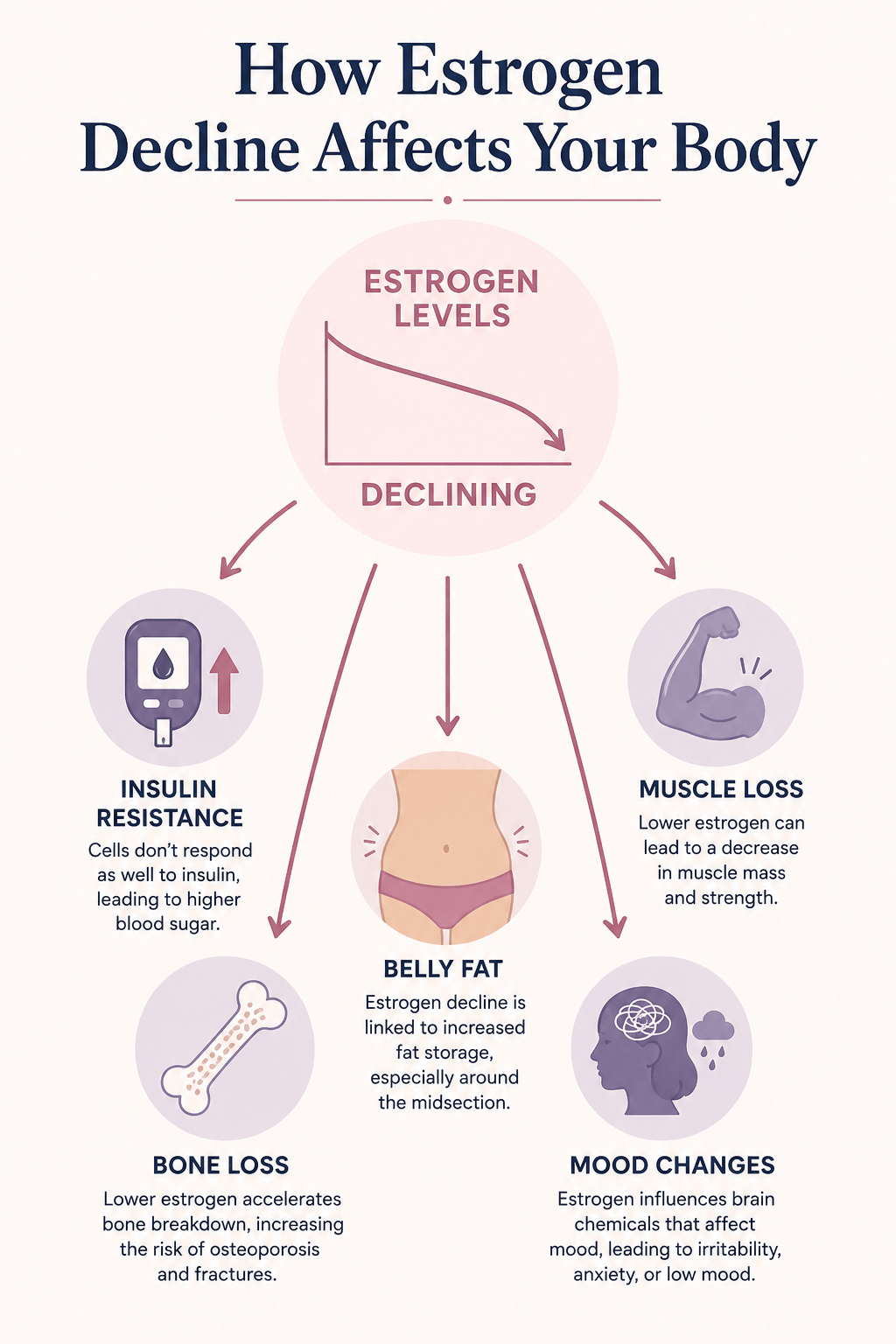
What “The House of Rose” Really Means: The Story Behind THOR Retreats & the Philosophy of Self-Love in Midlife

People often ask me what The House of Rose means. Why a rose? Why a house? The simplest answer is that the rose has represented love across cultures for thousands of years, while the house represents the body. Together, they express the idea of living in your own body with care, attention, and love.

That philosophy matters deeply in midlife, when many women realize how long they have placed work, family, responsibility, and other people ahead of their own well-being. At THOR, self-love is not treated as a slogan or an occasional act of indulgence. It is built through daily choices around nourishment, movement, rest, and reconnecting with the body.

I am Terry Tateossian, and I founded The House of Rose after twenty-five years of building businesses, raising two children, navigating early-onset menopause at forty-one, and experiencing an eighty-pound body transformation that changed how I understood midlife health.

This article shares the story behind the name, the history and symbolism of the rose, and how those ideas shape every part of the THOR retreat experience in the Smoky Mountains.

Why Has the Rose Symbolized Love for Thousands of Years?

Wild roses are ancient. The fossil record places the rose family at somewhere between 35 and 70 million years old, with native species spread across the temperate northern hemisphere, from the wild prairies of the American Midwest to the foothills of the Caucasus and the mountains of western China.

By the time human civilizations began cultivating flowers for beauty and ritual, the rose was already there waiting.

Why the Rose Became the Flower of Love: A 5,000-Year History

From Ancient Sumer to the Roman World

The rose’s association with love, beauty, and ritual developed across several ancient civilizations. As roses moved between regions, each culture added another layer of meaning to the flower.

  • Ancient Sumer: The earliest written evidence of rose cultivation comes from Sumer in Mesopotamia and dates to roughly 2200 B.C.
  • Persian Empire: Vast fields of Damask roses stretched across what is now Iran. They produced rose water and rose oil that became central to Persian cuisine, perfumery, and ritual.
  • Islamic Tradition: The Damask rose became associated with the Prophet Muhammad, while its scent was understood as both a blessing and a preview of paradise.
  • The Silk Road: Damask roses moved west along ancient trade routes, crossed with European varieties, and helped shape what the modern world recognizes as a rose.
  • Ancient Greece and Rome: The Greeks and Romans connected the rose to Aphrodite and Venus, the goddesses of love, beauty, fertility, and desire. Roman banquets during the blooming season sometimes ended with cascades of rose petals, while wealthy Romans spent fortunes on rose water and perfume.

The Latin phrase sub rosa, meaning “under the rose,” also came from this period. A rose was hung above private meetings to show that everything spoken beneath it was confidential. According to mythology, Cupid gave a rose to the god of silence to protect his mother Venus’s secrets. The flower therefore became a symbol of love, intimacy, trust, and discretion.

From Spiritual Love to Royal Power

As the rose moved into Christian Europe and medieval England, its symbolism expanded beyond romantic love. It became associated with spiritual devotion, purity, political identity, and royal power.

  • Christian Devotion: When Christianity became the state religion of Rome in the fourth century, the rose took on a more spiritual meaning. Ambrose of Milan wrote that roses originally grew without thorns in the Garden of Eden and that the thorns appeared only after the fall.
  • The Rose Without Thorns: Mary was described as the “rose without thorns,” representing purity and spiritual love.
  • The Rosary and Rose Windows: By the twelfth century, the rose had become a central Christian symbol of devotion. The rosary took its name from the Latin word for a garland of roses, while European cathedrals began featuring rose windows that filtered light into prisms of color above the altar.
  • The Wars of the Roses: In medieval England, the white rose represented the House of York, while the red rose represented the House of Lancaster.
  • The Tudor Rose: Henry VII combined the two flowers into the Tudor rose after the conflict ended. It remains one of England’s most recognizable national emblems.

How the Rose Became a Language of Emotion

In Victorian England, the rose became a form of coded communication. Floriography, or the language of flowers, allowed women to express emotions they were not always permitted to speak aloud.

Different rose colors carried distinct meanings:

  • Red Rose: Passionate or romantic love.
  • Pink Rose: Admiration, affection, and appreciation.
  • Yellow Rose: Friendship and warmth.
  • White Rose: Innocence, purity, and secrecy.
  • Dark Crimson Rose: Mourning and deep sorrow.

In 1986, Ronald Reagan signed a proclamation making the rose the national floral emblem of the United States. By then, the rose had traveled through Sumer, Persia, China, Greece, Rome, Christian Europe, Tudor England, Victorian sitting rooms, and the American garden.

Across each of these cultures and thousands of years, the rose carried some version of the same meaning: love, devotion, beauty, and the sacredness of the living body.

No other flower has maintained such a continuous symbolic record. The rose is the flower human beings have always returned to.

Free 28-Day Fascia Reset Email Course

Get our Free 28-day email course series to help with 1 or 2 exercises per day to release your fascia. One short lesson per day. Two minutes to read each.
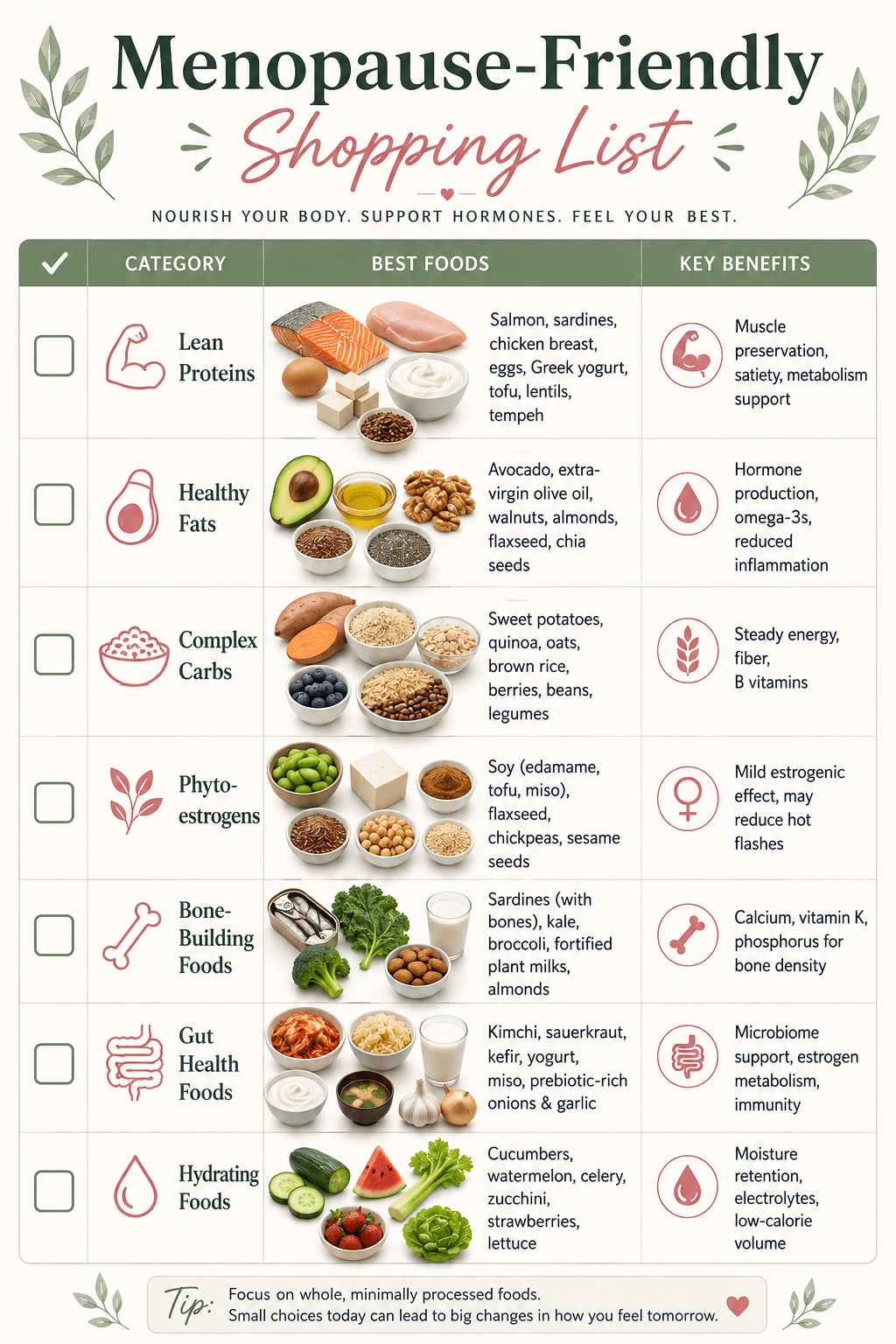
Why Is the Rose Associated With High Vibrational Energy?

The rose has long been associated with elevated energy, emotional healing, and love. This idea appears most clearly in energy medicine and aromatherapy traditions, but it also connects with the documented effects of rose scent on the body and nervous system.

What Does Rose Frequency Mean in Energy Medicine?

In the vibrational frequency framework associated with Bruce Tainio’s measurements of essential oils and David Hawkins’s work on consciousness, the rose is described as carrying one of the highest measured vibrations of any flower.

Rose essential oil is often cited within this tradition at around 320 MHz on the Tainio scale. This places it above other widely revered plant essences, including sandalwood, lavender, and frankincense.

I am careful with how I present this idea because vibrational frequency in this framework is not the same kind of measurement as a peer-reviewed biochemical assay. It comes from bioenergetics and aromatherapy practice rather than mainstream chemistry.

What can be said without qualification is that women across cultures have used rose oil, rose water, and rose petals for thousands of years in rituals connected to:

  • Love and Devotion: Roses have been used to express romantic, spiritual, and personal love.
  • Grief and Transition: Rose rituals have often marked loss, change, and important life passages.
  • Healing and Self-Care: Rose oil and rose water have been used in bathing, skin care, massage, and restorative practices.
  • Beauty and Ceremony: Roses have played a central role in celebrations, sacred rituals, and personal adornment.

What Does the Research Say About Rose Scent?

The biochemistry behind the scent is real. Rose absolute contains more than 300 known aromatic compounds that interact with the limbic system through the olfactory nerve.

Some of its best-known compounds include:

  • Citronellol: One of the primary compounds responsible for the rose’s fresh floral scent.
  • Geraniol: A fragrant compound also found in other aromatic plants.
  • Phenylethyl Alcohol: A major contributor to the soft, recognizable scent of fresh roses.

Research on rose aromatherapy has documented effects on cortisol, blood pressure, anxiety, and mood. The scent creates a measurable response in the body, even when the explanation is framed through conventional biology rather than energy medicine.

When I chose the rose as the symbol of the house I was building, I chose a flower that humans have recognized as a concentrated symbol of love and self-care for at least five millennia. The energy medicine framework gives that intuition one language, while aromatherapy research gives it another.

Whether you call it frequency, chemistry, or a combination of both, the rose was the right choice.

What Is the Hidden Meaning Behind “The House of Rose”?

Perimenopause & Menopause Yoga Retreats Near Nashville & Knoxville: An Insider’s Comparison

The other half of the name is the part most people do not catch at first. The house is the body.

This idea appears across older spiritual and philosophical traditions, where the body is often described as a dwelling, vessel, temple, or home for the inner life.

Why Is the Body Described as a House?

Different traditions use different language, but the central idea remains similar:

  • Sanskrit Tradition: The word sharira refers to the physical body and comes from a root meaning “that which decays.” It also suggests a structure that holds something within it.
  • Christian Mysticism: The body is described as “the temple of the Holy Spirit.”
  • Greek Thought: The soma, or body, is understood as the vessel of the psyche.
  • Yogic Tradition: The body is described through the koshas, or sheaths, that hold the deeper layers of being.

Across these traditions, the body is understood as the place where the inner life is carried and experienced.

What Happens When the House Meets the Rose?

When you put the house together with the rose, you get a sentence: the body is where love lives.

The body is where love is felt, practiced, given, and received. It is also where love can be neglected and where it can be restored. To care for the body is to care for the place where your love lives.

To inhabit your body with attention is to live inside a house you have furnished, cleaned, and made beautiful for yourself.

That is what THOR, The House of Rose, means.

This framing is more than a poetic idea for me. It describes the work I do every day at the property and the work I ask every woman who comes through to do for herself. Self-love, in this sense, is the practice of caring for the place where you live rather than waiting for a feeling or affirmation to create change on its own.

What Does Self-Love Look Like as a Daily Practice?

The reason I had to invent this particular language for the work is that the phrase “self-love” had become almost meaningless by the time I needed it most. In the wellness industry it has been reduced to bubble baths, candle ads, and motivational quotes printed over sunset photos.

None of that was what I needed when I was in early-onset menopause, gaining weight no matter what I did, sleeping four hours a night, raising two children, running a global creative agency, and slowly losing the thread of who I was.

What I needed was a definition of self-love that was concrete enough to do something with. So I wrote one for myself, and then I built a retreat around it.

Self-love as I teach it has four daily expressions, and each one is something you can measure rather than only feel.

Free 28-Day Fascia Reset Email Course

Get our Free 28-day email course series to help with 1 or 2 exercises per day to release your fascia. One short lesson per day. Two minutes to read each.
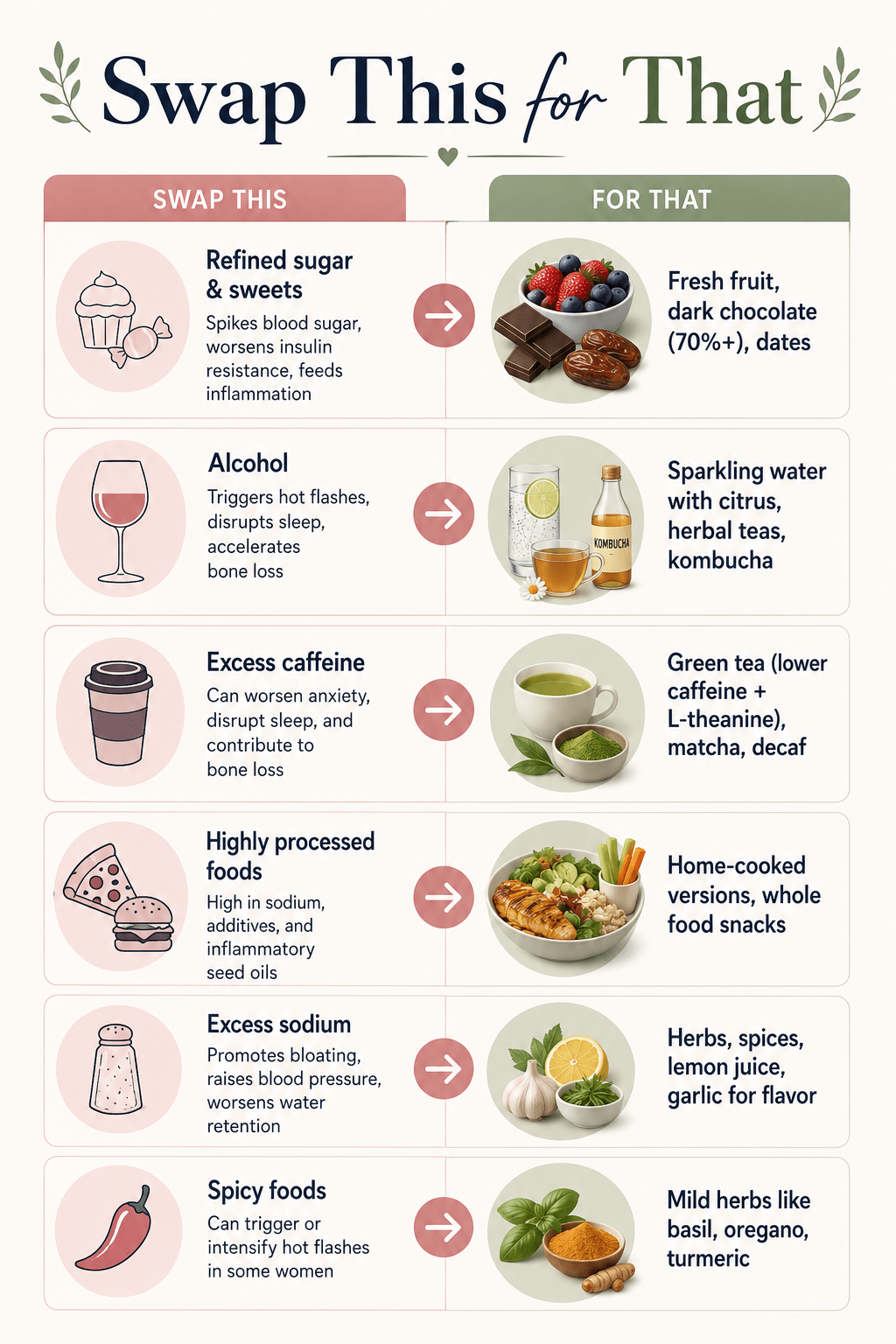
Nourishing Your Body With Real Food

The body that has been under-eating, over-caffeinating, and grabbing the nearest snack between meetings cannot receive love through an affirmation. It needs protein, fiber, minerals, electrolytes, and the kind of food that an actual human body has metabolized for the last 200,000 years.

The free Macro Calculator on our site is the first piece of work I ask every guest to do, often before they even arrive, because the math of nourishment is where self-love starts being measurable. The Macro Miracle Mediterranean Cookbook is the practical follow-on, with eighty recipes that give the calculator a place to live in your week.

Choosing Movement That Builds Your Body

Movement that the body actually wants, rather than punishment, performance, or the kind of training that elevates cortisol in a woman who is already at her limit. Strength work, walking, yoga, and rebounding all belong in the rotation, and the consistent thread is movement that builds the body rather than wearing it down.

In midlife, that distinction is the difference between a body that becomes stronger every year and one that breaks down faster.

How to Choose a Women's Yoga and Wellness Retreat in Midlife - Step by Step Guide
How to Choose a Women’s Yoga and Wellness Retreat in Midlife – Step by Step Guide

Allowing Your Body to Rest Without Guilt

The third is rest that the body needs without earning it first. Most of the women who come to me have been raised on the idea that rest has to be earned through productivity. The body does not work that way. The body needs rest the way it needs water and food, as a precondition for being alive, not as a reward for being useful.

Learning to rest without guilt is one of the hardest pieces of midlife work, and it is one of the things a properly built retreat actually teaches.

Practicing How to Be Present in Your Body

The fourth is the deliberate practice of being in your body rather than escaping it. Most of modern life is built to pull us out of the body. Screens, alcohol, sugar, scrolling, the endless to-do list. To practice self-love in the way the rose tradition points at, a woman has to come back into her body deliberately, regularly, and for long enough to actually feel it.

Yoga is one path. Breathwork is one path. Fascia work and lymphatic practice are paths. Forest bathing, cold water, massage, slow walking, and time in nature are all paths. None of them require belief. They require minutes, daily, accumulated over time.

That is the daily practice. The rose is the symbol that holds it together because the rose, across every culture, has always carried a kind of love that is intimate and embodied rather than abstract or theoretical: love that is felt in the body, smelled in the air, and held in the hand.

How Do Women’s Wellness Retreats Carry the Rose Tradition?

There is a reason wellness retreats keep finding their way to women in midlife. The retreat as a form is a modern echo of something much older: the practice of stepping away from ordinary life to reset the body, the breath, and the inner self.

The pattern is older than any one religion or culture. A person reaches a threshold that everyday life cannot carry them across, so they step away to do that work somewhere designed for it.

How Do Retreats Continue an Ancient Practice?

Different traditions have used different names for this act of stepping away:

  • Christian Monasticism: Retreat was a period of withdrawal for rest, reflection, and spiritual renewal.
  • Yogic Traditions: Sadhana and tapas described focused practices intended to create discipline, transformation, and deeper awareness.
  • Sufi Practice: Khalwa referred to spiritual seclusion and time away from everyday distractions.
  • Indigenous Traditions: Vision quests created space for reflection, transition, guidance, and personal transformation.

The language changes, but the pattern remains the same. A person leaves the ordinary structure of life for a period of time so the body and inner life can move through an important transition.

Midlife PilatesWhy Does This Matter During Midlife?

For women in perimenopause and menopause, that threshold is a real biological event rather than a spiritual abstraction. The hormonal shift of midlife can reorder the nervous system, metabolism, sleep architecture, emotional baseline, and sense of self in a way that few other life passages can match.

Trying to move through that change entirely inside the same daily structure that brought you to the threshold is like asking the body to renovate itself while still living in the construction zone.

A retreat creates a temporary structure for that work. It concentrates the same practices that self-love asks for at home into five focused days:

  • Nourishment: Eating food that supports the body rather than simply getting through the day.
  • Supportive Movement: Choosing movement that strengthens and restores the body without punishing it.
  • Rest Without Guilt: Giving the nervous system enough time and space to slow down.
  • Embodied Presence: Deliberately returning attention to the body instead of constantly escaping or overriding it.

These practices take place in an environment built around them, with a knowledgeable team and a small group of women moving through the same season of life.

How Do Yoga and Wellness Practices Carry the Tradition?

Yoga is one of the older threads running through the modern women’s wellness retreat. The Sanskrit word yoga comes from a root meaning to yoke, join, or bring together. The original yogic project was the reunification of the inner life with the body it inhabits.

For a woman who has been pulled out of her body by years of stress, screens, caretaking, and ambition, yoga becomes a daily ceremony of coming back home to the house.

The slower the practice, the more space it creates for this return. Yin and restorative yoga hold poses for several minutes, allowing the fascia, breath, and nervous system to recalibrate gradually. These forms are particularly suited to the midlife body. Hot vinyasa and power yoga can be valuable at the right stage, but they are not always the best entry point for a midlife reset.

The surrounding wellness practices are where the rose tradition becomes even more visible:

  • Food and Nourishment: Care for the body through meals built around restoration.
  • Spa and Bodywork: Hands-on practices that help the body soften and receive care.
  • Fascia and Lymphatic Support: Techniques that encourage mobility, fluid movement, and physical release.
  • Cold Water and Nature: Sensory practices that bring attention back into the body and the present moment.
  • Small-Group Community: A supportive space where women can be seen without having to perform.
  • Integration Support: Guidance that helps the retreat practices continue after the woman returns home.

Each element reflects the older traditions of rose oil, rose water, rose ritual, and rose ceremony. The modern wellness retreat is the rose tradition translated for a contemporary body.

Free 28-Day Fascia Reset Email Course

Get our Free 28-day email course series to help with 1 or 2 exercises per day to release your fascia. One short lesson per day. Two minutes to read each.
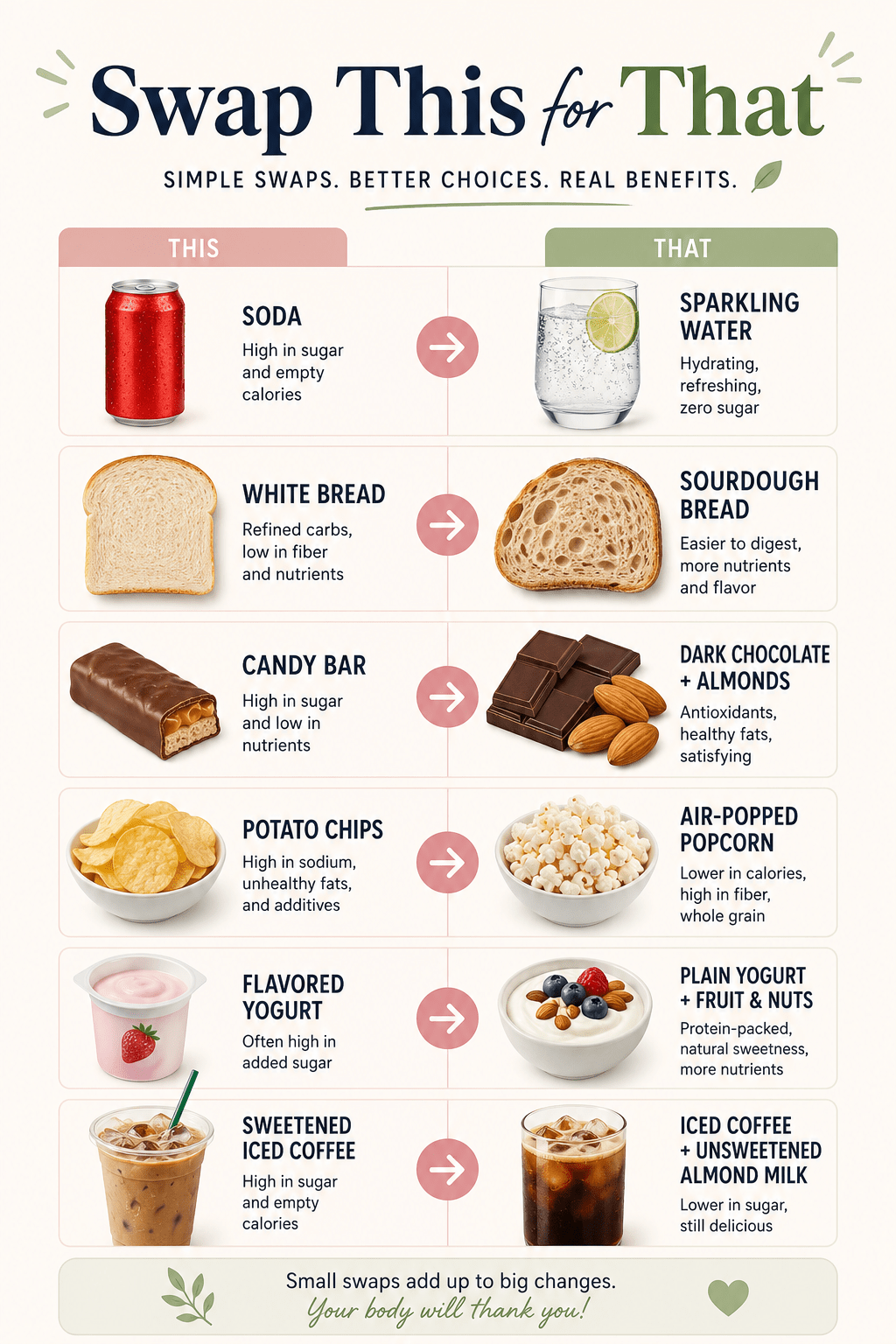
Which 5 Self-Love Practices Shape the THOR Experience?

When I bought the property in the Smoky Mountains, I sat with the question of what a retreat would have to do to actually deliver on the promise of self-love, not just market it. I wrote down five practices, and we built every aspect of the property and the program around them.

Slow Arrival

The day a guest arrives, we move slowly. The transport from the Knoxville airport is unhurried. The check-in is gentle. The first meal is built around protein, fiber, and warmth. The first yoga session is restorative. The first night is intentionally early. The body needs forty-eight hours to recognize that it is somewhere different from home, and we honor that.

Real Nourishment

Every meal at THOR is built for a midlife body, with thirty to forty grams of protein, a real vegetable and fiber base, and the kinds of slow carbohydrates and healthy fats that support hormonal recovery. We do not run juice cleanses. We do not run intermittent fasting protocols. We do not serve smoothie bowls as the main meal.

The kitchen is one of the hardest parts of the operation, and one of the most important. The foundational supplement stack is integrated where it belongs, alongside the meals.

Body Work That Changes the Tissue

Fascia release, lymphatic brushing, massage, infrared sauna, red light therapy, and cold water exposure are all on offer through the week, integrated rather than billed as luxury upsells. The biology behind these practices is real.

Fascia work changes the connective tissue. Lymphatic drainage moves fluid that has been stagnant for years in many midlife women. Cold water shifts vagal tone in minutes. Infrared and red light have published research support for inflammation, sleep, and mitochondrial function.

Community Without Performance

Twelve women per retreat is the cap and we hold it. The reason is that anything larger turns into an audience, and the practice we are doing together cannot happen in front of an audience. It can only happen in a small enough room that everyone can see each other, hear each other, and (within forty-eight hours) trust each other.

The community that forms inside a small retreat is one of the most underrated aspects of the entire experience, and one of the reasons women come back.

The Practice of Integration

The retreat is not finished when the guest goes home. The work for us begins on day six. We send guests home with a daily practice they can keep, the Macro Calculator foundation, access to follow-up coaching, and the option of joining the Monthly Personal Training and Nutrition Coaching Program or the sixteen-week Age With Strength program for women who want sustained 1:1 support after the retreat ends.

The integration window is roughly four weeks, and it determines whether the changes a woman makes at the property take root in the rest of her life.

These five practices are what The House of Rose is in operation. The rose is the symbol that holds them together. The house is the body that benefits from them.

What Does “Coming Home to Your Body” Mean in Midlife?

The phrase “coming home to your body” has been used so loosely in the wellness industry that it has lost much of its meaning. I want to give it back some specificity because it is one of the actual aims of every retreat we run.

For a woman in midlife, coming home to the body is rarely one dramatic transformation. It usually looks like a series of small reclamations that build over weeks and months.

What Do These Small Reclamations Look Like?

The changes often appear in ordinary moments that are easy to overlook:

  • The First Restful Night: You sleep through without waking at three in the morning with your heart racing.
  • The First Clear Morning: The puffiness around your eyes is gone because you ate enough protein and drank enough water the day before.
  • The First Week of Easier Movement: Your joints feel looser because your fascia has received real attention.
  • The First Unhurried Workday: You stop white-knuckling your way through the day and remember that you can take a real lunch break.
  • The First Season of Feeling Like Yourself: You stop dreading getting dressed because your body begins to feel like it belongs to you again.

None of these changes are dramatic. They do not photograph particularly well, and they are not as easy to market as a before-and-after weight loss number.

But they are the real experience of self-love showing up in the body.

How Does the Practice Take Root?

The rose tradition has always understood that love is felt in the body through small, repeated acts. It appears in the way you nourish yourself, rest, move, breathe, and pay attention to what your body needs each day.

The wellness industry often overlooks these acts because they are not as visually striking as a dramatic transformation story. Yet these quieter changes are what make self-love sustainable.

The retreat is where these small acts are practiced in a concentrated way, every day for five days, within an environment that supports them. The home practice is where they continue. Integration support is where they begin to take root.

Over time, the rose tradition starts to feel less like an idea and more like the way the body actually lives.

Free 28-Day Fascia Reset Email Course

Get our Free 28-day email course series to help with 1 or 2 exercises per day to release your fascia. One short lesson per day. Two minutes to read each.
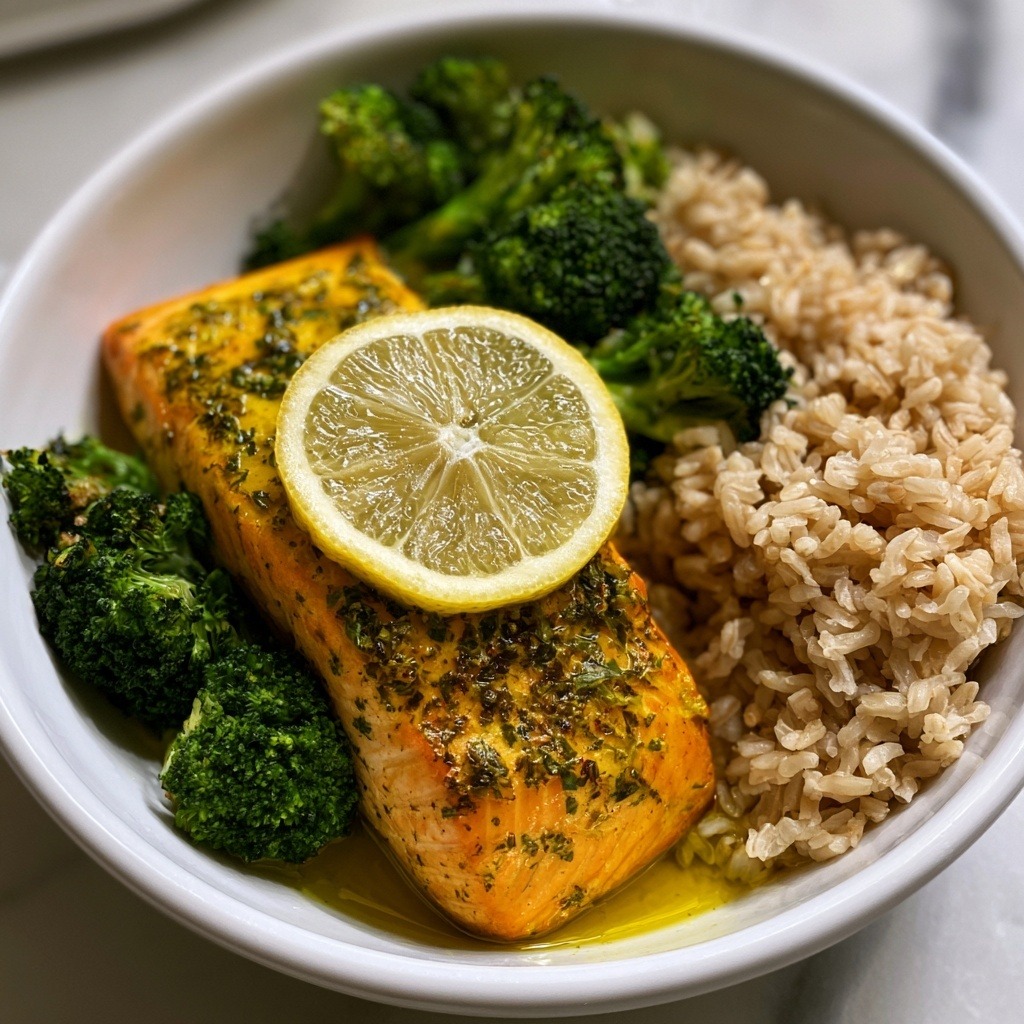
Why Is THOR Located in the Smoky Mountains?

I am often asked why I chose the Smoky Mountains specifically. The short answer is that the geography itself supports much of the work the program is designed to do.

The setting creates conditions for rest, nervous system regulation, movement, and reconnection with nature before a guest even begins the daily retreat practices.

How Does the Natural Environment Support the Retreat?

The Smoky Mountains are among the oldest mountain ranges in North America and contain one of the densest forest canopies in the world. The Cherokee called this region the place of the blue smoke, referring to the mist that rises from the trees in the morning.

Research on spending time in dense forests, often called shinrin-yoku or forest bathing, has documented benefits for cortisol, sleep, immune function, and parasympathetic nervous system activity. For a woman whose nervous system has been stuck in sympathetic gear for years, the setting becomes part of the restorative process.

Several features of the region support the retreat experience:

  • Dense Forest: Time beneath the tree canopy creates space for slower movement, quiet reflection, and nervous system regulation.
  • Moderate Elevation: The property sits at an elevation that supports the mountain experience without the discomfort associated with high altitude.
  • Fresh Air: The deep mountain environment provides a noticeable contrast to the traffic, screens, and indoor spaces that shape everyday life.
  • Cold Water: The naturally cold water supports sensory practices that bring attention back into the body.
  • Distinct Seasons: Late spring and early fall provide particularly comfortable conditions for outdoor movement, nature walks, and restorative practices.

The geography does not replace the program. It strengthens it by creating an environment where the body can begin slowing down naturally.

Why Did Accessibility Matter?

I could have built the property in California or Sedona. Both locations might have appeared more glamorous, but they also would have made the retreat significantly more expensive for guests.

I chose East Tennessee because the geography fit the work and because I wanted the price point to remain reachable for women who genuinely needed the program, not only those who could afford a luxury spa weekend.

The rose tradition has always been democratic in its own way:

  • Persian Rose Fields: Roses were grown in open fields and used by ordinary people, not only the wealthy.
  • Roman Rose Festivals: Rose celebrations were public events shared across the community.
  • Victorian Floriography: The language of flowers became a code used by women across social classes.

The house I built needed to reflect that same principle. It had to be accessible to women who needed a place to restore themselves, not only to women who could pay a premium for the same idea wrapped in a more exclusive aesthetic.

What Is the Deeper Vision Behind The House of Rose?

The deeper mission of THOR is to teach women, in a way the modern world has stopped doing, to inhabit their own bodies with love.

Most women I work with are between forty and sixty-five. They have spent decades caring for other people and holding together nearly every part of their families, careers, and communities.

What Does It Mean to Be Cared For?

By the time many women arrive at the retreat, they have already spent years:

  • Raising Children: Putting their children’s needs, routines, and well-being ahead of their own.
  • Building Careers: Managing responsibilities, deadlines, businesses, and teams.
  • Supporting Loved Ones: Caring for partners, aging parents, relatives, and friends.
  • Holding Communities Together: Becoming the person everyone relies on for support, organization, and stability.

They are often genuinely surprised when someone asks them: What do you actually need? When was the last time you were the priority? What does your body specifically want this week?

The vision of THOR is that every woman who walks onto the property finds an environment that has anticipated her, prepared for her, and built itself around her well-being for five days.

The whole point of being at THOR is that someone has finally been thinking about you carefully and placing that care into:

  • Every Meal: Food designed to nourish and support the midlife body.
  • Every Session: Movement and practices selected with her needs in mind.
  • Every Treatment: Bodywork that creates space for physical and emotional restoration.
  • Every Quiet Hour: Time to rest without having to earn it or explain it.

The week is meant to recalibrate a woman’s expectations of what it feels like to be cared for. When she returns home, she has a working model for how to offer that same care to herself.

That recalibration is what self-love actually requires. You cannot love yourself well if you do not have a felt sense of what well looks like. The retreat is where that felt sense is built. Daily practice is what keeps it alive afterward.

How Does the Host Retreat Path Extend the Mission?

The host side of the mission is the other half of the work, and one I want to mention briefly.

Some women who come through our retreats discover that they want to create this kind of experience for their own communities, in their own way. We work with them to build their retreats, sometimes on our property, sometimes elsewhere, and sometimes with our team working alongside them.

The host retreat path is one of the deepest expressions of the rose tradition. It teaches a woman not only to love and care for her own body, but also to build the kind of sanctuary that helps other women come home to theirs.

If that is calling to you, we can talk.

Free 28-Day Fascia Reset Email Course

Get our Free 28-day email course series to help with 1 or 2 exercises per day to release your fascia. One short lesson per day. Two minutes to read each.
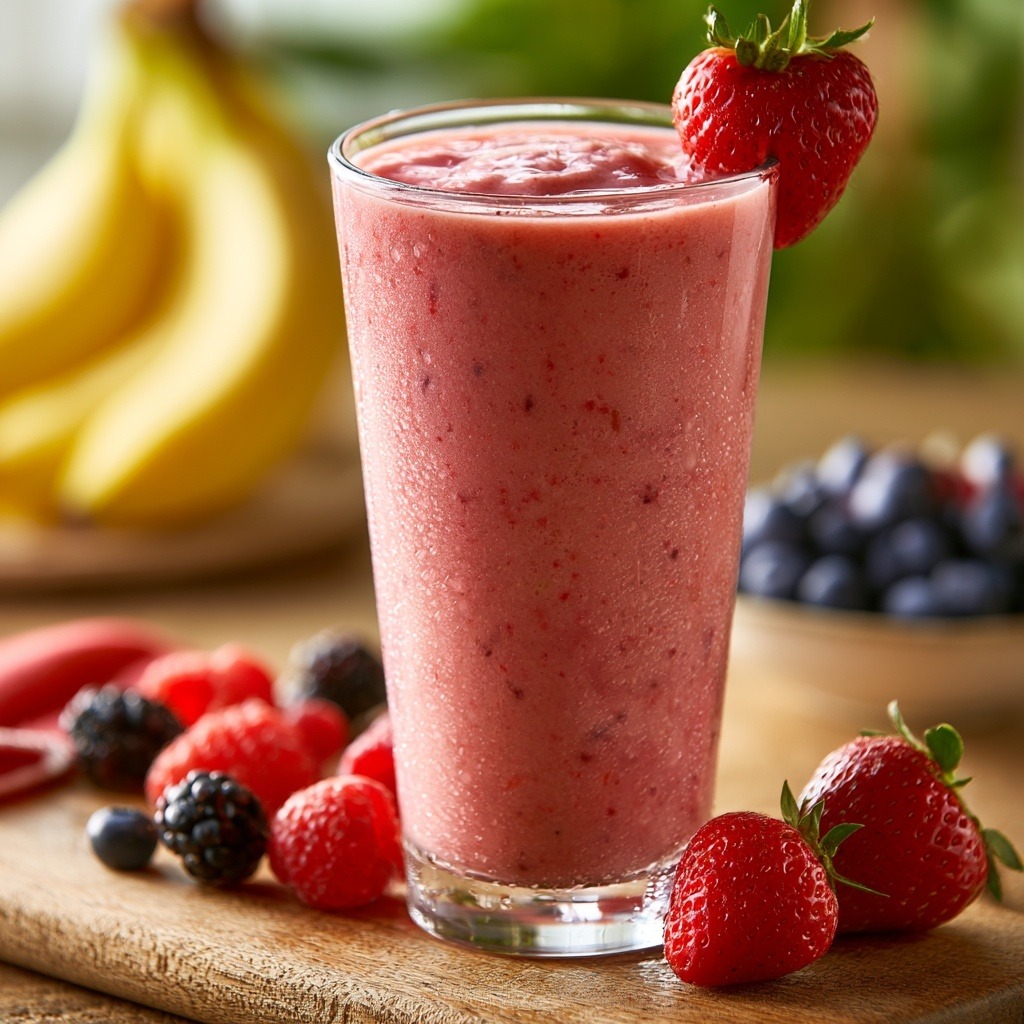
How Can You Begin Your Journey With THOR?

If you have read this far, the rose tradition is already speaking to something in you. The next step is yours to make, and the right one depends on where you are in your own journey.

THOR offers several ways to begin, from simple nutrition tools you can use at home to a complete retreat experience in the Smoky Mountains.

Which Starting Point Is Right for You?

You do not need to change everything at once. Begin with the level of support that fits your current needs:

  1. Start With Nutrition: The free Macro Calculator is the first resource I would put in your hands. It provides the foundation for the nutrition work and is one of the easiest places to begin.
  2. Bring the Plan Into Your Kitchen: The Macro Miracle Mediterranean Cookbook gives the calculator a practical place to live through meals you can prepare as part of your regular week.
  3. Add Another Layer of Support: The supplement collection supports women who are ready to build on their existing nutrition and wellness practices.
  4. Work With Our Team: The Monthly Coaching Program provides 1:1 support for women who want guidance between retreats or prefer a longer-term option instead of attending one.

Each path begins with the same goal: helping you understand what your body needs and giving you practical ways to respond.

What Does the Full THOR Reset Include?

For women ready for a more immersive reset, the Deeply Restorative Yoga and Nature Retreat in the Smoky Mountains is the experience described throughout this article.

The retreat includes:

  • Five Days and Four Nights: Enough time for the body to slow down and begin adjusting to a different rhythm.
  • A Small Group: Each retreat is limited to a maximum of twelve women.
  • Food and Nourishment: Meals designed to support the needs of the midlife body.
  • Restorative Bodywork: Spa treatments, fascia work, and lymphatic protocols are built into the experience.
  • Movement and Strength: Practices that help women reconnect with and support their bodies.
  • Integration Support: Guidance that helps the retreat practices continue after returning home.
  • Airport Transportation: Transport from Knoxville is included to make arrival and departure easier.

Everything is designed to work together, creating a temporary structure in which nourishment, movement, rest, and embodied presence can become daily practices rather than ideas.

How Can You Carry the Work Into Your Community?

For women who feel called to create this kind of experience for others, the host retreat path is open. We can explore what it might look like to build the work in your own community, whether that happens at our property, somewhere else, or with support from our team.

Whatever your next step may be, the philosophy beneath the work remains the same. The body is the house, the rose is the love, and the practice is the daily work of inhabiting one with the other.

The retreat provides a temporary structure that makes those daily practices easier to learn. The wider mission is to give every woman who arrives at THOR a felt sense of what it means to be carefully supported and cared for, so she can eventually offer that same quality of care to herself.

That is what The House of Rose means, and it is what I built THOR to be from the beginning.

Frequently Asked Questions

What does THOR stand for?

THOR is the acronym for The House of Rose. The full name is the way we usually refer to the brand, and the acronym is the shorthand used in conversation, on the property, and across the program names.

Why a rose?

The rose has been the symbol of love across nearly every human culture for at least 5,000 years, from Sumerian temple offerings to Persian rose water to Greek and Roman devotion to Aphrodite and Venus, through the Christian transformation to the Virgin Mary, the Tudor rose of England, the Victorian language of flowers, and the modern American national flower.

No other plant has carried a continuous symbolic record of love over that span of time. Choosing the rose tied the brand to the deepest and longest lineage of love symbolism that human beings have produced.

What does “the house” refer to in the name?

The house is the body. In nearly every wisdom tradition I have studied (yogic, Christian, Greek, Sufi, Indigenous), the body is described as a dwelling, a vessel, or a temple. Putting the house together with the rose gives a phrase that translates as “the body as the place where love lives.” Self-love, in other words.

Is the rose really the highest vibrational flower?

In the bioenergetic and aromatherapy framework popularized by Bruce Tainio and David Hawkins, rose essential oil is measured at one of the highest vibrational frequencies of any plant essence, typically cited around 320 MHz on the Tainio scale. That framework is rooted in energy medicine traditions rather than mainstream biochemistry.

What is verifiable through peer-reviewed research is that rose oil contains over 300 aromatic compounds and has measurable effects on cortisol, anxiety, and mood through olfactory pathways. Either lens supports the choice of the rose as a primary symbol of love.

What is the meaning of self-love at The House of Rose?

Self-love is taught as a concrete daily practice rather than a feeling or affirmation. It consists of four daily expressions: real nourishment, movement the body actually wants, rest taken without guilt, and the deliberate practice of being in the body rather than escaping it. Every aspect of the retreat program is built to make those four practices easier to do, and the integration support extends them into the months after a guest goes home.

How does a women’s wellness retreat fit into the rose tradition?

Across nearly every culture, the rose was used in rituals around love, healing, transition, and beauty, often in contexts of stepping away from ordinary life to do internal work. The modern wellness retreat is a contemporary form of the same impulse.

A retreat creates the temporary structure for the work, gives the body the conditions to reset, and builds a daily practice that the woman takes home with her. The yoga, the food, the spa work, the fascia release, and the small group are all modern translations of the older rose tradition.

Who is THOR built for?

THOR is built for women in perimenopause, menopause, and post-menopause who are ready to reset their relationship with their bodies. The youngest women who come are usually in their late thirties dealing with early hormonal shifts. The oldest are usually in their mid sixties. The common thread is a woman who has spent years caring for everyone else and is ready to be cared for, and to learn to care for herself, in a deeper way.

Free 28-Day Fascia Reset Email Course

Get our Free 28-day email course series to help with 1 or 2 exercises per day to release your fascia. One short lesson per day. Two minutes to read each.
Why is THOR in the Smoky Mountains specifically?

The Smoky Mountains have one of the densest forest canopies in the world, exceptional air quality, moderate elevation that supports sleep, cold mineral-rich water, and a climate that supports a full retreat season in spring and fall.

The published research on forest immersion (shinrin-yoku) shows real biological effects on cortisol, immune function, and the autonomic nervous system. The geography is doing some of the work the program is doing. The location also keeps the price point accessible compared to a California or Sedona equivalent.

How is the THOR retreat different from other yoga retreats?

The retreat is built specifically for midlife and menopausal bodies. Group size is capped at twelve women. Every meal is designed around thirty to forty grams of protein with hormonal recovery in mind. Restorative and yin yoga are the spine of the practice rather than hot vinyasa.

Fascia work, lymphatic brushing, massage, infrared sauna, and red light therapy are integrated into the program. The schedule has flexible afternoon sessions. The founder (me) is on the property, not flying in for a single session. The integration support extends six weeks after the retreat ends.

Is The House of Rose a religious or spiritual program?

THOR is not a religious or spiritual program in the formal sense. The name draws on the symbolic and historical traditions around the rose, but the program itself is grounded in evidence-based wellness practice. Nutrition, strength training, fascia work, breathwork, restorative yoga, and integrated body work are all rooted in research.

The philosophy is humanist and embodied rather than religious. Women of any faith background (or none) find the work resonant.

What does the mission of THOR include beyond the retreat?

The retreat is the most concentrated form of the work, but the full mission spans the free macro calculator (the entry point to the nutrition piece), the Macro Miracle Mediterranean Cookbook, the supplement collection, the 1:1 coaching programs, the guest retreat experience, and the host retreat partnership path for women who want to build similar work in their own communities. Every layer is built on the same philosophy.

Can I bring a friend, sister, or daughter to a THOR retreat?

Bringing a companion is welcome and common. Many women come with a partner, friend, sister, or adult daughter. The age range and life-stage range of the group is usually wide enough to accommodate this well. Both formats (alone and with a companion) work. A good retreat creates community within the first twenty-four hours regardless.

What if I am brand new to yoga or wellness retreats?

Most women who come to THOR are not seasoned yogis. The practice on the property is built to be accessible to beginners and to women returning to movement after a long break. The strength work, the breathwork, the fascia release, and the nutrition work do not require any prior experience. The retreat assumes you are starting where you are.

How do I know if THOR is the right retreat for me?

The clearest signal is whether the philosophy in this article resonates with what you are actually looking for. If “the body as the home where love lives” lands as the kind of frame you have been searching for (and if you are in midlife or close to it), THOR is probably the right fit.

If you are looking for a high-intensity fitness camp, a juice cleanse, a silent meditation retreat, or a luxury spa weekend, there are excellent options elsewhere that will serve you better. The best next step is to schedule a call with our team or read through our retreat overview pages to see whether the program matches what your body is asking for.

References

  • Morley, S. (2024). By Any Other Name: A Cultural History of the Rose. Oneworld Publications.
  • Roos, D. (2026, May 29). The secret history of roses. History.com. https://www.history.com/
  • Reagan, R. (1986). Proclamation 5574: Designation of the Rose as the National Floral Emblem of the United States of America. The Ronald Reagan Presidential Library. https://www.reaganlibrary.gov/archives/speech/proclamation-5574-designation-rose-national-floral-emblem-united-states-america
  • Antonelli, M., Donelli, D., & Barbieri, G. (2019). Effects of forest bathing (shinrin-yoku) on levels of cortisol as a stress biomarker: a systematic review and meta-analysis. International Journal of Biometeorology, 63(8), 1117–1134.
  • Park, B. J., Tsunetsugu, Y., Kasetani, T., Kagawa, T., & Miyazaki, Y. (2010). The physiological effects of shinrin-yoku (taking in the forest atmosphere or forest bathing): evidence from field experiments in 24 forests across Japan. Environmental Health and Preventive Medicine, 15(1), 18–26.
  • Li, Q. (2010). Effect of forest bathing trips on human immune function. Environmental Health and Preventive Medicine, 15(1), 9–17.
  • Hongratanaworakit, T. (2009). Relaxing effect of rose oil on humans. Natural Product Communications, 4(2), 291–296.
  • Igarashi, M., Song, C., Ikei, H., & Miyazaki, Y. (2014). Effect of olfactory stimulation by fresh rose flowers on autonomic nervous activity. Journal of Alternative and Complementary Medicine, 20(9), 727–731.
  • Mahboubi, M. (2016). Rosa damascena as holy ancient herb with novel applications. Journal of Traditional and Complementary Medicine, 6(1), 10–16.
  • Boskabady, M. H., Shafei, M. N., Saberi, Z., & Amini, S. (2011). Pharmacological effects of Rosa damascena. Iranian Journal of Basic Medical Sciences, 14(4), 295–307.
  • Neff, K. D. (2003). Self-compassion: An alternative conceptualization of a healthy attitude toward oneself. Self and Identity, 2(2), 85–101.
  • Cramer, H., Lauche, R., Langhorst, J., & Dobos, G. (2018). Yoga for menopausal symptoms: a systematic review and meta-analysis. Maturitas, 109, 13–25.
  • Innes, K. E., Selfe, T. K., & Vishnu, A. (2010). Mind-body therapies for menopausal symptoms: a systematic review. Maturitas, 66(2), 135–149.
  • Hopper, S. I., Murray, S. L., Ferrara, L. R., & Singleton, J. K. (2019). Effectiveness of diaphragmatic breathing for reducing physiological and psychological stress in adults. JBI Database of Systematic Reviews and Implementation Reports, 17(9), 1855–1876.
  • Bauer, J., Biolo, G., Cederholm, T., et al. (2013). Evidence-based recommendations for optimal dietary protein intake in older people: a position paper from the PROT-AGE Study Group. Journal of the American Medical Directors Association, 14(8), 542–559.
  • Hawkins, D. R. (2002). Power vs. Force: The Hidden Determinants of Human Behavior. Hay House.
  • Tainio Technology. (Cited within bioenergetic and aromatherapy literature, frequencies of essential oils measured in MHz on the Tainio scale).
  • Ambrose of Milan. (4th century). De Institutione Virginis. Referenced in Duke University’s Stroll in the Garden archive on Christian rose symbolism. https://arts.duke.edu/stroll-in-the-garden/
  • Friends of Notre Dame de Paris. The rose windows of Notre-Dame Cathedral. https://www.friendsofnotredamedeparis.org/cathedral/artifacts/rose-windows/
  • de La Tour, C. (1819). Le Langage des Fleurs. (Original French publication; English translations available through Cornell University Library exhibits on floriography). https://exhibits.library.cornell.edu/written-in-petals/feature/le-langage-des-fleurs-charlotte-de-la-tour

Free 28-Day Fascia Reset Email Course

Get our Free 28-day email course series to help with 1 or 2 exercises per day to release your fascia. One short lesson per day. Two minutes to read each.
Menopause Yoga Retreats Near Knoxville and Nashville, Tennessee: How to Choose the Right One

If you have been searching for a menopause yoga retreat near Knoxville or Nashville and feeling overwhelmed by the options, I want to make this easier for you. I am Terry, the founder of The House of Rose, and I built our retreat property in the Smoky Mountains of East Tennessee specifically because I went through early-onset menopause, lost 80 pounds in midlife, and could not find a single retreat that actually understood what a hormonally shifting body needs. Most of them were either too intense, too generic, or marketed at women in their twenties with a soft “everyone welcome” disclaimer slapped on top.

Tennessee has quietly become one of the best retreat destinations in the country for women in perimenopause and menopause. The combination of geography, pace, and cost relative to California or Sedona makes it a strong option for midlife wellness. The catch is that not every yoga or wellness retreat near Knoxville or Nashville is built for a midlife body, and the wrong choice can leave you more depleted than when you arrived.

This is the guide I wish someone had handed me a decade ago. It covers what to look for, how to choose between the Knoxville gateway and the Nashville gateway, what the Smoky Mountain region offers that nowhere else in the South does, and also how to tell a real menopause-aware retreat from one that just changed its marketing copy.

I am writing this from inside the industry, not from the outside. So I am going to be specific.

I will also be honest about what THOR offers and where we sit in the Tennessee retreat landscape, because pretending I do not run a retreat would be insulting to your intelligence. 🙂

Why Tennessee Has Become a Top Destination for Menopause Yoga Retreats

Five years ago, if you typed “yoga retreat Tennessee” into a search bar, you got mostly Bible Belt women’s gatherings, a handful of yoga teacher trainings in Nashville, and maybe one or two spa weekends in the mountains. The state was not on the wellness map.

That has shifted, and it has shifted for specific reasons that matter if you are looking for the right menopause yoga retreat near Knoxville or Nashville.

The first reason is geography.

Tennessee sits at an elevation, climate, and biodiversity sweet spot that most of the country does not. The Smoky Mountains in the eastern part of the state are the oldest mountain range in North America, with one of the densest forest canopies in the world. Time in dense forest has been shown in published research to lower cortisol, drop heart rate, and shift autonomic balance toward the parasympathetic side. For a woman in perimenopause or menopause, where cortisol is often chronically high and the nervous system is stuck in fight-or-flight, that biological backdrop is doing half the work before you even unroll a mat.

The second reason is accessibility.

Tennessee is within a 90 minute flight of roughly 70% of the United States population. You can get to Knoxville (TYS) or Nashville (BNA) from most major cities without a connection, which matters when you are trying to do a 5 day reset and not lose a full day on each end to airports.

The third reason is cost.

A 5 night all-inclusive menopause yoga retreat in Tennessee typically runs about half of what an equivalent stay would cost in Sedona, Big Sur, or Tulum, with comparable or better food, slower service, and zero travel days lost to international logistics.

What Makes a Yoga Retreat Actually Menopause-Friendly

A lot of yoga retreats put the word “menopause” or “midlife” into their marketing without changing a single thing about their program. The schedule is still built for a 25 year old, the food is still salad-heavy with no real protein, the breathwork is still designed to stoke heat in a body that is already overheating, and the schedule has zero rest blocks. A program like that is a regular yoga retreat with a midlife filter on the website, and the difference matters once you arrive.

A real menopause-friendly yoga retreat near Knoxville or Nashville will do most or all of the following.

It will give you actual protein at every meal. Women in perimenopause and menopause need significantly more protein than the average woman, somewhere around 1.0 to 1.2 grams per pound of bodyweight per day, to preserve lean muscle as estrogen drops. If the retreat menu is a string of “plant-based bowls” with chickpeas and quinoa for protein, that is not going to support hormonal recovery. It might sound healthy, but it leaves most midlife women under-fueled and crashing by day three. (For a deeper read on this, check out protein for women over 40 and our free Macro Calculator are good places to start before you book any retreat.)

It will offer restorative and yin yoga alongside vinyasa rather than only vinyasa or hot yoga. Hot vinyasa on day one of a menopause yoga retreat tends to spike cortisol and can trigger night sweats by day two. A midlife-aware retreat front-loads the slow practices and brings in stronger work only after the nervous system has down-regulated.

It will build in nervous system reset modalities. Look for things like guided breathwork that emphasizes longer exhales, vagus nerve work, lymphatic practices, forest bathing, and cold exposure if the woman wants it. These modalities are how a midlife body actually shifts state, and they belong on the schedule rather than as luxury add-ons billed separately.

It will have flexible scheduling with optional sessions because menopause is unpredictable. You might wake up on day two with a hot flash that ran from 3 a.m. to 5 a.m. and need to sleep until 10. A well-built menopause yoga retreat designs the schedule around the possibility that you might need to skip a session and rest, while a retreat that demands attendance for every session is operating more like a yoga teacher training than a midlife reset.

It will pair the yoga with actual recovery work. Fascia release, lymphatic drainage, massage, infrared sauna, red light therapy, and sleep optimization belong in a midlife yoga retreat in a way that they do not need to be at a 28 year old’s bachelorette weekend. If the retreat does not include or offer these, it is missing a piece. THOR includes most of them, but the more important point is that you should not book any menopause yoga retreat in Tennessee that does not have at least three of these on offer.

It will have a maximum group size. A real midlife retreat will not put 30 women in a room with one teacher and call it intimate. Twelve is roughly the ceiling for any retreat where you actually get personal attention.

Knoxville vs Nashville: Which Tennessee Gateway Works Best for Your Retreat

The practical decision most women face is not whether to choose a Knoxville yoga retreat or a Nashville yoga retreat. The better question is what kind of post-menopause recovery you actually need, and which gateway city sets up that experience best.

Nashville (BNA) as your retreat gateway

Nashville is the bigger airport, with more direct flights from most US cities. If you are coming from the West Coast, Texas, or anywhere in the Midwest, Nashville is often easier and cheaper to fly into.

The trade-off is that retreats reachable from Nashville tend to be in Middle Tennessee, the rolling hill country and farmland west of the Cumberland Plateau. That region is beautiful, but it does not have the same forest density, elevation, or wilderness pull as the Smoky Mountain region in the east. You also do not get the same scientific nervous-system-reset effect because the canopy is lighter and the topography is gentler.

Nashville-based retreats are often a good fit for women who want a softer landing, who like a barn-style or working-farm setting, who want food-and-wine country adjacency, and who do not need the dramatic mountain environment. If your stress profile is “low-grade chronic” rather than “burnout crisis,” Middle Tennessee might be perfect.

The other consideration is that Nashville itself has a strong wellness scene, which means some women combine a Nashville-area retreat with a day or two in the city for shopping, music, food, or restorative spa work. Knoxville does not give you that, because the closest comparable downtown is Knoxville itself, which is smaller.

Knoxville (TYS) as your retreat gateway

Knoxville is smaller, but the airport is closer to the actual mountain retreats. From Knoxville you can be at most Smoky Mountain region retreats within 30 to 60 minutes, and the drive itself is part of the decompression because you are climbing into the forest the entire way.

This gateway is better suited for women who want what I would call a deep reset rather than a softer weekend recharge. The Smoky Mountains are not a gentle terrain. They are old, dense, and the forest absorbs you in a way that flatter geography does not. For a woman who is dealing with full-blown midlife burnout, perimenopause cortisol crisis, sleep loss, or what I call the “tired in ways sleep cannot fix” pattern, the Smoky Mountain region delivers something that Middle Tennessee cannot.

The flight options into Knoxville are fewer and sometimes more expensive on a per-flight basis, but you save money on the back end because you do not need a long ground transfer or a rental car. Most retreats in the Knoxville orbit include or sell airport transfers as an add-on. (At THOR, our airport transport line is one of our most-booked retreat add-ons. It is not a glamorous detail, but it is one of the things that makes the difference between a retreat that starts the moment you land and one that starts after a tense 2 hour drive in an unfamiliar rental car.)

The Smoky Mountains Advantage: Why Geography Matters for Hormonal Recovery

A few specific reasons the Smoky Mountain region deserves consideration if you are choosing a menopause yoga retreat near Knoxville.

The forest density of the Great Smoky Mountains is among the highest in the world. The published research on shinrin-yoku, which translates roughly to “forest bathing,” consistently shows reduced cortisol, reduced sympathetic nervous system activity, increased parasympathetic activity, and increased natural killer cell activity after time spent in dense forest. For a perimenopausal or menopausal woman whose nervous system is often stuck in the sympathetic gear and whose immune system is shifting with estrogen loss, that is meaningful.

The elevation in the Smoky Mountains is moderate, generally 1,500 to 4,000 feet for most retreat properties, which is the sweet spot for women in midlife. High enough to slightly boost red blood cell production and improve sleep quality, but not so high that you are dealing with altitude headaches or insomnia like you would in Sedona or Colorado retreats.

The air quality in the deep Smoky Mountain region is exceptional. Tennessee’s eastern mountains have some of the cleanest air in the eastern United States, and there is published research linking air quality to inflammation markers, sleep quality, and even hot flash frequency in perimenopausal women.

The water in the East Tennessee mountain region runs cold and mineral-rich. If your retreat includes any cold exposure work, hydrotherapy, or natural water immersion, that is part of the medicine. The vagal effect of cold water on the face and neck is well-documented and especially useful for women whose nervous systems are stuck in overdrive.

The seasonality matters too. The Smoky Mountains hit a particular sweet spot in late spring (April through mid-June) and early fall (mid-September through October) where the weather is mild, the bug pressure is low, the forest is at its most active, and the light shifts in ways that are subtly mood-elevating. These are the seasons I would most recommend for a menopause yoga retreat in Tennessee.

What to Look For in a Menopause Yoga Retreat Schedule

When you are reading a retreat schedule, you are reading the body’s request for the next five days. A good menopause yoga retreat schedule should have certain patterns. Look for these:

  1. A slow first day. Day one of a retreat should be arrival, gentle yoga, a nervous system reset session, a beautiful meal, and an early lights-out. A day one that opens with a sweaty 90 minute vinyasa signals the retreat is built for a different audience than midlife.
  2. Morning practices that emphasize breath and slow movement. Menopausal bodies do not need to be jolted out of sleep with cardio. A morning that opens with breathwork, fascia release, gentle mobility, and a slow-build yoga practice sets up a totally different chemistry than an early HIIT session.
  3. A real lunch with adequate protein. The lunch on a menopause yoga retreat is one of the truest tests. If lunch is a tiny salad with two ounces of chicken, you are looking at a retreat that has not actually thought about midlife metabolism. You want protein in the 30 to 40 gram range per meal, fiber from real vegetables, healthy fat, and a slow carbohydrate.
  4. Afternoon options instead of demands. A real menopause retreat will offer a 2 p.m. massage, a 3 p.m. fascia workshop, a 4 p.m. nature walk, and tell you to pick one (or none). A retreat that runs three back-to-back sessions in the afternoon is overstuffed.
  5. A dinner that supports sleep. Heavy, late dinners interfere with menopausal sleep almost every time. A well-thought-out retreat finishes dinner by 6:30 or 7 p.m., keeps it moderate in size, and includes the kind of magnesium-rich, tryptophan-supporting foods that help sleep onset.
  6. An evening wind-down that is not a “fun” group activity. Menopause retreats need real wind-down time, not an evening soundbath that lasts until 10 p.m. and leaves everyone wired. Yin yoga, restorative work, or a guided sleep protocol is the better fit.
  7. A built-in integration day. Day five of a retreat should not be packed. It should be the day where the group rests, reflects, and prepares for re-entry. The best retreats build that day in deliberately.

The Practices That Help in Perimenopause and Menopause 

Not every yoga or wellness practice is equally effective for the midlife body. The following are the ones with the strongest published evidence for women in perimenopause and menopause, and the ones I would most want to see on the schedule of any Tennessee retreat you are considering.

  1. Yin yoga and restorative yoga have published evidence supporting their effects on cortisol regulation, sleep quality, and symptom severity in perimenopausal women. These are the slow, ground-based practices that hold poses for 3 to 5 minutes at a time.
  2. Diaphragmatic breathing with extended exhales has been shown to shift the autonomic nervous system toward parasympathetic dominance within minutes. For hot flashes, sleep, and overall stress reactivity, this practice is one of the most underused tools in midlife wellness.
  3. Fascia work, including self-myofascial release with tools and structured stretching, has emerging research support for its role in lymphatic drainage and tissue mobility in midlife women. (Chck out our article on unlocking tight fascia and lymphatic flow.)
  4. Strength work, even at moderate loads, is now considered foundational for menopause health. Estrogen decline accelerates muscle and bone loss, and the research on resistance training in this population is unambiguous. A menopause retreat that includes some form of strength work, even if it is bodyweight-based, is doing more for your long-term health than one that is yoga-only.
  5. Cold exposure, including cold water face immersion and brief cold showers, has documented effects on vagal tone, mood, and inflammation. Even 60 seconds at the end of a warm shower has measurable benefits.
  6. Forest bathing has published research support specifically for stress hormone reduction, immune function, and mood. The Smoky Mountains are one of the most forest-bathing-ready environments in the country.
  7. Magnesium supplementation, particularly magnesium glycinate or threonate, has solid evidence for sleep quality, muscle relaxation, and mood support in midlife women. Most women in perimenopause are deficient.

What is generally not as helpful are things like juice cleanses, fasting protocols longer than 14 hours for most women in midlife, and intense ayahuasca or psychedelic retreats. Some of these are great for the right person in the right phase. But most are not appropriate as the foundation of a menopause retreat.

Red Flags: Yoga Retreats That Are Not Aligned for Menopausal Bodies

A short list of things that should make you think twice.

  1. A schedule with two hot vinyasa sessions per day is built for the wrong audience and will tax a menopausal body more than it restores one.
  2. A 7-day juice cleanse retreat marketed with promises of rapid change usually elevates cortisol exactly when a midlife body needs the opposite.
  3. A retreat that advertises “no phones, no contact with the outside world” as the main feature is the wrong fit for women with aging parents, teenagers, businesses to run, or perimenopause symptoms that might require a check-in with a doctor. Full isolation amplifies stress for most women in midlife rather than relieving it.
  4. A retreat with no posted schedule on the website. If a property will not show you what the days look like, the team is hiding something.
  5. A retreat where the founder or lead teacher is not visible on the website. If you cannot find a real, named human running it, the experience tends to reflect that.
  6. A retreat that lists “weight loss” as a primary goal. Sustainable weight loss for midlife women does not happen in 5 days, and any retreat that promises it is selling you a story.
  7. A retreat that does not specify maximum group size. Without a published cap, the program is usually being run as a revenue machine rather than a curated experience.
  8. A retreat with menus that look like 2010-era fitness influencer plates. Smoothie bowls, raw vegan dinners, and 200-calorie lunches will leave a menopausal body under-fueled by day three.

What to Pack for a Menopause Yoga Retreat in East Tennessee

This section is less about gear and more about not making the trip harder than it needs to be. The Smoky Mountains have a mountain climate, which means layers, weather shifts, and surprising humidity in summer and chill at night even in late spring.

  1. Bring layers in every season. A light long-sleeve, a sweatshirt or sweater, and a real warm layer all earn their place even in summer because mountain mornings drop into the 50s well into June.
  2. Bring real walking shoes rather than yoga slippers. The Smoky Mountain trails are uneven, sometimes muddy, and the elevation gain is significant even on the shorter trails.
  3. Build a sleep kit. Earplugs, an eye mask, your own pillowcase if you are picky, melatonin if you use it, and the magnesium you take at home all belong in the bag. Try not to rely on the retreat to have everything you need for night one.
  4. Bring a water bottle that holds at least 32 ounces. Hydration matters more at elevation, and mountain air dehydrates faster than most women expect.
  5. Bring a real paper journal rather than relying on the notes app on your phone. The part of your brain that does deep reflection responds differently to paper than it does to a screen.
  6. Pack comfortable clothes you can move and sit in. Yoga pants are the obvious base layer, and things you can hike in, sit by a fire in, and sleep in round out the rest.
  7. Leave expensive jewelry at home. A retreat is the wrong setting for it, and most properties do not have safes designed to protect it.
  8. Bring your own supplements in a labeled organizer with your morning and evening stack so the schedule stays clean. If you do not yet have a foundational stack, the vitamins and supplements collection has the basics most women in midlife should consider.

Travel Logistics: Getting to Knoxville vs Nashville

Travel logistics determine whether your retreat starts on day one or day two, which is why I am giving them their own section.

Flying into Nashville works well if you are landing from the West Coast, Texas, or much of the Midwest. The trade-off is that Nashville-to-Smoky-Mountains is roughly a 3.5 to 4 hour drive east. If you want a Smoky Mountain retreat, do not fly into Nashville. If you want a Middle Tennessee or Cumberland Plateau retreat, Nashville is fine.

Flying into Knoxville works well for any East Tennessee retreat. From TYS you are about 60 minutes from most Smoky Mountain retreat properties. Direct flights are available from major hubs but the menu of nonstops is smaller than Nashville’s. Booking 8 to 12 weeks ahead usually unlocks the best flight pricing.

The third option is flying into Asheville (AVL) in western North Carolina. Asheville is about 75 to 90 minutes east of most Smoky Mountain Tennessee retreats. It is a smaller airport but worth checking if your home city has a direct.

The fourth option is driving. If you are within a 6 hour drive of East Tennessee, the drive is often the better choice. You arrive on your own schedule, you decompress on the way in, and you have a car for the integration day if you want to take a side trip on the way out.

Airport transport is one of the most underrated retreat add-ons. A good retreat will arrange ground transport from the airport that doubles as a transition window. You are met, your bags are handled, the playlist is intentional, and by the time you arrive at the property the retreat has already begun. If your retreat does not offer ground transport, ask why.

The Integration Window: What Happens When You Get Home

The integration window is the part of the retreat experience the industry talks about least, and it tends to determine whether your menopause yoga retreat in Tennessee shifts something durable or just gives you a nice five days.

The integration window is the 3 to 6 weeks after a retreat where the changes you made on the property either take root in your daily life or vanish. The biology behind this is real. Your nervous system has spent 5 days in a different state, your sleep has reset to a different pattern, your eating has shifted, and your sense of what is possible has expanded. If you crash back into the exact same morning routine, the exact same evening scroll, and the exact same diet on day six, most of the reset will fade within 14 days.

The best menopause yoga retreats in Tennessee build integration support into the offer. Look for:

A pre-retreat onboarding call or questionnaire so the staff knows your specific midlife pattern before you arrive.

A daily home practice you can take with you, ideally 20 to 40 minutes long, designed to be sustainable.

A nutrition framework you can keep using. (Our Macro Calculator is the foundation we send guests home with, paired with the Macro Miracle Mediterranean Cookbook for the meals that fit the framework.)

A post-retreat check-in or community access, ideally 2 to 4 weeks after you get home.

An optional 1:1 coaching path for women who want to keep working with the team. (THOR offers the Monthly Personal Training & Nutrition Coaching Program and the 16 week Age With Strength Program for women who want personalized support after the retreat. Both are designed for midlife body composition and hormone-aware recovery, not generic fitness coaching.)

The Real Cost of a Menopause Yoga Retreat in Tennessee

A 5 night all-inclusive menopause yoga retreat in Tennessee usually falls in the $2,500 to $4,500 range per person, depending on accommodation level, group size, and inclusions. Day-only or weekend retreats run lower, and luxury 7 night experiences run higher.

What is worth the money:

  • Smaller group sizes (10 to 12 max). The personalization that comes from a small group is worth more than thread count.
  • Real protein at meals. If the food is built for midlife metabolism, you will leave feeling stronger, not just lighter.
  • A founder or lead teacher with lived experience in midlife. Twenty-eight year old yoga teachers are great. They are not the right teacher for a menopausal nervous system.
  • Spa, body work, and recovery modalities. Massage, fascia work, red light, and infrared sauna are not luxuries on a menopause retreat. They are part of the chemistry of the reset.
  • Integration support after you leave. This alone is worth several hundred dollars of the retreat price.

What is not worth the money:

  • A name brand wellness chain that runs a generic version of the retreat in 12 cities.
  • Imported teachers who fly in for the week and leave. The team that lives the work is the team you want.
  • Crystal-heavy aesthetic packaging without substance.
  • A spa-resort overlay where the yoga is an amenity rather than the foundation.

Why I Built THOR in the Smoky Mountains for Women in Midlife

The rest of this article has been general guidance. This section is the founder note, because the rest of the piece would feel incomplete without it. The House of Rose sits in the Smoky Mountains of East Tennessee, about 45 minutes from Knoxville (TYS) airport, and I built it because I went through what most of you are going through.

I had early-onset menopause in my early forties, lost 80 pounds in midlife, ran a global creative agency, raised two children, and watched my body do things I had no language for. I tried every retreat I could find in the United States, Europe, and Asia, and none of them were built for the body I was in at that stage. The programs were generally built for younger women, for women in active illness, or for women looking for escape, and none of them addressed a body in hormonal transition that needed to come back online. So I built the kind of property and program I had been looking for.

The Deeply Restorative Yoga and Nature Retreat at THOR runs 5 days and 4 nights, capped at 12 women per session, all-inclusive, with the food, the spa, the fascia work, the lymphatic protocols, the strength work, the integration support, and the airport transport built in. The schedule is what I am describing in this article because this article is how we built it.

If you want to look at it, the Deeply Restorative Yoga and Nature Retreat has the dates, the pricing, the included add-ons, and the actual photos of the property. If you want to talk it through with someone before you book, you can schedule a call and one of us will get on with you.

If THOR turns out not to be the right fit, the framework in this article still applies to any retreat you choose, and the checklist works as a comparison tool against other options. The right menopause yoga retreat in Tennessee near Knoxville or Nashville or anywhere in between is the one that meets your body where it is in this season of life, with a program designed for the hormonal phase you are actually in.

FAQs

What is the best time of year for a menopause yoga retreat in Tennessee?

Late spring (mid-April through mid-June) and early fall (mid-September through October) are the two strongest windows in East Tennessee. The weather is mild, bug pressure is low, the forest is most active, and the light is at its most mood-elevating. Summer can work but humidity and heat can be uncomfortable for women dealing with hot flashes. Winter retreats can be beautiful but require a different mindset and bring slightly more travel risk from weather.

How far is a Smoky Mountain yoga retreat from Knoxville?

Most Smoky Mountain wellness retreat properties are between 30 and 60 minutes from Knoxville (TYS) airport. The drive itself is part of the experience because you climb into the forest the entire way. THOR is about 45 minutes from TYS.

How far is a Smoky Mountain yoga retreat from Nashville?

Roughly 3.5 to 4 hours by car. If your goal is a Smoky Mountain region retreat, flying into Knoxville is almost always the better choice. Nashville works well for Middle Tennessee retreats but is a long ground transfer for East Tennessee retreats.

What should I look for to confirm a yoga retreat is actually menopause-friendly?

Look for protein at every meal in the 30 to 40 gram range, restorative and yin yoga on the schedule rather than only vinyasa or hot yoga, optional rather than mandatory afternoon sessions, a small group size of 12 or fewer, a published schedule on the website, a named founder or lead teacher with midlife experience, and recovery modalities like fascia work, lymphatic drainage, massage, and sauna integrated into the program.

Are yoga retreats in Tennessee safe for women in perimenopause with health conditions?

Most quality retreats in East Tennessee are within 25 to 45 minutes of a working hospital and ER, which is one of the underrated advantages of this region. Always disclose any conditions during the retreat application or onboarding process so the team can plan around your needs. If a retreat will not ask about your health status before you arrive, that is a flag.

What is the typical cost of a menopause yoga retreat near Knoxville or Nashville?

A 5 night all-inclusive retreat usually runs $2,500 to $4,500 per person depending on accommodation, inclusions, and group size. Day-only and weekend formats run lower, around $400 to $1,200 depending on the operator. Luxury 7 night formats can run $5,000 and up.

Can I do a menopause yoga retreat in Tennessee if I am brand new to yoga?

Yes, and the best retreats specifically welcome beginners. A real menopause-focused retreat will not assume yoga experience because the yoga in a midlife reset is mostly restorative, slow, and accessible. If a retreat is positioned as “advanced practice” or “intermediate to advanced,” it is the wrong setting for a first-time retreat goer.

Do I need to be a certain fitness level for a Tennessee yoga retreat?

For most well-designed menopause retreats, no. The pace is built around restoration. The optional hikes or walks usually have shorter and longer options. The strength work, when offered, is scaled. If you can walk for 20 to 30 minutes on uneven ground, you can do most of the program at the better retreats.

What is the difference between a yoga retreat and a wellness retreat in Tennessee?

A yoga retreat usually centers daily practice as the spine of the schedule. A wellness retreat often includes yoga but also weights movement, nutrition, spa, and nervous system work more equally. For most women in perimenopause and menopause, a wellness retreat with yoga as one of several pillars is the better fit than a yoga-only retreat.

Are there any yoga retreats in Tennessee specifically for women over 50?

Yes, and the number is growing. Look for language like “midlife,” “menopause,” “perimenopause,” “women over 40,” or “women over 50” in the retreat description. The most curated options cap at 12 women, focus on hormonal recovery, and include real strength and nervous system work alongside the yoga.

Should I do a retreat alone or bring a friend?

Either option works depending on what you need. Coming alone has the advantage of fewer obligations and a deeper inward experience, while coming with a friend gives you a shared integration partner when you get home. A well-run retreat creates community within the first 24 hours regardless, so you do not have to bring one to find one.

What is the integration support that comes with the best Tennessee retreats?

The best retreats include some combination of a pre-arrival onboarding call, a home practice you can take with you, a nutrition framework you can apply, post-retreat group access or check-ins, and an optional 1:1 coaching path. Without integration, most of the retreat benefit fades within 2 weeks of returning home.

How early should I book a menopause yoga retreat in Tennessee?

For peak seasons (spring and fall), book 4 to 6 months ahead. Small-group retreats fill faster than people expect because the cap is real. Off-peak (summer, winter) you can sometimes book 6 to 8 weeks out, but the calendar moves fast.

Can I bring my own supplements and medications?

Yes, and you should. Bring a clear daily organizer and a small first-aid kit. A good retreat will accommodate any dietary restrictions, supplement schedules, or medication timing without making it a thing. Always disclose what you are taking during the onboarding so the kitchen and the staff can plan around it.

References

  • Antonelli, M., Donelli, D., & Barbieri, G. (2019). Effects of forest bathing (shinrin-yoku) on levels of cortisol as a stress biomarker: a systematic review and meta-analysis. International Journal of Biometeorology, 63(8), 1117–1134.
  • Sliwinski, J. R., Johnson, A. K., & Elkins, G. R. (2014). Memory decline in peri- and post-menopausal women: the potential of mind-body medicine to improve cognitive performance. Integrative Medicine Insights, 9, 17–23.
  • Innes, K. E., Selfe, T. K., & Vishnu, A. (2010). Mind-body therapies for menopausal symptoms: a systematic review. Maturitas, 66(2), 135–149.
  • Jeong, J. Y., Jeong, Y. G., Lee, M. Y., et al. (2015). Effects of yoga on stress, stress adaption, and heart rate variability among mental health professionals. Asian Nursing Research, 9(4), 1–6.
  • Cramer, H., Lauche, R., Langhorst, J., & Dobos, G. (2018). Yoga for menopausal symptoms: a systematic review and meta-analysis. Maturitas, 109, 13–25.
  • Newton, K. M., Reed, S. D., Guthrie, K. A., et al. (2014). Efficacy of yoga for vasomotor symptoms: a randomized controlled trial. Menopause, 21(4), 339–346.
  • Hopper, S. I., Murray, S. L., Ferrara, L. R., & Singleton, J. K. (2019). Effectiveness of diaphragmatic breathing for reducing physiological and psychological stress in adults: a quantitative systematic review. JBI Database of Systematic Reviews and Implementation Reports, 17(9), 1855–1876.
  • Jerath, R., Crawford, M. W., Barnes, V. A., & Harden, K. (2015). Self-regulation of breathing as a primary treatment for anxiety. Applied Psychophysiology and Biofeedback, 40(2), 107–115.
  • Phillips, S. M., & Van Loon, L. J. C. (2011). Dietary protein for athletes: from requirements to optimum adaptation. Journal of Sports Sciences, 29 Suppl 1, S29–S38.
  • Bauer, J., Biolo, G., Cederholm, T., et al. (2013). Evidence-based recommendations for optimal dietary protein intake in older people: a position paper from the PROT-AGE Study Group. Journal of the American Medical Directors Association, 14(8), 542–559.
  • Beasley, J. M., LaCroix, A. Z., Neuhouser, M. L., et al. (2010). Protein intake and incident frailty in the Women’s Health Initiative Observational Study. Journal of the American Geriatrics Society, 58(6), 1063–1071.
  • Maddock, J., Geoffroy, M. C., Power, C., & Hyppönen, E. (2013). 25-Hydroxyvitamin D and cognitive performance in mid-life. British Journal of Nutrition, 110(11), 2129–2138.
  • Boyle, N. B., Lawton, C., & Dye, L. (2017). The effects of magnesium supplementation on subjective anxiety and stress: a systematic review. Nutrients, 9(5), 429.
  • Park, B. J., Tsunetsugu, Y., Kasetani, T., Kagawa, T., & Miyazaki, Y. (2010). The physiological effects of shinrin-yoku (taking in the forest atmosphere or forest bathing): evidence from field experiments in 24 forests across Japan. Environmental Health and Preventive Medicine, 15(1), 18–26.
  • Li, Q. (2010). Effect of forest bathing trips on human immune function. Environmental Health and Preventive Medicine, 15(1), 9–17.
  • Maki, P. M., Kornstein, S. G., Joffe, H., et al. (2018). Guidelines for the evaluation and treatment of perimenopausal depression: summary and recommendations. Menopause, 25(10), 1069–1085.
  • Santoro, N., Epperson, C. N., & Mathews, S. B. (2015). Menopausal symptoms and their management. Endocrinology and Metabolism Clinics of North America, 44(3), 497–515.
  • Bondarev, D., Sipilä, S., Finni, T., et al. (2018). The role of physical activity in the link between menopausal status and mental well-being. Menopause, 25(7), 757–765.

The Vagus Nerve & Gut Health Connection – What Every Woman Over 40 Should Know

Most women over 40 do not arrive at the vagus nerve through neuroscience. They arrive through a list of symptoms that no one has been able to put together. The bloating that shows up no matter what they eat. The 3 am wake up that comes with a racing chest. The food that used to be fine and now is not. The mood that swings without warning. The fatigue that sleep does not seem to touch. The constipation that comes back the moment work gets busy.

If you have been collecting symptoms like that, the vagus nerve and gut health connection is almost always sitting under the pile.

I have spent the last decade of my life as a 25 year founder, a marketing agency CEO, and then a woman who had to rebuild her own health after burnout, early onset menopause, and an 80 pound weight gain. The single most useful frame I have found for what was happening inside my body in those years is the vagus nerve. Once I understood what it does, what stops it from doing it well, and how to actually feed it again, my digestion, my sleep, my mood, and my nervous system all started moving in the same direction at the same time.

This article walks through what the vagus nerve actually is, how the vagus nerve and gut health connection works, what dysfunction looks like in a midlife woman, why yoga, fascia, lymphatic work, and retreats are all really doing the same job underneath, and five vagus nerve exercises you can start tonight with video walk throughs.

What the Vagus Nerve Actually Does in Plain English

The vagus nerve is the longest nerve in the body that is not part of the spinal cord. It runs from the base of the skull, down the side of the neck, behind the collarbone, through the chest, around the heart and lungs, and into the abdomen where it branches into the stomach, liver, pancreas, small intestine, and most of the colon.

It is the main wire of the parasympathetic nervous system. That is the side of your wiring that calms you down, helps you digest, lets your heart rate slow, and tells your body it is safe enough to recover, sleep, ovulate, and heal.

Think of the vagus nerve as the conductor of the rest and digest orchestra. When it is doing its job, your stomach makes acid on time, your gallbladder squeezes bile when you eat fat, your intestines move food through at the right pace, your heart rate variability is healthy, your inflammation is controlled, your immune system stays balanced, and your mood stays steady.

When it is under fed, under stimulated, and over stressed, almost every system it touches starts to drift.

About 80 percent of vagus nerve fibers are afferent, which means they send information from the body up to the brain. Only about 20 percent are efferent, sending signals from the brain down to the organs. That ratio matters. Your gut is telling your brain how it is feeling far more than your brain is telling your gut what to do. That is a huge part of why anxiety, mood, and gut symptoms keep showing up together.

How the Vagus Nerve & Gut Health Connection Actually Works

The vagus nerve is the physical wire of what people call the gut brain axis. Underneath the buzzword is a real two way conversation that runs every minute of every day.

Here is what that conversation looks like when it is working well.

You sit down at a meal. The smell, the sight, and the chewing send a signal up the vagus nerve to the brain. The brain sends a signal back down to the stomach to release acid, to the pancreas to release enzymes, and to the gallbladder to send bile. That part is called the cephalic phase of digestion and it is one of the reasons eating in a hurry is so brutal on the gut.

Food enters the stomach. The vagus nerve tells the muscles of the stomach when to relax, when to contract, and how fast to push food into the small intestine.

In the small intestine and colon, the vagus nerve helps regulate motility, which is the wave of muscle action that moves food through your digestive tract. Too fast and you get loose stools. Too slow and you get constipation, bloating, and the kind of sluggishness that takes the joy out of eating.

While all of this is happening, the gut is sending information back up the vagus nerve. The vagus is constantly reporting on the state of your microbiome, your gut lining, your immune cells in the intestinal wall, and the level of inflammation in your tissues. Your brain uses that information to set your mood, your energy, your appetite, your sleep drive, and your sense of safety.

This is also where the famous serotonin and dopamine numbers come from. The often quoted line that “90 percent of your serotonin is made in your gut” is true in the sense that the gut produces large amounts of serotonin used locally to regulate motility. Most of the brain’s serotonin is made in the brain itself. But the gut and the brain are constantly talking through the vagus nerve about what mood and what behavior the body should be in, which is why a quiet, healthy gut tends to mean a quieter, more stable head.

Your microbiome is also part of that conversation. Trillions of microbes in your large intestine make short chain fatty acids, neurotransmitter precursors, and metabolites that talk to the vagus nerve in real time. A well fed microbiome makes the vagus nerve’s life easier. A starved, low fiber, alcohol heavy diet makes the conversation hostile.

When the vagus nerve is well toned, all of these signals move smoothly. You eat. You digest. Your mood holds. You sleep well. Your stress finds a top and then comes down. When the vagus nerve is poorly toned, almost every link in that chain stutters.

Symptoms of a Vagus Nerve That’s Not Working Right

The vagus nerve does not get headlines like cortisol or estrogen because it does not show up as a single number on a blood test. But the symptoms of a vagus nerve that is not working right are very recognizable once you know what you are looking at.

These are the patterns I see most often in women over 40 with low vagal tone or vagus nerve misalignment.

Gut symptoms. Chronic bloating that is worse in the evening. Constipation, especially under stress. Acid reflux or burping after meals. Feeling full very quickly. Food sensitivities that keep expanding. New bouts of nausea, particularly first thing in the morning. Irregular bowel movements that swing between sluggish and urgent.

Mood and anxiety symptoms. Anxiety that feels physical before it feels mental. A chest that is tight before your thoughts catch up. Mood swings that line up with bad gut days. Low mood that responds more to a long walk and a real meal than to talking about it. Crying more easily than you used to. Feeling emotionally flat in the morning.

Sleep symptoms. Falling asleep fine and then waking at 3 or 4 am with a racing heart or a worry loop. Light sleep. Waking up tired even after seven or eight hours. Vivid stressful dreams.

Energy and resilience symptoms. Tired all the time but wired at night. Caffeine no longer giving you energy the way it used to. A short fuse with the people you love most. A nervous system that goes from zero to one hundred over small things.

Heart and breath symptoms. Heart palpitations, especially when lying down. Shortness of breath that is not asthma. Sighing a lot without noticing. A chest that feels armored or stiff.

Voice and throat symptoms. A frog in the throat. Hoarseness. A sense that things are stuck in the throat. A weak gag reflex when you brush your tongue.

Inflammation symptoms. Joint and muscle aches that come and go. Skin flare ups. Slow recovery from workouts. Frequent low grade illness.

Cognitive symptoms. Brain fog that gets worse after meals. Trouble focusing when stressed. Memory that feels less sharp than it used to.

You do not need every symptom on this list. Most women have a cluster of four or five at any given time. If you read this and recognized your last six months, the vagus nerve and gut health connection is not a curiosity for you. It is the most important conversation in your body right now.

A separate but related question women ask me is what a vagus nerve that is “in misalignment” feels like. Most of the time the word misalignment in this context is a loose word for low vagal tone or chronic sympathetic dominance, meaning the gas pedal is stuck and the brake is not engaging. The symptoms above are the daily life version of that. The good news is that this state is responsive to deliberate practice. The vagus nerve is trainable.

Why Women Over 40 Are Dealing With Vagus Nerve Dysfunction More Than Anyone Is Talking About

There is a reason this conversation lands so hard in the perimenopause and menopause years.

Estrogen and progesterone both interact with the autonomic nervous system. Estrogen has a calming and supportive influence on vagal tone. Progesterone has a soothing effect through GABA pathways. When both start dropping, the brake of the nervous system gets less responsive. Many women describe this as “I am the same person but my reactions are not.” That is not in your head. It is in your wiring.

At the same time, midlife is when the cortisol pattern often goes upside down. Many women in their forties and fifties have higher than ideal cortisol at night and a flatter morning cortisol curve. That makes it harder to fall back asleep at 3 am and harder to feel awake at 7 am, both of which compound the vagus nerve picture.

Add a midlife life. Most women I work with have spent two decades carrying caregiving, work, household management, and emotional labor at a pace that no human nervous system was built to maintain. Chronic stress drives down vagal tone over time. The vagus nerve is like a muscle. If you stop using it, it stops responding.

Then there is the gut itself. The microbiome shifts during the menopause transition. Estrogen helps maintain microbial diversity. As estrogen drops, gut diversity tends to narrow, the gut lining can become more permeable, and inflammation can creep up. All of which sends a louder, more chaotic signal up the vagus nerve to the brain.

So a midlife woman is often dealing with hormonal change, sleep disruption, accumulated stress, microbiome shifts, and depleted vagal tone at the same time. No single fix will get the whole system back online. But once you understand that all of these symptoms are on the same circuit, you can start sending the right signals into the system every single day.

How Yoga, Fascia, Lymphatic Work, and the Vagus Nerve All Work Together

This is one of the most useful realizations a midlife woman can have. Yoga, fascia release, lymphatic drainage, and vagus nerve work are not four separate practices competing for your time. They are different doors into the same room.

The vagus nerve travels through the neck, the front of the throat, the chest, and the abdomen. It runs alongside the carotid sheath, behind the sternocleidomastoid muscle, near the cervical fascia, and through layers of connective tissue that wrap every organ it innervates. When that connective tissue is tight, dehydrated, or chronically braced, the vagus nerve is being asked to do its job inside a compressed environment.

Fascia, the connective tissue web that wraps muscles, organs, and nerves, responds to slow, sustained movement, hydration, and breath. Yoga, especially the slower forms, is one of the best ways to soften fascia. So is the kind of long held mobility and self massage work covered in the article on unlocking tight fascia and lymphatic flow.

The lymphatic system is a slow moving fluid network that drains waste from your tissues. It has no central pump, so it depends on muscle contraction, deep breathing, and movement to keep moving. The diaphragm, when it moves fully on a deep breath, is one of the most powerful lymphatic pumps in the body. The diaphragm is also one of the most direct pieces of vagus nerve real estate. When you breathe deeply with a long exhale, you are stimulating the vagus nerve and pumping lymph at the same time.

This is why a single twenty minute slow yoga session can leave you feeling lighter in the gut, calmer in the head, looser in the neck, and clearer in the throat. You are not doing four things. You are doing one thing in four places at once.

Yoga’s effect on vagal tone is now well documented. Trials show measurable improvements in heart rate variability, lower cortisol, lower self reported anxiety, and improved gut motility after consistent yoga practice. The bigger the focus on breath and slow movement, the bigger the vagal effect.

This is also why a few days at a real women’s yoga retreat moves the needle in ways that one drop in class cannot. You are stacking yoga, breath, slow nature time, real food, real sleep, hydration, and community on top of each other for several days in a row. The vagus nerve responds to repetition. A retreat is repetition compressed into a week.

How Women’s Yoga Retreats Help Heal the Vagus Nerve

When women ask me whether a yoga retreat is “worth it” for someone with gut issues, brain fog, midlife anxiety, or sleep problems, my honest answer is that the right retreat is one of the strongest vagus nerve interventions available outside of a clinic.

Here is what is actually happening underneath the schedule.

The slower pace lowers the daily sympathetic load. The nervous system gets a chance to recognize that it is not under threat for several days in a row.

The yoga itself uses long exhales, slow movement, breath work, and gentle inversions that all stimulate the vagus nerve directly. Inversions and supported postures increase blood return to the heart and activate baroreceptors in the carotid arteries that talk to the vagus nerve.

The food at a well run retreat is built for the gut. Protein, fiber, real plants, fermented foods, less processed sugar, less alcohol, and minimal industrial seed oils. Several days of this is enough to start shifting the microbiome and to lower inflammation that has been driving the vagus nerve crazy.

Sleep gets protected. Retreats that respect midlife women build the schedule around sleep, not against it. Deeper sleep is one of the single most powerful vagus nerve repair tools available to a body.

Time outdoors and in nature drops cortisol, increases parasympathetic activity, and quiets the gut brain inflammation loop. Forest exposure and time near water both have measurable effects on vagal tone.

Social co regulation in a group of women you actually feel safe with does something to the nervous system that solo practice cannot. The vagus nerve has a strong social engagement branch, sometimes called the social vagus, that responds to safe human connection.

The combination is what makes the difference. A retreat is not a stronger yoga class. It is the same vagus nerve being supported from every direction at once for several days. This is why women often say their gut symptoms, their sleep, and their mood all calm down together at a retreat. They are not separate. They were always on the same wire.

THOR’s women’s wellness retreats in the Smoky Mountains, in Sedona, and in the South of France are built around this exact stack. The setting, the schedule, the food, and the structure of the days are all chosen to feed the vagus nerve in the same direction.

5 Daily Vagus Nerve Exercises With Video Walk Throughs

You do not need a retreat to start. The vagus nerve responds to daily, simple, consistent input. Here are five vagus nerve exercises that have research behind them, can be done in ten minutes a day, and are safe for almost everyone. Each one has a video walk through to make it easy to follow.

Exercise 1. Extended Exhale Diaphragmatic Breathing

This is the most direct and most studied vagus nerve practice. The vagus nerve fires more strongly on the exhale. When you make your exhale longer than your inhale, you are sending a clear safety signal to the parasympathetic system.

How to do it. Sit or lie comfortably. Place one hand on your chest and one on your belly. Inhale through your nose for a count of 4, letting the belly rise. Exhale through your nose or pursed lips for a count of 6 to 8, letting the belly fall. Repeat for 5 to 10 minutes. Aim for 5 to 6 breaths per minute, which is the breathing rate that produces the highest heart rate variability gains in studies.

When to do it. First thing in the morning before coffee. Before meals. In the car before a hard meeting. At bedtime.

Exercise 2. Bhramari or Humming Bee Breath

The vagus nerve has a motor branch that runs through the larynx. Anything that vibrates the back of the throat and the soft palate stimulates that branch. Bhramari is a yoga breath practice where you hum on the exhale, and it has shown measurable vagal effects in research on autonomic function and stress.

How to do it. Sit tall. Close the eyes. Inhale through the nose for a count of 4. On the exhale, with the mouth closed and the jaw relaxed, hum like a bee for as long as the breath lasts. Feel the vibration in the back of the throat, behind the soft palate, and ideally up into the skull. Repeat for 5 to 10 rounds.

When to do it. Mid morning. After a tense call. Before a meal if you are eating in a hurry. Before bed.

Exercise 3. Cold Water Face Immersion

Cold on the face, especially around the eyes, the cheekbones, and the forehead, triggers what physiologists call the mammalian dive reflex. That reflex slows the heart rate and increases parasympathetic activity through the trigeminal and vagus nerves. It is one of the fastest ways to drop a panicked or wired nervous system in under a minute.

How to do it. Fill a bowl with cold tap water. If your sink water is not very cold, add a few ice cubes for the first 30 seconds. Take a slow breath in. Submerge your face from the temples to the chin for 15 to 30 seconds. Come up, breathe, and repeat 2 or 3 times. If full immersion is too much, splash cold water on your face and hold a cold wet cloth against your face for 30 seconds at a time. Skip if you have certain heart conditions and check with your physician.

When to do it. When you are wired but tired. After a hard call. At 3 am when you cannot get back to sleep. Before a stressful meeting.

Exercise 4. Vigorous Gargling

The vagus nerve innervates the muscles at the back of the throat. Vigorous gargling activates those muscles in a way that is hard to replicate with any other movement. It is silly and it works.

How to do it. Take a mouthful of water. Tilt the head slightly back. Gargle vigorously enough that your eyes water a little. Aim for 30 seconds at a time. Pause and breathe. Repeat 2 or 3 rounds. Spit out the water.

When to do it. Once or twice a day. Morning and evening are easy windows. Right before brushing teeth is the easiest place to anchor it as a habit.

Exercise 5. Neck, Trap, and Side Throat Self Release With Slow Head Rotation

The vagus nerve runs through the neck alongside the sternocleidomastoid muscle, the carotid sheath, and the upper trapezius. When that whole area is tight, the vagus nerve is asked to do its job in a compressed space. A short daily self massage on the sides of the neck and the upper traps, paired with slow controlled head rotations, helps unstick the fascia around the nerve and improves how the head signals safety to the brain.

How to do it. Sit tall. Use the pads of your fingers, not your nails. With light pressure, slowly stroke down the side of the neck from behind the ear toward the collarbone, on both sides, for about 30 seconds each side. Then move to the upper traps and use small, slow circles for another minute. Finally, look slowly up and to the right, hold for 5 to 10 deep breaths, then slowly to the left and hold again. Finish by looking up to the ceiling for 5 breaths and down to the floor for 5 breaths.

When to do it. Once a day, ideally before bed. Also great after long screen sessions.

The five together take about 12 to 15 minutes a day. You will not feel a fireworks display in week one. Around week two and three is where most women I work with start noticing better sleep, less reactive moods, calmer gut, and a smaller stress response to things that used to spike them.

If you want to layer in more midlife specific fascia and lymphatic work, the article on how to unlock tight fascia and lymphatic flow with 5 exercises walks through the full body version of this same idea.

How Food, Hydration, and Supplements Support Vagus Nerve and Gut Healing

You cannot exercise your way out of a vagus nerve that is being inflamed and undernourished by your plate. This is the part that is often missing from the gut brain conversation.

The first move is enough protein. Most women over 40 are walking around chronically under fed in protein. That destabilizes blood sugar, increases cortisol, narrows the microbiome, and keeps the vagus nerve in a state of low grade alarm. A target of roughly one gram of protein per pound of your goal body weight per day, spread across meals with 30 to 40 grams per sitting, is the single biggest move most women can make for both gut health and nervous system stability. Run your numbers through the free Macro Calculator at THOR to get a starting point that is built for your body, not for a 25 year old.

Then add fiber and plant variety. A diverse microbiome talks to the vagus nerve in a calmer voice. Aim for 25 to 35 grams of fiber a day from real food. Try to hit 30 different plants a week if you can, including herbs and spices. This is not a perfection target. It is a direction. The 80 Macro Friendly Mediterranean Recipes cookbook is built around this exact principle, with each recipe tagged for macros, fiber, and prep time.

Reduce the obvious gut and vagus nerve aggravators. Alcohol, especially in the evening, is one of the most direct ways to suppress vagal tone and disrupt sleep. Heavily processed seed oils, ultra processed foods, and high sugar drinks all push inflammation higher and microbial diversity lower. You do not need to be perfect. You need to be honest about what is in your weekly intake.

Hydrate properly. The vagus nerve and the fascia it runs through both work better in a hydrated body. Drink water across the day, not all at once. Add a pinch of mineral salt or an electrolyte mix in the morning if your sleep has been broken. If you want a real ritual that is easy to keep, the Retreat Tea Collection on the THOR shop is built to slot into the slower parts of your day as a calming pause, not a clinical fix.

Supplements that have evidence behind them for this picture. Magnesium glycinate in the evening for sleep and nervous system calm. Omega 3 from a clean source for inflammation. A daily probiotic that has been studied in women, not just men. Soluble fiber if you struggle to hit fiber from food alone. A vagus and stress supportive stack like a balanced B complex and adaptogens for women who have spent years in high stress. Vitamin D if your levels are low. Creatine if you are training. The curated Thorne supplements list at THOR is the same one I use with women in coaching for this picture.

Two notes of honesty. No supplement will outwork a chronically depleted nervous system, three glasses of wine a week, and 90 grams of protein a day. And no daily breath work practice will outwork a gut that is being asked to digest food in 30 second intervals between Slack messages.

How to Build a Daily Vagus Nerve Practice That Survives Real Life

The women who get the biggest gains from this work are not the ones who do the most. They are the ones who do a few things consistently and let the body believe them.

Here is a starter rhythm that holds up in a busy life.

Morning, 5 to 8 minutes. Before coffee, before email. Five to ten minutes of extended exhale breathing in bed or sitting on the floor. A glass of water with a pinch of salt. A protein anchored breakfast within an hour of waking.

Mid day, 3 minutes. One or two rounds of humming bee breath before you eat lunch. Eat with your shoulders down and your phone face down. Chew until food is paste.

Late afternoon, 5 minutes. A walk if you can, even ten minutes. If you cannot, two rounds of cold water on the face and a minute of slow head rotations at your desk.

Evening, 10 minutes. Vagus nerve neck and trap self release before bed. Slow exhales for five minutes lying down. Lights low. Phone in another room. Magnesium with water.

Once a week, 30 to 60 minutes. A real slow yoga or restorative session. Outside if you can.

Once or twice a year, several days. A women’s yoga retreat or wellness retreat that lets the whole system reset in the same direction at the same time.

That is the practice. Twelve to fifteen minutes most days, one longer session a week, and one or two real reset windows a year. The vagus nerve responds to consistency in a way that nothing else in your body does.

If you want a structured, accountable version of this that is built around your hormones, your sleep, your strength, and your gut, that is exactly what the Age With Strength 1:1 coaching program is designed to do over 16 weeks.

Frequently Asked Questions About the Vagus Nerve and Gut Health Connection

Can a damaged vagus nerve really cause gut problems?

Yes. A vagus nerve that is under stimulated, inflamed, or working in a chronically stressed body can absolutely produce real gut symptoms. The most common ones are slow motility leading to bloating and constipation, weak digestive secretions leading to poor breakdown of food and food sensitivities, and chronic low grade inflammation in the gut lining. Most people I see do not have a structurally damaged vagus nerve. They have a poorly toned one. That is responsive to daily practice.

How long does it take to improve vagal tone?

Most women notice small changes inside the first two weeks of consistent practice, such as better sleep and a calmer baseline. Meaningful changes in gut symptoms, heart rate variability, and stress reactivity tend to show up in the four to eight week range. Six months of consistent work is where the body really resets the new baseline.

Are vagus nerve exercises safe for everyone?

The five exercises in this article are safe for the vast majority of healthy adults. Cold face immersion should be approached with caution if you have certain heart conditions or are pregnant. Talk to your physician before adding it if you have any cardiac history. Pregnant women should check with their care team before doing any breath holds.

Do vagus nerve stimulator devices work?

Wearable and at home vagus nerve stimulators are an emerging area. The research is most mature for medical grade devices used in conditions like treatment resistant depression and epilepsy under physician supervision. For most women, you can get a very large percentage of the benefit from breath, cold, humming, gargling, slow movement, sleep, food, and community. Save the device money for a real retreat or a coaching program first.

How is the vagus nerve connected to the gut in one sentence?

The vagus nerve is the main two way wire between your gut and your brain, controlling digestion, motility, and inflammation on the way down and reporting your microbiome’s emotional weather to your brain on the way up.

What are the symptoms of a vagus nerve that is not working right?

The most common cluster is bloating, constipation, food sensitivities, anxiety that feels physical, 3 am wake ups, fatigue that sleep does not fix, brain fog after meals, heart palpitations, a tight throat, and a short fuse with the people you love most. Most women have four or five of these at a time, not all of them.

Can yoga really change my gut symptoms?

In multiple studies, consistent yoga practice has been associated with reduced symptoms of irritable bowel syndrome, improved heart rate variability, lower self reported anxiety, and lower inflammatory markers. The mechanism includes vagal tone improvement, reduced sympathetic drive, better diaphragmatic breathing, and reduced cortisol load. Yoga is not a magic pill. It is a steady input that the gut responds to.

Do women in perimenopause need different vagus nerve work than younger women?

The exercises themselves are the same. The dose and the surrounding lifestyle matter more. Midlife women need to pair vagus nerve work with adequate protein, real strength training, sleep protection, and microbiome support. Without those, breath work alone is not enough to undo what hormonal change and chronic stress are doing.

Will a yoga retreat actually do more than a daily home practice?

A retreat does not replace a daily practice. It accelerates one. The repetition of several days of yoga, breath, food, sleep, nature, and community in a row creates a state shift that is hard to reach at home in a busy life. Most women come back from a real retreat with a clearer baseline that they then maintain with their daily practice. The retreat plus the practice is more powerful than either one alone.

What about probiotics? Do they really help the vagus nerve?

Certain probiotic strains have been studied for their effects on mood, anxiety, and the gut brain axis. The category is sometimes called psychobiotics. Bifidobacterium longum and certain Lactobacillus strains have early evidence behind them. A good women’s daily probiotic is a reasonable starting point. Probiotics work best when paired with real fiber and plant variety in the diet, not on their own.

Can I improve vagal tone if I have anxiety or panic attacks?

Yes, and this is one of the most useful applications of vagus nerve work. The cold face reflex, slow exhale breathing, and humming are some of the most reliable in the moment tools for downshifting a panic response. If your anxiety is severe or you have a history of trauma, do this work with a clinician at your side, not instead of one.

What is the connection between fascia, lymph, and the vagus nerve?

The vagus nerve runs through layers of fascia in the neck, chest, and abdomen. The diaphragm, which is one of the vagus nerve’s most important neighbors, is also one of the strongest lymphatic pumps in the body. When you do slow yoga, breath work, fascia release, and lymphatic drainage moves, you are physically clearing the space the vagus nerve operates in and pumping fluid through it at the same time. They are not separate practices. They are the same nervous system being supported from different angles.

How do I know if I should see a doctor for these symptoms?

Anything that is severe, sudden, or progressive should be evaluated. Sudden weight loss, blood in the stool, severe abdominal pain, chest pain, fainting, or new neurological symptoms are reasons to see a physician. The vagus nerve work in this article is meant to complement medical care, not replace it.

What is the single most important thing to start with?

If you only do one thing this week, do five minutes of extended exhale breathing each morning before coffee. That one practice sets the tone for everything else and is the most likely to actually stick.

I write 3 essays per week on Lifestyle Medicine for women in midlife on what is happening in the body and what to do about it. No fluff, no hype. Free.

References and Further Reading

  1. Breit S, Kupferberg A, Rogler G, Hasler G. “Vagus nerve as modulator of the brain gut axis in psychiatric and inflammatory disorders.” Frontiers in Psychiatry, 2018.
  2. Carabotti M, Scirocco A, Maselli MA, Severi C. “The gut brain axis. Interactions between enteric microbiota, central and enteric nervous systems.” Annals of Gastroenterology, 2015.
  3. Cryan JF, O’Riordan KJ, Cowan CSM, et al. “The microbiota gut brain axis.” Physiological Reviews, 2019.
  4. Mayer EA. “Gut feelings. The emerging biology of gut brain communication.” Nature Reviews Neuroscience, 2011.
  5. Bonaz B, Sinniger V, Pellissier S. “The vagus nerve in the neuro immune axis. Implications in the pathology of the gastrointestinal tract.” Frontiers in Immunology, 2017.
  6. Gerritsen RJS, Band GPH. “Breath of life. The respiratory vagal stimulation model of contemplative activity.” Frontiers in Human Neuroscience, 2018.
  7. Pascoe MC, Thompson DR, Ski CF. “Yoga, mindfulness based stress reduction and stress related physiological measures. A meta analysis.” Psychoneuroendocrinology, 2017.
  8. Tyagi A, Cohen M. “Yoga and heart rate variability. A comprehensive review of the literature.” International Journal of Yoga, 2016.
  9. Streeter CC, Gerbarg PL, Saper RB, Ciraulo DA, Brown RP. “Effects of yoga on the autonomic nervous system, gamma aminobutyric acid, and allostasis in epilepsy, depression, and post traumatic stress disorder.” Medical Hypotheses, 2012.
  10. Kuppusamy M, Kamaldeen D, Pitani R, et al. “Effects of Bhramari pranayama on health. A systematic review.” Journal of Traditional and Complementary Medicine, 2018.
  11. Brown RP, Gerbarg PL. “Sudarshan Kriya yogic breathing in the treatment of stress, anxiety, and depression. Part 1. Neurophysiologic model.” Journal of Alternative and Complementary Medicine, 2005.
  12. Foster JA, McVey Neufeld KA. “Gut brain axis. How the microbiome influences anxiety and depression.” Trends in Neurosciences, 2013.
  13. Bravo JA, Forsythe P, Chew MV, et al. “Ingestion of Lactobacillus strain regulates emotional behavior and central GABA receptor expression in a mouse via the vagus nerve.” Proceedings of the National Academy of Sciences, 2011.
  14. Park BJ, Tsunetsugu Y, Kasetani T, Kagawa T, Miyazaki Y. “The physiological effects of Shinrin yoku. Evidence from field experiments in 24 forests across Japan.” Environmental Health and Preventive Medicine, 2010.
  15. Hopper SI, Murray SL, Ferrara LR, Singleton JK. “Effectiveness of diaphragmatic breathing for reducing physiological and psychological stress in adults. A quantitative systematic review.” JBI Database of Systematic Reviews and Implementation Reports, 2019.
  16. Sjogren P, Hokwerda H, Vermeer K, et al. “Vagal nerve stimulation for treatment of inflammatory bowel disease. A review.” Inflammatory Bowel Diseases, 2018.
  17. Porges SW. “The polyvagal theory. Phylogenetic substrates of a social nervous system.” International Journal of Psychophysiology, 2001.
  18. Vora M, Mitchell B, Saluja S, et al. “Effects of cold water face immersion on autonomic activity. A review.” Frontiers in Physiology, 2021.

Women’s Yoga Retreats Are Changing. Here Is What to Book Now

Something is shifting in the way women over 40 talk about retreats. The pictures are still pretty. The yoga mats are still rolled out at sunrise. The juices are still cold pressed and beautifully styled. But the reason women are booking is no longer about the photo. It is about the nervous system underneath the photo.

After two and a half decades of building businesses, raising two children, running a marketing agency, and then coming out the other side of burnout, early onset menopause, and an eighty pound weight gain in my forties, I have ended up in a lot of yoga rooms. Some of them changed my life. Some of them felt like a hotel package with downward dog bolted on. The difference between the two is not the building. It is the way the work is held and the way the woman in the room is met.

This guide is for the woman who is past the phase where she just needs a break. She wants the break, yes. She also wants something to shift. She wants to leave the retreat with a more regulated body, a clearer head, and a relationship with herself that travels home with her.

Why Women Over 40 Are Booking Women’s Yoga Retreats Differently Now

The retreat industry is growing fast. Most of that growth is healthy. Some of it is noise. The women I work with are reading retreat pages with sharper eyes than they did ten years ago, and that is a good thing.

Three forces are driving the change in how women’s yoga retreats are being chosen.

The first is biology.

By the time a woman is in her forties, her estrogen and progesterone are no longer in the cycle they were in her twenties and thirties. Sleep gets thinner. Cortisol becomes louder. Strength quietly walks out the door if it is not being trained. A yoga retreat that ignores all of this and still calls itself “transformational” is not built for a midlife body. The honest woman over 40 can feel that mismatch within an hour of arriving.

The second is exhaustion with the AI feed.

The online space is now flooded with retreat marketing that all looks the same. Same drone shot of a pool. Same crop top. Same caption about “coming home to yourself.” Women are not stupid. They scroll past the polish and look for the person behind the page. They want to know who is leading the work, what training that person actually has, and whether the program is built or copied.

The third is the slow death of escape as a marketing angle.

After the years between 2020 and today, women have figured out that escape does not work. You can fly anywhere and you still pack your nervous system with you. What does work is going somewhere structured enough to do the actual repair. That is what women’s yoga retreats are starting to be sold on, and the women who book them know the difference.

Internal link opportunity inside THOR content: this same shift is unpacked from the founder perspective in the article on rewilding retreats for busy professionals and entrepreneurs and from the body perspective in the article on why so many fitness programs fail women over 40.

What Women in Midlife Actually Want From a Women’s Yoga Retreat

If you ask a woman in her forties or fifties what she wants from a yoga retreat, she will often start with the surface answer. Rest. Some yoga. Good food. Maybe a hike. Maybe a massage. If you keep asking, the real list comes out.

She wants to sleep through the night for the first time in months. She wants to remember what her body feels like when no one needs anything from her. She wants to do something physical that does not punish her. She wants to eat food that is built for her hormones, not for a twenty five year old’s metabolism. She wants to be in a room with other women who are tired in the exact same way she is tired and not have to explain it. She wants to leave with a habit or two that survives the airport.

That is the brief. And it is a real brief. Most retreat marketing tries to answer the surface list. The good retreats are built around the deeper one.

The yoga itself is only one ingredient. A women’s yoga retreat that works in midlife is built around four pillars that all reinforce each other.

Movement

The first pillar is movement that is intelligent for the body you have now. That means yoga that protects joints, builds usable strength, and supports bone health. It also means making space for strength work, walking, breath work, and recovery. A retreat that only stretches you is leaving the muscle and bone you need on the table.

Nutrition

The second pillar is nutrition that supports a midlife metabolism. Protein at every meal. Real fiber. Plants that you can identify. Less of the green smoothie theatre and more of the actual macro structure that helps a woman over 40 hold muscle, manage blood sugar, and not crash by 3 pm.

Nervous System Regulation

The third pillar is nervous system regulation. This is the part most retreats still under deliver on. Slowness, breath, sleep, and gentle social co regulation are not extras. They are the work.

Identity & Integration

The fourth pillar is identity and integration. The shift you make in the room only matters if it can come home with you. A retreat that does not give you tools for the return is a beautiful weekend, not a turning point.

When all four pillars are present, the words “women’s yoga retreats” stop being a search term and start being a place where something actually changes. You can see how these same pillars show up in our Age With Strength coaching framework and across the women’s wellness retreats we host at THOR.

How to Tell If a Women’s Yoga Retreat Is Built for Your Nervous System

Yoga Retreats for women for Nervous System Regulation
Yoga Retreats for Women Over 40+ for Nervous System Regulation

The most expensive mistake a woman over 40 can make with a retreat is booking one that is too intense for the nervous system she is bringing.

If you have been running on caffeine and adrenaline for a decade, your body is not going to respond well to a 5 am cold plunge, two ninety minute power vinyasa sessions a day, an evening breath work intensive, and a group sharing circle that runs until midnight. That schedule looks impressive on a brochure. And it will burn through a depleted woman in three days.

A women’s yoga retreat that is built for a real midlife nervous system has a few visible signals.

Space

The schedule has white space in it. There are blocks of the day that are not programmed. You are allowed to nap. You are allowed to sit by the window and stare at nothing. The retreat understands that one of the most healing things a tired woman can do is be slow without anyone needing anything from her.

Yoga

The yoga is varied across the days. There is a slow restorative or yin class somewhere in the lineup. There is a stronger vinyasa or hatha if you want it. There is breath work that is paced, not performative. There is space for women who have been in yoga for twenty years and women who are touching a mat for the first time in five.

Food

The food is real. It is built with intention, not just plated for the camera. You are not being underfed in the name of “lightness.” Lightness is not a calorie deficit. Lightness is what your body feels when it is fed properly and is not flooded with stress.

Sleep

There is sleep protection. The schedule does not pretend you can be up at dawn, in workshops all day, and at a fire circle past 10 pm without a cost. Real retreats for women over 40 protect the sleep window the way an athlete protects training recovery.

The leader is not selling intensity. Intensity is easy to sell because it photographs well. Repair is harder to sell because it looks like a woman sitting in a chair with her eyes closed.

Repair is also the work.

If you want a deeper read on why this matters in midlife, our article on being tired in ways sleep cannot fix gets into the science of nervous system exhaustion in midlife women.

The Role of Nature, Slowness and Embodiment in Women’s Yoga Retreats

The setting of a yoga retreat is not just background. Research on time spent in green and forested environments shows real measurable shifts in cortisol, blood pressure, heart rate variability, and immune markers when humans are placed in nature for sustained windows. For a woman whose system has been wired into screens, traffic, and inbox alerts for years, the setting is part of the medicine.

The best women’s yoga retreats are not held in places that compete with the city. They are held in places that contrast with it. Mountains. Forests. Coastlines. Old village mornings. Places where the loudest sound is wind, birds, or a stream and the night is dark enough to remind your body what dark is.

This is also where the embodiment work lives. Most women over 40 have spent two or three decades managing the world from the neck up. Brain, calendar, decisions, performance. Retreats that drop you back into a body, slowly and on purpose, are doing something the average vacation cannot. Walking on uneven ground. Bare feet on grass. Skin in cold water. Breath that is shaped instead of grabbed.

A yoga retreat in a city hotel can be useful. A yoga retreat in nature is doing something different to your physiology. The body recognizes that it is safe in a way it does not recognize next to a six lane road.

This is one of the reasons THOR’s women’s wellness retreats are set in places like the Smoky Mountains in Tennessee, Sedona in Arizona, and the South of France. Each of those settings is doing nervous system work before the first yoga class even starts.

Red Flags to Watch For When Choosing a Women’s Yoga Retreat

The retreat space is growing faster than the training and accountability structures around it. That means a beautiful page and a beautiful pool do not guarantee a safe or skilled experience. Here are the things I look at when I am vetting a women’s yoga retreat for a friend.

The first red flag is no clear person behind the brand. If you cannot find a real human with real training and real life context behind the retreat, that is a problem. Trust does not happen with a logo. Trust happens with a person you can see, hear, and ask questions of.

The second is vague language about transformation. Words like “journey,” “awakening,” and “alchemy” are fine when they are backed by structure. They are a warning sign when they are the whole offer. Ask what the actual hours of the day look like. Ask what the post retreat support is. Ask who the retreat is and is not for.

The third is no honest filter at the front. A serious retreat host will tell you who the retreat is not built for. If anyone is welcome with no questions asked, the retreat is not deeply built.

Real programs have shape.

The fourth is a leader running deep emotional or trauma based work without a credential or a referral structure for the women who need more support than a retreat can offer. If a retreat is going to open the door to grief, identity, body image, or family of origin material, there needs to be a competent person holding that and a referral plan for what happens if it goes deeper than the room can hold.

The fifth is the absence of any nutrition or strength component for a midlife audience. A retreat marketed at women over 40 that has no meaningful protein in the meals and no resistance work in the schedule is not built for the population it claims to serve. Cardio and salads are not enough for a perimenopausal or postmenopausal body. The science on this is clear and growing.

The sixth is excessive intensity sold as “doing the work.” Sleep deprivation, very low calorie eating, ice immersion as a daily requirement, and back to back deep practices are not the work. They are theater, and they can take a midlife body weeks to recover from.

If you are evaluating a retreat and any of these red flags are present, that is not a reason to never go on a yoga retreat. It is a reason to keep looking until you find one that respects the body and the nervous system you are bringing.

How to Prepare Your Body and Mind for a Women’s Yoga Retreat

A retreat does not start on arrival day. The two weeks before you leave can change what you get out of it.

The most useful preparation is not extra cardio or skipping meals to “look better in yoga clothes.” It is the opposite. You are loading your body for a meaningful experience, not trying to outrun it.

Start with protein. Most women over 40 are walking around underfed in protein. Getting closer to one gram of protein per pound of your goal body weight per day in the two weeks before a retreat will steady your blood sugar, support your muscle, and make it much harder for the retreat to wreck your energy on day two. If you want a starting point, run your numbers through the free Macro Calculator at THOR. Then build a few meals you actually like around those numbers using something like the 80 Macro Friendly Mediterranean Recipes cookbook so you arrive at the retreat with a body that is already fed and stable.

Add real movement to your week. Two strength sessions, a walk or two, and a couple of slower yoga or mobility sessions are more useful than a sudden surge of intense workouts in the days before you fly.

Bring sleep with you. Two weeks of protected sleep before a retreat is one of the strongest predictors of how much you get out of it. A retreat cannot fix months of sleep debt in five days, but it can build on a body that has started to rebuild it.

Reduce alcohol in the run up. Even one fewer drink per week in the two weeks before a retreat tends to leave women with deeper sleep, calmer mornings, and a steadier nervous system. You do not have to be a saint. You just have to give your body a smaller backlog to clear.

Pack for warmth and slowness, not photos. Layers. A real water bottle. A journal you will actually write in. A book you have been ignoring. Comfortable shoes. The clothes you already feel like yourself in.

Set one intention. Not five. One. The women who arrive with one quiet question they want to answer tend to get more out of a retreat than the women who arrive with a list of things they want to fix. The body cannot do five identity rewrites in a week. It can do one, and that one is enough.

You can support the physical side of preparation with a small set of evidence backed supplements. Magnesium glycinate at night, a quality omega 3, vitamin D if you are deficient, and creatine if you are training are common starting points for women in midlife. We carry a curated list of these at the THOR supplements page. Do not arrive on a retreat trying ten new supplements for the first time. Start them two weeks early.

What Integration Looks Like After a Women’s Yoga Retreat

The week after the retreat is where most of the value is either kept or lost. This is the part the brochure does not show.

The first 72 hours back home are emotionally tender for almost everyone. You will probably sleep hard on the first night and oddly on the second. You will probably cry at something small. You will probably feel a quiet resistance to going back to the version of your life that depleted you in the first place. None of that is a problem. It is the body doing exactly what it should be doing.

Strong integration looks like a few specific moves in that first week.

Keep one part of the retreat in your morning.

The 20 minutes that helped you most. The breath sequence. The journaling. The mobility flow. Pick one. Keep it. The retreat that ends on the airplane is the retreat that did not change you. The retreat that becomes a 20 minute morning is the one that does.

Protect a slow window in your day.

The retreat taught your nervous system that it is allowed to be slow somewhere in the day. Do not let your real life take that back from you within 48 hours. A 15 minute slow window in the morning or evening is enough to keep the work alive.

Keep one woman from the retreat in close contact.

Sometimes the most lasting outcome of a women’s yoga retreat is one woman who actually gets you. Hold onto her. A short voice note once a week is plenty.

Do not try to change everything at once.

The post retreat impulse is to come home and rebuild your whole life on Monday. That impulse burns out by Wednesday. Pick one habit. Keep it for six weeks. Then add the next.

Keep moving and keep feeding yourself well.

The most common reason women lose the gains from a retreat is that they go straight back to underfeeding themselves and to inconsistent movement. The retreat unlocked the door. Your daily protein, your strength work, and your sleep keep the door open.

If you want a structured way to keep the work alive after a retreat, this is exactly what the Age With Strength 1:1 coaching program is built for.

The Transformational Case for Women’s Yoga Retreats in Midlife

There is a reason women over 40 keep coming back to yoga retreats even after they have already been to several. The transformation is not a one event story. It is a series of resets, each one slightly deeper than the last.

The science behind why yoga and yoga adjacent retreat work has so much pull for midlife women is no longer a hunch. Studies on yoga in midlife and menopausal women have shown reductions in hot flash distress, improvements in subjective sleep quality, lower scores on self reported anxiety and depression, improvements in heart rate variability, and reductions in waking cortisol. Other research on women’s nervous systems in midlife shows that slow breath, controlled exhalation, and embodied movement directly increase vagal tone, which is the same physiological mechanism that helps a body recover faster, sleep deeper, and respond to stress with less reactivity.

Layer on top of that the bone and muscle work. Women lose lean mass and bone density faster after 40, and the loss accelerates around the menopause transition. A retreat that includes strength work alongside yoga is not just relaxing you. It is also putting load through your skeleton and your muscle in a way that protects the next twenty and thirty years of your life.

Add the nutrition piece. Most women over 40 are walking into the retreat with chronically low protein, scattered meals, and a metabolism that has been managed by anxiety and caffeine for years. Five days of structured meals built around protein, fiber, plants, and real fats can reset hunger cues, blood sugar, and energy in a way that takes weeks to do alone.

And then there is the part that does not show up in studies. The part where you sit at a table with eight other women you have only known for three days and one of them says the thing you have been quietly carrying for years. That is not a side effect of the retreat. That is the retreat.

A women’s yoga retreat at this stage of life is not a treat. It is a return. To muscle. To sleep. To breath. To the version of yourself who decides what comes next on purpose.

The most honest case for going on one is this. The next twenty years are going to ask you for more energy, more discernment, and more nervous system capacity than the last twenty did. A real retreat builds those things in you. A pretty one only photographs them.

If you have been thinking about a retreat for months and have not pulled the trigger, that is information. Not a verdict. The women I see get the most out of THOR’s women’s wellness retreats are the ones who finally treated the decision as a health decision, not a luxury one.

Frequently Asked Questions About Women’s Yoga Retreats

Are women’s yoga retreats actually different from co ed retreats, or is that just marketing?

They are different in practice when they are run properly. A women only retreat lets the schedule, the language, the food, the breath work, and the social structure be built around what a female nervous system in midlife actually needs. Conversations about hormones, body image, caregiving fatigue, identity, and burnout tend to go deeper and faster when the room is all women. The marketing is real when the program is real. Look at the actual schedule and the actual leader before you decide.

Do I need to already be a “yoga person” to go on a women’s yoga retreat?

No. Most women I meet on retreat have either fallen off their yoga practice years ago, never had one, or only ever did fitness style classes. A retreat built for women over 40 should welcome a beginner without making her feel like a beginner. If the marketing is full of advanced poses and one armed inversions, that retreat is built for a different audience.

How long should my first women’s yoga retreat be?

Three to seven nights is the sweet spot for a first retreat. Shorter than that and you barely get out of the airport version of yourself. Longer than that on a first retreat can be more emotional weight than the average woman wants to take on her first time out. Most of our guests do a four to six night retreat their first time and then often come back for a longer one.

What is the right level of physical intensity for a midlife yoga retreat?

You want a schedule that has variety. Some sessions that build strength and warmth in the body. Some sessions that are slow, restorative, or yin style. Some breath work that is paced. Some real walking or light hiking if the setting allows. If the retreat schedule is two ninety minute power flows a day and nothing else, that is not built for a midlife body unless you are already a daily practitioner.

How do I know if a women’s yoga retreat is safe for someone in perimenopause or menopause?

Look for a few specific things. The leader has training or working knowledge of midlife hormonal change and does not pretend that yoga alone solves it. The schedule includes sleep protection, not sleep deprivation. The food has real protein at every meal. There is access to cooler rooms, layers, and breath work that can help with hot flashes rather than provoking them. The marketing does not promise medical outcomes.

Should a women’s yoga retreat include nutrition, or just yoga?

For women over 40, real nutrition is part of the work, not an add on. A retreat that ignores food for midlife women is missing one of the highest impact ways to support sleep, energy, mood, and body composition during the experience. If you want a starting point at home, the free Macro Calculator is a good first step.

How much should a women’s yoga retreat cost?

Honest pricing varies based on location, length, accommodation, and what is actually included. A four to seven night retreat in a beautiful setting with curated meals, real programming, small group sizing, and skilled leadership is generally going to land in the mid four figures. If you are seeing very low pricing, look very carefully at group size, food quality, and who is actually leading the work. Real depth costs real money to deliver.

Will I lose weight on a women’s yoga retreat?

You may lose some water weight and feel lighter from sleep, protein, and reduced alcohol. Treat that as a side effect, not the goal. The women who book a retreat to lose weight tend to be disappointed. The women who book a retreat to rebuild their nervous system, eat well, sleep deeply, and walk away with a habit or two tend to keep losing weight in the months after the retreat because the underlying physiology shifted.

What should I pack for a women’s yoga retreat?

Layers for cool mornings and warm afternoons. Real shoes you can walk in. A reusable water bottle. A journal. A book. Comfortable clothes you already feel like yourself in. Skip the pressure to buy a whole new wardrobe. The retreat is not a fashion show. It is a body that finally gets to be at home in itself.

Can I bring my partner or my friend group, or should I go solo?

Both can work. The deeper personal work usually happens when you go alone or with one trusted friend who is also there to do their own work, not to manage your experience. Big group bookings can be wonderful socially and a little harder for individual depth. If you are deciding, the answer is often to go alone the first time and bring people the second time once you know what the experience is.

What is the difference between a women’s yoga retreat and a wellness retreat for women?

A women’s yoga retreat tends to put yoga at the center, with everything else built around it. A women’s wellness retreat tends to put the whole woman at the center, with yoga as one of several pillars alongside strength, nutrition, breath work, sleep, nervous system work, and community. THOR’s offerings sit in the second category by design, because the data on midlife women is very clear that a single modality is rarely enough.

What if I cry, or break down, or feel raw during the retreat?

That is part of why the structure of the retreat matters. Tears, anger, grief, and relief are all normal at any women’s yoga retreat that goes below the surface. A good retreat has the space for that to happen safely, the leadership to hold it without making it a spectacle, and the integration tools to help you bring it back home as something useful rather than something raw.

How do I know if I am ready for a women’s yoga retreat?

If you have been quietly searching for something for a while, you are ready. Readiness is not a vibe. It is a willingness to take five days and let your body, your sleep, your food, your breath, and your nervous system be supported by people who know what they are doing. The fact that you are still reading this article is part of the answer.

Can I do a retreat as a host or founder, not just as a guest?

Yes. THOR also runs a host model where founders, executives, and community leaders bring their teams or their communities into one of our properties and our team runs the experience. This is a useful model for women who have built a network or a company and want to give the women in their world the same kind of nervous system reset that changed them.

What if I want this kind of support beyond a retreat?

That is exactly what the Age With Strength 1:1 coaching program was built for. It is the longer arc of the same work. Strength, nutrition, hormones, mindset, and nervous system in one structured 16 week container so that the shift you make on a retreat keeps building once you are home.

References and Further Reading

  1. McKinsey & Company. “The trends defining the 1.8 trillion dollar global wellness market in 2024.” McKinsey & Company Insights.
  2. Skift. “Skift Trend Report. The State of Global Wellness Travel. Where the Sector Is Headed Next.”
  3. Deloitte. “2024 Travel and Hospitality Industry Outlook.” Deloitte Insights.
  4. Cramer H, Lauche R, Langhorst J, Dobos G. “Yoga for menopausal symptoms. A systematic review and meta analysis.” Maturitas, 2018.
  5. Avis NE, Legault C, Russell G, Weaver K, Danhauer SC. “Pilot study of integral yoga for menopausal hot flashes.” Menopause, 2014.
  6. Pascoe MC, Thompson DR, Ski CF. “Yoga, mindfulness based stress reduction and stress related physiological measures. A meta analysis.” Psychoneuroendocrinology, 2017.
  7. Tyagi A, Cohen M. “Yoga and heart rate variability. A comprehensive review of the literature.” International Journal of Yoga, 2016.
  8. Gerritsen RJS, Band GPH. “Breath of life. The respiratory vagal stimulation model of contemplative activity.” Frontiers in Human Neuroscience, 2018.
  9. Park BJ, Tsunetsugu Y, Kasetani T, Kagawa T, Miyazaki Y. “The physiological effects of Shinrin yoku. Evidence from field experiments in 24 forests across Japan.” Environmental Health and Preventive Medicine, 2010.
  10. Hunter MR, Gillespie BW, Chen SYP. “Urban nature experiences reduce stress in the context of daily life based on salivary biomarkers.” Frontiers in Psychology, 2019.
  11. Halpern J, Cohen M, Kennedy G, Reece J, Cahan C, Baharav A. “Yoga for improving sleep quality and quality of life for older adults.” Alternative Therapies in Health and Medicine, 2014.
  12. Lu YH, Rosner B, Chang G, Fishman LM. “Twelve minute daily yoga regimen reverses osteoporotic bone loss.” Topics in Geriatric Rehabilitation, 2016.
  13. Schuver KJ, Lewis BA. “Mindfulness based yoga intervention for women with depression.” Complementary Therapies in Medicine, 2016.
  14. Woods NF, Mitchell ES, Smith Dijulio K. “Cortisol patterns in midlife women.” Menopause, 2009.
  15. Gard T, Brach N, Holzel BK, Noggle JJ, Conboy LA, Lazar SW. “Effects of a yoga based intervention for young adults on quality of life and perceived stress. The potential mediating roles of mindfulness and self compassion.” Journal of Positive Psychology, 2014.
  16. Kirby JN, Tellegen CL, Steindl SR. “A meta analysis of compassion based interventions. Current state of knowledge and future directions.” Behavior Therapy, 2017.
  17. Warren JM, Smith N, Ashwell M. “A structured literature review on the role of mindfulness, mindful eating and intuitive eating in changing eating behaviors.” Nutrition Research Reviews, 2017.