
 By Team THOR
Free 28-Day Fascia Reset Email Course
Get our Free 28-day email course series to help with 1 or 2 exercises per day to release your fascia. One short lesson per day. Two minutes to read each.
The Lion’s Gate Portal on August 8: The History, the Astronomy, the Tradition, and a Complete Manifestation Ritual for Midlife Women
In the last hour before dawn, some year around 2500 BCE, a priest of the temple of Isis stood on a flat white roof somewhere along the western bank of the Nile. He was waiting for a specific star. He had waited every morning for weeks. Each morning the sky had been empty in the place he was watching. Then, on the particular morning that mattered, a single bright point of light lifted above the eastern horizon just before the sun did. He would have named the star Sopdet. Later civilizations would call her Sothis. In modern star charts, she is Sirius, the brightest star in the night sky.
For the priest and for the entire kingdom he served, the appearance of Sopdet on the horizon in the pre-dawn hour was not a poetic event. It was a calendar event. Within days, the Nile would begin its annual flood. Silt from the highlands of Ethiopia would spread across the fields. The land that had been sun-baked and dead through the long dry season would receive the water that made a civilization possible. Everything the Egyptians called wealth flowed from that flood. And the flood was announced, every year, by the heliacal rising of one particular star.
This is where the practice we now call the Lion’s Gate Portal begins. Not with pastel graphics on social media. Not with manifestation coaches selling August 8 workshops. Not with New Age quotes shared with a raised-hands emoji. With a priest on a temple roof, watching for a specific star that told him the year was turning and that abundance was arriving.
For midlife women in the modern world, most of us do not stand on temple roofs anymore. We stand in kitchens with the coffee maker running. We stand at bathroom mirrors trying to decide whether to color the gray. We stand in office lobbies at seven in the morning waiting for elevators that never come quickly enough. But the specific season of late July and early August still contains the tradition that priest was tending. And the practice, done with care and honesty, can still turn something in a life that has been waiting for turning.
This article is about what happened in the ancient tradition, what the modern practice draws from and departs from that tradition, and how to work with the season in a way that respects both the history and your own life.
What Is the Lion’s Gate Portal?
The Lion’s Gate Portal is a modern spiritual observance that takes place each year around August 8. It draws on three separate strands that got braided together in late twentieth-century Western spiritual practice:
- The astronomical strand: The Sun is in the astrological sign of Leo (the lion) from approximately July 23 to August 22. In the ancient Egyptian sky, the star Sirius rose heliacally (just before dawn) around this same season, which coincided with the flooding of the Nile.
- The numerological strand: In a numerological framework where the year and month positions carry meaning, 8/8 (August 8) is read as a doubled 8, which in many numerological traditions is associated with abundance, prosperity, infinity, and the movement of energy between physical and spiritual realms.
- The manifestation strand: In modern Western spirituality, the combination of these two factors is understood as creating an “open portal” or heightened receptive state during which conscious intention-setting is thought to have amplified effect on the manifestation of desired outcomes.
The name “Lion’s Gate” combines the astrological reference (Sun in Leo, the lion) with the concept of a gate or portal opening. The specific date of August 8 became the anchor point in modern practice, though observers often note that the energy is understood as building through late July and lingering through mid-August.
What the Lion’s Gate Portal is:
- A modern spiritual observance with ancient roots
- A specific window in the year associated with intention-setting and inner work
- A cultural practice that combines astronomy, astrology, numerology, and psychology
- A structured occasion for the kind of reflective work most modern women rarely make time for
What the Lion’s Gate Portal is not:
- Not a supernatural event that will manifest anything on its own
- Not a substitute for concrete action in the world
- Not a tradition unchanged from ancient Egyptian practice (modern observance is a reconstruction)
- Not a religion or a specific spiritual system that requires belief
- Not something that will hurt you if you do not observe it correctly
Approaching the Lion’s Gate Portal thoughtfully means holding both what it draws from and what it has become. The modern practice is a Western reconstruction shaped by twentieth-century spirituality, not a direct continuation of Egyptian temple ritual. This does not make it invalid. It does mean that treating it as ancient wisdom without acknowledging its modern shape is inaccurate.
What Is the Astronomy Behind August 8?
The astronomical facts underlying the Lion’s Gate tradition are worth understanding on their own terms.
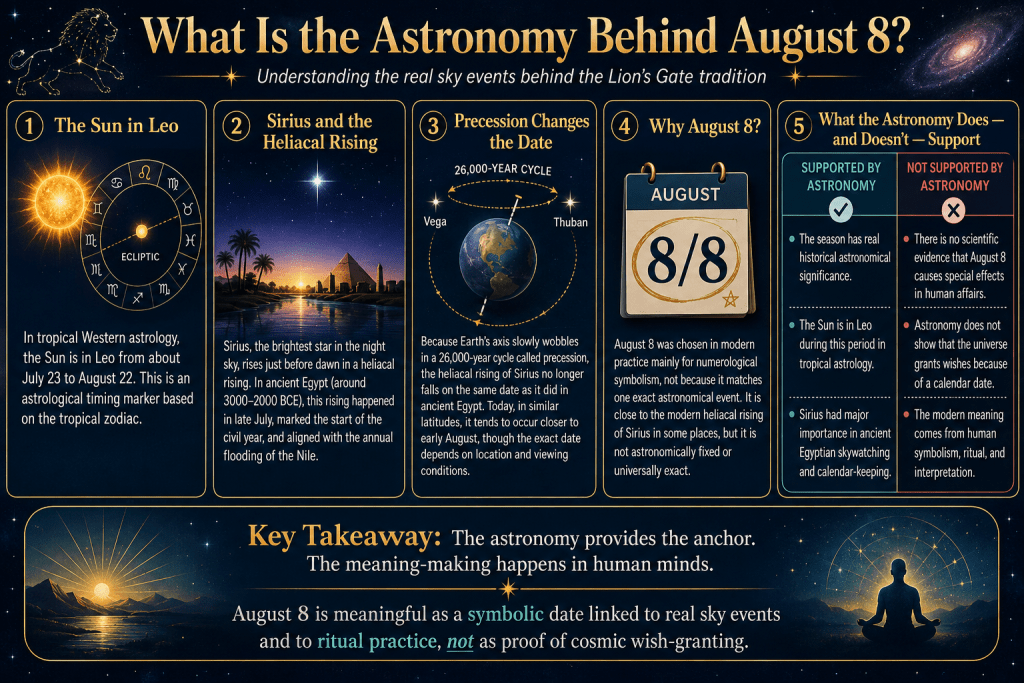
- The Sun in Leo: In tropical Western astrology, the Sun occupies the sign of Leo from approximately July 23 to August 22. This is a straightforward astrological fact based on the position of the Sun relative to the ecliptic as understood in the twelve-sign tropical zodiac.
- Sirius and the heliacal rising: Sirius, the brightest star in the night sky, is located in the constellation Canis Major. In ancient Egyptian latitudes around 3000 to 2000 BCE, Sirius appeared to rise just before dawn (its “heliacal rising”) in late July, marking the beginning of the Egyptian civil year and coinciding with the annual flood of the Nile. This event was one of the most important astronomical observations in ancient Egyptian religion and calendar-keeping.
- Precession: Because of the slow wobble of Earth’s axis (a 26,000-year cycle called precession), the heliacal rising of Sirius has shifted over the past four thousand years. It no longer occurs on the same date it did in ancient Egyptian times. In modern latitudes matching ancient Egypt, the heliacal rising of Sirius now occurs closer to early August than to late July, though the exact date varies by geographic latitude and atmospheric conditions.
- August 8 specifically: The date August 8 was fixed in modern practice for the numerological reasons described in the next section rather than because it corresponds to any specific astronomical event. It is close to but not identical with the modern heliacal rising of Sirius in most latitudes. Some practitioners emphasize this coincidence. Others treat the specific date as symbolic rather than astronomically precise.
The astronomy supports the claim that the season has real astronomical significance historically. It does not support the claim that any specific effect on human affairs is caused by these astronomical events. What the modern Lion’s Gate practice works with is the meaning-making that happens when humans mark a specific date as significant. The astronomy provides the anchor. The meaning-making happens inside human minds.
This distinction is worth making explicitly because it separates honest practice from claims that overreach. The tradition is meaningful because it is old, because it involves genuine astronomical events, and because the practice of ritual on a marked date has measurable psychological effects on the practitioner. It is not meaningful in the sense that the universe is arranging itself to grant your specific wishes because of a date on a calendar.
Free 28-Day Fascia Reset Email Course
Get our Free 28-day email course series to help with 1 or 2 exercises per day to release your fascia. One short lesson per day. Two minutes to read each.
What Is the Ancient Egyptian Tradition of Sopdet?
The Egyptian tradition surrounding the heliacal rising of Sirius deserves its own careful treatment because it is where the modern practice draws much of its cultural weight.
Sopdet and the Flood
Sopdet (later called Sothis by the Greeks and identified with the goddess Isis) was the personification of the star Sirius. Her heliacal rising after 70 days of invisibility marked the beginning of the Egyptian civil year and the start of the annual Nile flood.
The flood brought fertile silt to the fields and made Egyptian agriculture possible. Without the flood, there was no harvest. Without the harvest, there was no civilization. Sopdet’s rising was therefore one of the most watched astronomical events in the ancient world.
The Temple Ritual
Egyptian priests were assigned to watch for the specific pre-dawn morning when Sopdet reappeared on the eastern horizon after her long invisibility. This required careful daily observation from temple rooftops. The morning of her rising was marked by ritual observance.
New Year celebrations, offerings, and ceremonies invoking Isis and Osiris were held. The connection between the star, the flood, and the goddess was central to Egyptian religious cosmology for thousands of years.
Isis and Abundance
The goddess Isis, associated with Sopdet, was one of the most important deities in Egyptian religion. She was connected with motherhood, healing, magic, and the mysteries of life and death. Her cult spread far beyond Egypt into the broader Mediterranean world, eventually reaching Rome and forming one of the mystery religions of late antiquity.
Some scholars trace elements of later Christian Mariology to Isis worship, though this is a contested academic question.
How Much of Lion’s Gate Practice Is Historically Egyptian?
We know Sopdet’s heliacal rising was ritually significant. We know Isis was one of the most important goddesses. We do not have detailed ritual scripts for what individual women would have done privately to observe the season. Much of what modern Lion’s Gate practice claims about “ancient Egyptian ritual for manifestation” is reconstruction rather than historical record. The modern practice draws on Egyptian imagery, but the specific manifestation-focused framing is a twentieth-century development, not an ancient continuation.
Honoring the tradition means acknowledging both what it was and what has been added to it. The heliacal rising of Sirius truly marked the New Year for one of the longest-lasting civilizations in human history. That civilization associated the event with abundance, renewal, and the divine feminine. Working with that season now, with awareness of both its ancient significance and its modern reconstruction, is a legitimate spiritual practice. Pretending the modern practice is identical with the ancient practice is not.
How Did Egyptian Ritual Evolve Into Modern Lion’s Gate Practice?
The path from ancient Egyptian temple ritual to the current Lion’s Gate Portal observance ran through several distinct historical moments.
- Late antiquity: Egyptian religious traditions influenced the mystery religions of the Roman Empire. Isis worship spread across the Mediterranean. Elements of Egyptian symbolism entered Hermetic and Gnostic traditions that would themselves influence later Western esoteric practice.
- Renaissance revival: Interest in Egyptian wisdom revived during the European Renaissance. Scholars and mystics translated Hermetic texts (some of which claimed Egyptian origin) and integrated Egyptian symbolism into esoteric Christianity, alchemy, and the developing occult sciences.
- Nineteenth-century occultism: The Hermetic Order of the Golden Dawn, founded in 1888, incorporated substantial Egyptian symbolism into its rituals and teachings. Theosophy, founded by Helena Blavatsky in 1875, made extensive reference to Egyptian wisdom traditions. These influences shaped the twentieth-century Western esoteric tradition.
- New Age synthesis: In the second half of the twentieth century, elements of Egyptian mythology, Vedic astrology, numerology, and Western astrology were synthesized into the framework we now recognize as New Age spirituality. Specific dates and portals became part of this synthesis, drawing on genuine astronomical and cultural traditions but reshaping them for a modern audience.
- The specific Lion’s Gate framing: The specific concept of a “Lion’s Gate Portal” opening on August 8 appears to have crystallized in the late twentieth and early twenty-first centuries in the context of astrological writing, channeling communities, and manifestation-focused spirituality. Practitioners and teachers popularized the concept through books, workshops, and eventually social media. The framing became widely known through the 2010s and now shows a strong annual search pattern each August.
The Lion’s Gate practice endures for several reasons that are worth naming honestly. First, humans have always marked seasonal transitions with ritual, and modern secular life has left many people without a framework for doing this. The Lion’s Gate provides one. Second, the practice of setting clear intentions on a specific date has documented psychological effects regardless of any supernatural mechanism.
Third, the astronomical anchor gives the practice a specificity that pure invented rituals lack. Fourth, the connection to Egyptian tradition provides a sense of continuity with something older than modern culture. The practice is what it is. It is not literally what the ancient Egyptians did. It is also not empty.
It occupies a space where cultural longing for meaning meets a real astronomical season meets the human capacity for intentional attention. That combination has produced a practice worth taking seriously, on its own terms, without either dismissing it as invented nonsense or elevating it as untouchable ancient wisdom.
Free 28-Day Fascia Reset Email Course
Get our Free 28-day email course series to help with 1 or 2 exercises per day to release your fascia. One short lesson per day. Two minutes to read each.
Why Is 8/8 Significant in Numerology?
The date August 8 receives special attention in Lion’s Gate practice because of the numerological weight of 8/8.
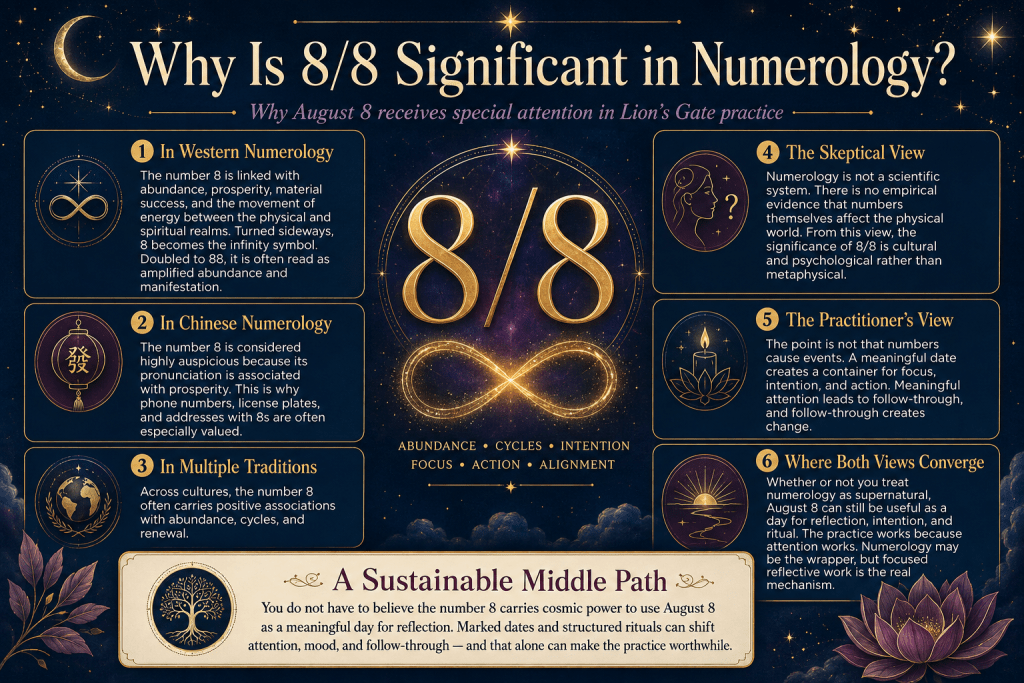
- In Western numerology: The number 8 is associated with abundance, prosperity, material success, and the movement of energy between the physical and spiritual realms. The shape of the numeral itself, when turned on its side, becomes the mathematical symbol for infinity. Doubled to 88, the number is understood to carry amplified meaning around abundance and manifestation.
- In Chinese numerology: The number 8 is considered highly auspicious because its pronunciation is similar to the word for prosperity. This cultural association is strong enough that phone numbers, license plates, and addresses containing 8s command premium prices in many Chinese-speaking regions.
- In multiple traditions: The number 8 recurs across cultures with generally positive associations related to abundance, cycles, and renewal.
- The skeptical view: Numerology is not a scientific system. There is no empirical evidence that specific numbers carry inherent meaning that affects the physical world. From a purely materialist standpoint, the significance of 8/8 is cultural and psychological rather than metaphysical.
- The practitioner’s view: The point of numerological practice is not that numbers cause external events. The point is that marking a specific date with clear meaning creates a container for focused attention and intention. Humans are meaning-making creatures. Meaningful dates produce meaningful attention. Meaningful attention produces action. Action produces change.
- Where both views converge: Whether or not you accept the numerological framework as a supernatural claim, the psychological utility of marking August 8 as a specific day for reflection, intention, and ritual is defensible on grounds that a careful skeptic could accept. The practice works because attention works. The numerology is the wrapper, not the mechanism. The mechanism is what happens when a person sits down and does the reflective work the tradition invites her to do.
For midlife women who may be moving in and out of belief in these frameworks, this middle path is often the most sustainable. You do not have to affirm that the number 8 carries cosmic power. You can observe that human minds respond to marked dates and structured rituals with measurable shifts in attention, mood, and follow-through. That is enough to justify the practice.
Why Does the Lion’s Gate Season Matter More in Midlife?
The Lion’s Gate season falls in a specific window each year, and midlife women often find themselves particularly responsive to it for reasons that are worth naming.
Mid-Year Reassessment
August sits in the middle of the year in the Northern Hemisphere, past the enthusiasm of new-year resolutions but before the year’s end forces reflection. This mid-year window is one of the underused opportunities for intentional reassessment.
Midlife women often carry unmet commitments from January and cannot yet see the end of the year. August provides an interstitial moment for looking honestly at what has happened and what is still possible.
Post-Summer Clarity
By early August, most women have had at least some contact with the slower pace of summer. Vacation time (even if short), longer daylight, and slightly softer schedules create a temporary opening in which honest reflection becomes possible.
The nervous system that spent the winter in survival mode has had a few weeks of parasympathetic breathing space. This is fertile ground for the kind of quiet reflective work the Lion’s Gate season invites.
The Invitation of Leo
The astrological season of Leo emphasizes qualities that midlife women often need to reclaim: visibility, courage, generosity, creative self-expression, and comfort with occupying space.
The cultural pressure on midlife women is often toward invisibility. The Leo season, whether or not you take the astrology literally, offers a symbolic counterweight to that pressure.
Perimenopause and Menopause Meaning-Making
The hormonal transition of midlife often brings a re-examination of what a life is for. Questions that felt settled at thirty-five reopen at fifty. Career priorities shift. Relationships get renegotiated. The self-model built over decades of caregiving and achievement begins to be reworked.
A structured occasion for this kind of reflection, held annually, provides ritual scaffolding for work that would otherwise happen only in crisis.
The Connection to the Divine Feminine
Whether or not you work with any specific goddess framework, the association of the Lion’s Gate season with Isis, Sopdet, and the ancient Egyptian tradition of the goddess-star provides symbolic resources that many midlife women find useful.
The image of a mature, powerful, magical feminine figure is not one that mainstream culture provides many of. The Lion’s Gate tradition offers one.
Free 28-Day Fascia Reset Email Course
Get our Free 28-day email course series to help with 1 or 2 exercises per day to release your fascia. One short lesson per day. Two minutes to read each.
What Does Manifestation Mean, and What Does It Not Mean?
The word “manifestation” has been so heavily used in contemporary spirituality that its actual meaning has become fuzzy. Working thoughtfully with the Lion’s Gate Portal requires being clear about what manifestation is and is not.
Manifestation is the practice of getting clear about what you want, holding it consistently in your attention, and taking action aligned with it. It works through the psychological mechanisms of clarified intention, sustained attention, and consistent action. When it appears to work “magically,” the magic is usually the accumulation of thousands of small aligned decisions that a clarified intention makes possible.
Manifestation is not:
- Wishing for something and having the universe deliver it
- A guarantee that any specific outcome will happen
- A substitute for concrete action
- A framework where lack of manifestation means you did not want it enough or held wrong thoughts
- A magical mechanism that overrides material realities like economics, biology, or other people’s agency
What the Lion’s Gate Practice Adds to General Manifestation Work
The specific date and ritual container create a structured moment for the reflective work that general manifestation talk often skips. Sitting down on August 8 with a clear intention to look at what you want and why is different from vaguely thinking about wanting things.
The date provides the container. The ritual provides the structure. The attention provides the mechanism.
Why the “Victim Blaming” Critique of Manifestation Matters
The manifestation industry has produced justified backlash for suggesting that people who do not manifest desired outcomes have failed at the practice. This framing ignores structural inequities, medical realities, and the many circumstances beyond individual control.
A healthy manifestation practice, including Lion’s Gate work, holds the practice as one input among many rather than as the sole determinant of outcomes.
A Midlife Woman’s Realistic Frame
By the time you have lived fifty years, you have accumulated evidence that outcomes depend on many factors including your own effort, other people’s choices, biological realities, economic conditions, and forces you cannot see or influence.
Manifestation as a practice works best when held inside this realistic frame. Clarify what you want. Hold it consistently. Take aligned action. Notice what shifts. Accept that some things will and some things will not. This is a mature practice compatible with a mature life.
“The Lion’s Gate Portal became meaningful to me only after I stopped expecting it to do anything for me. When I approached it as a scheduled occasion for looking honestly at what I wanted, at what I was willing to work for, and at what I was ready to release, the practice became one of the few structured reflection times I would keep for myself all year. What made it work was not the date. What made it work was the fact that I would show up on that date every year, sit down with a journal, and refuse to move until I had told myself the truth about my own life. The date created the appointment. The appointment created the space. The space created the change. If you wait for the universe to move for you, nothing much happens. If you use the tradition to move for yourself, quite a lot can happen.”
Terry Tateossian, Founder of The House of Rose
How Does the Lion’s Gate Portal Compare to Other Seasonal Practices?
The Lion’s Gate Portal sits within a broader tradition of seasonal spiritual observance. The table below places it in context.
|
Practice |
Timing |
Core focus |
Best for |
Compatibility with Lion’s Gate |
|
Lion’s Gate Portal |
August 8, energy building late July through mid-August |
Intention-setting, manifestation, personal power |
Mid-year reassessment, self-visibility work |
(Itself) |
|
New Year (secular) |
January 1 |
Fresh start, resolutions |
High-level annual planning |
Complementary; different phase of year |
|
New Year (lunar) |
Late January or February |
Fresh start with astrological grounding |
Rest, planning, quieter reflection |
Complementary; different energy |
|
Spring Equinox |
March 20-21 |
New beginnings, planting seeds |
Setting intentions to develop over months |
Complementary; earlier in growing cycle |
|
Summer Solstice |
June 20-21 |
Fullness, power, activation |
Celebrating what has grown, taking action |
Complementary; leads into Leo season |
|
Autumn Equinox |
September 22-23 |
Harvest, gratitude, gathering |
Assessing what came to fruition |
Complementary; harvest of Lion’s Gate intentions |
|
Winter Solstice |
December 20-21 |
Rest, inward turn, deep reflection |
Silence, integration, honoring what has been |
Complementary; opposite phase |
|
Full Moon Ritual |
Monthly |
Release, culmination, illumination |
Regular practice, monthly reset |
Complementary; ongoing rhythm |
|
New Moon Ritual |
Monthly |
Intention-setting, planting |
Regular practice, monthly reset |
Complementary; ongoing rhythm |
|
Personal Birthday |
Annual |
Personal cycle, life reflection |
Individual accountability, birthday year themes |
Complementary; personal counterpart |
Lion’s Gate occupies a specific position in this list. It is a mid-year opportunity that sits between the enthusiasm of spring and the reflection of autumn. It is Sun-focused (Leo season, solar significance) in a way that lunar practices are not. It is annual rather than monthly, which makes it more weighty than the moon cycles. And it has cultural weight through its Egyptian associations that pure personal rituals lack.
Most women who work seriously with seasonal practice eventually develop a rhythm that includes several of these observances. Lion’s Gate can be an entry point for those new to seasonal practice, or a specific annual anchor for those already working with a broader ritual calendar.
Free 28-Day Fascia Reset Email Course
Get our Free 28-day email course series to help with 1 or 2 exercises per day to release your fascia. One short lesson per day. Two minutes to read each.
How Should You Prepare for August 8?
The Lion’s Gate ritual is more meaningful when the days leading up to it have been prepared thoughtfully. This is not required. Meaningful practice can be done in one sitting on August 8. But if you have the week, use it.
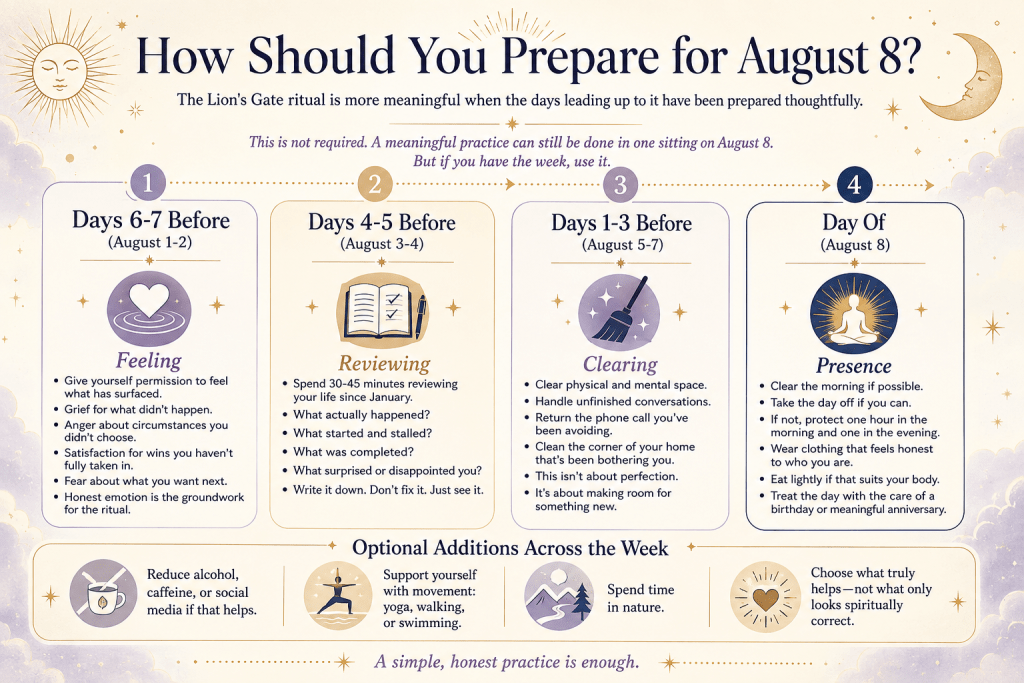
Days 1 Through 3 Before (August 5, 6, 7): Clearing
Use these days to clear physical and mental space. Attend to unfinished conversations you have been avoiding. Return the phone call you have been putting off. Clean the specific corner of your home that has bothered you for weeks. This is not about producing a magazine-perfect space. It is about signaling to yourself that you are making room for something new.
Days 4 Through 5 Before (August 3, 4): Reviewing
Spend 30 to 45 minutes over these two days reviewing where you are in your life. What has happened since January. What you started that stalled. What you completed. What surprised you. What disappointed you. Write these out. Do not fix them. Just see them.
Days 6 Through 7 Before (August 1, 2): Feeling
Give yourself permission during these days to feel what has come up during the clearing and reviewing. Grief for things that did not happen. Anger about circumstances you did not choose. Satisfaction about wins you have not fully taken in. Fear about what you want next. Feeling the honest emotional terrain is prerequisite for the ritual because the ritual works with actual current material, not with performed material.
Day of (August 8): Presence
Clear the morning if possible. Take the day off if you can. If you cannot, protect an hour in the early morning and another hour in the evening. Wear clothing that feels honest to who you are on this day. Eat lightly if that suits your body. Approach the day with the same care you would bring to a birthday or an important anniversary.
Optional Additions Across the Week
Some women find it useful to reduce alcohol, caffeine, and social media during the preparation week. Others find that a specific movement practice (yoga, walking, swimming) supports the emotional work. Others benefit from time in nature. Choose what helps rather than what looks spiritually correct.
How Do You Perform the Complete Lion’s Gate Portal Ritual?
This is the ritual. It can be done alone or with women you trust. It takes approximately 90 minutes if done unhurried. Do not rush it.
Setup (10 Minutes)
Choose a physical space where you can sit without interruption. Cleanse the space in whatever way feels right (opening windows, lighting a candle, wiping surfaces). Place on a small altar or table: a candle, a journal or paper, a pen, one object that represents something you want to release, and one object that represents something you want to welcome.
Optional additions include rose quartz (for the heart), citrine (for abundance), a photograph of yourself as a young girl, and something from nature.
Grounding (10 Minutes)
Sit comfortably. Close your eyes if that helps. Take twelve slow breaths, breathing in for a count of four and out for a count of six. Notice the weight of your body on the chair or floor. Notice the sounds around you. Notice the feeling of your hands resting.
This grounding step reduces the anxious rushing quality that would otherwise contaminate the ritual.
Acknowledgment (10 Minutes)
Speak or write, in whatever form feels natural, an acknowledgment of the tradition you are drawing on. This does not require religious belief. It requires honesty.
Example: “I am doing this practice with awareness that it draws on ancient Egyptian tradition and modern spiritual synthesis. I honor both. I take from it what is useful to me.”
Release (20 Minutes)
Write down, without editing or judging, everything you are ready to release from your life. This can include specific circumstances, relationships, self-beliefs, roles, or ways of showing up. Write until you have nothing left to write. Then read what you wrote. Then, if you have a safe way to do it, burn the paper.
If you cannot burn it, tear it into small pieces and put it in the trash. The physical destruction of the writing is not optional. It matters.
Intention (20 Minutes)
Take a fresh sheet of paper. Write, without editing, what you are ready to welcome into your life. Not what you should want. Not what other people would approve of. What you want. Write in specific and concrete language.
Not “success” but “the promotion I have been avoiding asking for.” Not “love” but “the partnership I stopped believing was still possible for me.” Write until you have named the specific things.
Integration (15 Minutes)
Read what you wrote about what you want to welcome. Sit with it. Ask yourself: what is one small aligned action I could take within the next 48 hours toward each of these? Write those small actions next to the intentions.
This is the step that transforms Lion’s Gate practice from wishful thinking into actual manifestation, defined honestly.
Closing (5 Minutes)
Extinguish the candle. Thank yourself for the practice. Fold the intention paper and put it somewhere you will encounter it during the year.
Consider taking a warm shower or bath to close the ritual physically. Drink water.
Notes on the Ritual
This structure is one approach. It is not the only one. If you already have a spiritual practice or ritual tradition, integrate the elements that fit and skip the ones that do not.
If you are new to ritual work, this structure gives you scaffolding you can adjust in future years. The specific actions matter less than the honest attention behind them.
Free 28-Day Fascia Reset Email Course
Get our Free 28-day email course series to help with 1 or 2 exercises per day to release your fascia. One short lesson per day. Two minutes to read each.
What Lion’s Gate Portal Manifestation Journaling Prompts Should You Use?
For the ritual’s writing portions, the following prompts help move past surface-level responses into more honest material. Use whichever prompts land. Skip the ones that do not.
For the Release Phase
- What did I promise myself in January that I have not kept, and what would it take to stop pretending I might still keep it?
- What relationship in my life is asking me to say something I have been avoiding saying?
- What identity have I outgrown that I keep performing anyway?
- What story about my body have I inherited that I do not want to pass on?
- What am I afraid to release because I do not know what I would be without it?
- What have I been tolerating that a woman I respect would not tolerate?
- What would I do if I stopped waiting for someone to give me permission?
For the Intention Phase
- What do I actually want that I have never said out loud?
- What would my sixty-five-year-old self tell my current self to prioritize?
- What creative work have I been postponing because I told myself it was frivolous?
- What relationship needs my honest attention in the coming year?
- What is the specific next chapter of my work life that I have been afraid to name?
- What kind of woman do I want to be in the second half of my life, and what does she need to start doing this year?
- If I knew this year would end well, what would I begin?
For Integration
- What is one small aligned action I can take in the next 48 hours toward each intention?
- What resource, relationship, or knowledge do I need to gather to take these actions?
- Who do I need to tell about one of these intentions to make it real?
- What am I willing to give up in order to make room for what I say I want?
- How will I know, six months from now, whether this ritual was more than performance?
The point of the prompts is not to answer them all. The point is to give yourself questions that go past the polished surface of your usual self-narrative into material that surprises you. Surprising material is the material worth working with.
What Are the Most Common Lion’s Gate Mistakes & How Can You Avoid Them?
- Mistake: Treating the ritual as magic. The ritual is not a spell that produces external results without your action. It is a structured occasion for reflection and clarification. The results come from the aligned action that flows from the clarified intention, not from the ritual itself. Approach it as a serious appointment with yourself, not as a supernatural transaction.
- Mistake: Setting intentions that are actually shoulds. If you write intentions that would please your mother, your therapist, or your Instagram followers rather than intentions that reflect what you actually want, the practice will not sustain. The whole point is to get past the performance of desire into actual desire. This can be uncomfortable. It is also the work.
- Mistake: Skipping the release phase. Some women want to skip to the intention phase without doing the release work. This produces intentions that get quietly undermined by the material that was not released. Do the release phase. Even when it feels like nothing needs releasing, take the time.
- Mistake: Making the ritual too elaborate. An hour of honest attention with a candle, a journal, and a pen is worth more than four hours of elaborate ritual with crystals, cards, altar objects, and specific incenses. The instrument is your attention. Everything else is scaffolding.
- Mistake: Doing it alone when you would benefit from company. Some women do their best reflective work alone. Others do it best in the presence of one or two trusted women. Neither is more spiritual than the other. If you have women in your life who would participate seriously, consider inviting them. If your circle would not take it seriously, protect the practice by doing it alone.
- Mistake: Doing it in company when you would benefit from solitude. The reverse is also common. Some women feel obligated to make Lion’s Gate a social event when what they actually need is quiet. If solitude serves you better, choose solitude.
- Mistake: Comparing your practice to social media images. Social media is saturated with Lion’s Gate content each August. Elaborate altars, expensive crystals, ceremonial clothing. None of this is required. Your practice does not need to be photogenic. Photogenic practice is often less honest than practice that happens in your ordinary kitchen at your ordinary table.
- Mistake: Skipping the integration action step. Writing beautiful intentions and then doing nothing about them until next August is the specific failure mode that gives manifestation practice its bad name. The 48-hour aligned action step is what transforms the ritual from wishful thinking into something that changes your life. Do not skip it.
- Mistake: Judging the practice by whether specific outcomes appear. The practice works even when specific external outcomes do not appear on your timeline. Its value is in clarifying what you actually want, releasing what has been quietly draining you, and taking small aligned action. If external outcomes appear on your timeline, treat it as a bonus. If they do not, the internal work still had value.
Free 28-Day Fascia Reset Email Course
Get our Free 28-day email course series to help with 1 or 2 exercises per day to release your fascia. One short lesson per day. Two minutes to read each.
What Should You Expect After the Lion’s Gate Portal Closes?
The days and weeks following August 8 often bring specific experiences worth naming so you know they are normal.
The First Week
Some women experience heightened emotional sensitivity, vivid dreams, or a sense of having stirred something up. This is normal. The release phase of the ritual can bring old material to the surface. Give it space. Do not fight it. Continue your ordinary self-care.
Weeks 2 to 4
The clarity from the ritual begins to translate into small decisions in ordinary life. You may find yourself saying no to invitations you would previously have accepted. You may find yourself reaching out to people you had lost touch with. You may notice that the aligned actions you wrote down are actually happening. This is the practice working.
Months 1 to 3
Larger shifts begin to appear. Not always the specific outcomes you named, but a general reorientation of what you are giving your time to. Some intentions come to fruition faster than expected. Others take longer or take different forms than you predicted. Watch for the shape of the change rather than for exact literal fulfillment.
Months 6 to 12
A full year gives the intentions time to work through. When August 8 returns, some of what you released has stayed released. Some of what you welcomed has arrived. Some of what you asked for has taken a form you would not have predicted. The annual return of the ritual becomes a form of accountability, letting you see the arc of what has actually shifted in a year.
When the Ritual Does Not Seem To Have “Worked”
If nothing appears to have shifted a year later, several possibilities are worth considering. The intentions may have been shoulds rather than actual desires. The release phase may have been incomplete. The aligned action steps may not have happened.
External circumstances may have been truly unresponsive to any amount of intention. Any of these are worth examining. None of them means the practice is worthless. They may mean the specific version of the practice you did last year deserves adjustment this year.
When Is Ritual Work Not the Right Tool?
Ritual work has limits. Some situations call for other tools.
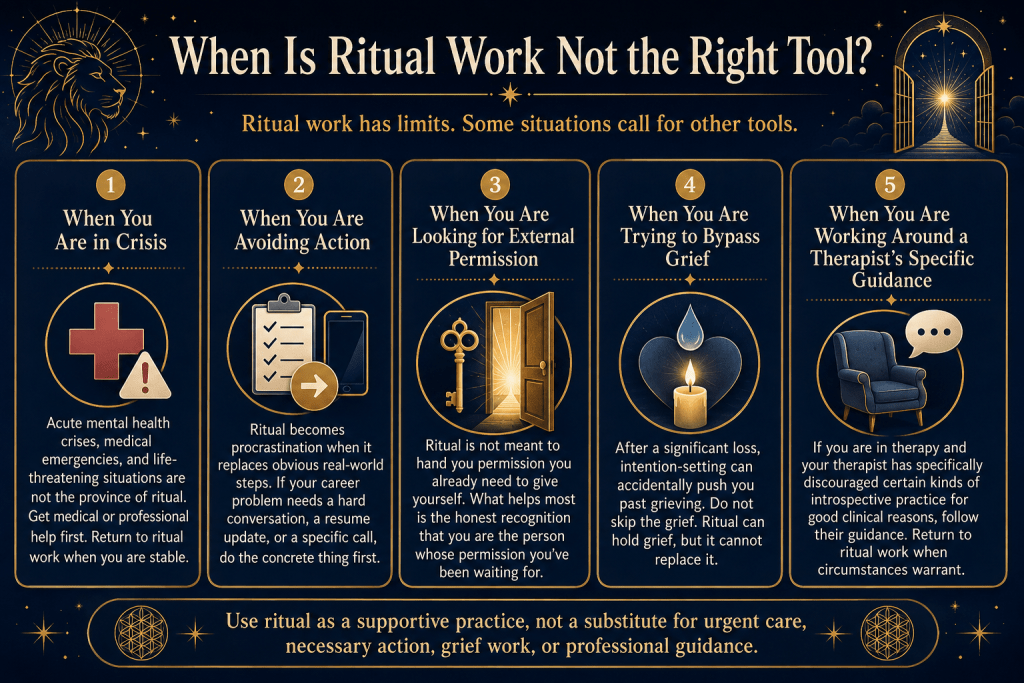
When You Are in Crisis
Acute mental health crises, medical emergencies, and immediate life-threatening situations are not the province of ritual. Get medical or professional help first. Return to ritual work when you are stable.
When You Are Avoiding Action
Ritual work becomes procrastination when it substitutes for taking obvious actions in the world. If you are using Lion’s Gate practice to feel like you are doing something about a career problem that actually needs a difficult conversation, a resume update, or a specific call, the ritual is not the right tool. Do the concrete thing first.
When You Are Looking for External Permission
Ritual work at its worst becomes a way of feeling like you have someone else’s permission to do something you already know you need to do. This is not what the practice is for. If you are looking for external permission, the ritual will not provide it. What can provide it is the honest recognition that you are the person whose permission you have been waiting for.
When You Are Trying To Bypass Grief
If a significant loss has happened recently, the intention-setting phase of ritual work can inadvertently ask you to skip past the grieving. Do not skip the grief. Grief has its own time. Ritual work can hold grief, but it cannot replace it.
When You Are Working Around a Therapist’s Specific Guidance
If you are in therapy and your therapist has specifically discouraged certain kinds of introspective practice for good clinical reasons, follow their guidance. Return to ritual work when clinical circumstances warrant.
Your Next Steps
- If Lion’s Gate prompts you to make space for deeper reflection, the Women’s Yoga & Hiking Retreat offers an immersive setting where ritual, movement, nature, and community come together.
- For more individualized support, the Online Nutrition Coaching Program can help you integrate reflective practices with the broader nutrition, movement, and lifestyle foundations of midlife wellness.
“The women who get the most out of Lion’s Gate practice are the ones who treat it as a serious appointment with themselves and who do the small aligned action within 48 hours. The ones who write beautiful intentions and take no action are the ones who quietly become skeptical of manifestation practice over time. This is not because the practice failed them. It is because they mistook the intention-setting for the whole practice. The intention is the seed. The action is the water. Both are required.”
Terry Tateossian, Founder of The House of Rose
Free 28-Day Fascia Reset Email Course
Get our Free 28-day email course series to help with 1 or 2 exercises per day to release your fascia. One short lesson per day. Two minutes to read each.
Frequently Asked Questions
When is the Lion’s Gate Portal?
The Lion’s Gate Portal is observed each year on August 8, with energy considered to be building through late July and lingering through mid-August. The specific peak date of August 8 (8/8) is fixed by numerological rather than astronomical considerations.
Is the Lion’s Gate Portal a real thing?
The Lion’s Gate Portal is a modern spiritual observance drawing on genuine ancient astronomical and cultural traditions (particularly the Egyptian tradition of Sirius rising). The astronomy is real. The Egyptian cultural significance was real. The modern manifestation framing is a twentieth-century synthesis, not an unbroken continuation of ancient practice.
Do I need to believe in astrology to practice this?
No. The practice can be approached as psychological and reflective work regardless of whether you accept the astrological or metaphysical framework. The mechanism is the focused attention and intentional action, not the metaphysics.
Can I do the ritual on a different day?
Yes. The specific date has cultural weight, but nothing prevents you from doing the practice on August 7 or August 9 or any other day near the season. The ritual’s power comes from the honest attention, not from precise calendar timing.
What if I miss August 8?
Do the ritual when you can. The energy of the season is understood to extend across late July through mid-August. If you miss the whole window, save the practice for next year, or adapt it to another seasonal marker like your birthday.
Do I need special objects for the ritual?
No. A candle, a journal, and a pen are sufficient. Additional objects (crystals, cards, altar items) can support the practice but are not required. The instrument is your attention.
Should I share my intentions with others?
This is personal. Some women find that sharing intentions with one or two trusted people creates useful accountability. Others find that keeping intentions private protects the honesty of the intention from social pressure. Choose what serves your specific work.
What if I feel emotional after the ritual?
Emotional responses are normal. The release phase can bring old material to the surface. Give yourself space to feel what comes up. Consider journaling further, going for a walk, or talking with someone you trust. If distress is significant, contact a mental health professional.
Can I do this practice during my period, pregnancy, or menopause?
Yes. The practice is compatible with any phase of hormonal life. Some women find that the ritual takes on particular meaning during perimenopause and menopause because of the broader life re-examination happening simultaneously.
Are there side effects to the Lion’s Gate Portal?
The reflective work can bring up old material and produce temporary emotional intensity. Some practitioners speak of “portal energy” causing sleep disruption or vivid dreams. These experiences are normal responses to intentional reflection. There are no known physical harms from the practice.
What do the ancient Egyptians actually have to do with this?
The ancient Egyptian tradition of Sopdet/Sothis (the star Sirius) and its heliacal rising was one of the most important astronomical observances in that civilization. It marked the beginning of the year and the flooding of the Nile. Modern Lion’s Gate practice draws imagery and symbolic weight from this tradition, but the specific manifestation-focused framing is a modern reconstruction rather than a direct continuation.
Is this a religious practice?
The Lion’s Gate Portal can be practiced in a secular framework or integrated with religious or spiritual practice. It is not affiliated with any specific religion. The 2021 academic literature on pronoia, cognitive reappraisal, and intentional practice supports the psychological utility of structured reflective work regardless of metaphysical framing.
What if my religion disapproves of astrological practice?
If your religious tradition specifically prohibits astrological or manifestation practices, respect that guidance. You can do the reflective work of the ritual (release, intention, integration) using your religion’s own framework and vocabulary rather than the astrological framing.
Can men practice Lion’s Gate?
Yes. Lion’s Gate practice is not gender-specific. This article is written for midlife women because the specific application to the midlife transition is under-served, and because the divine feminine associations of the tradition resonate with many women. The practice itself is available to anyone.
How do I find out about the exact heliacal rising of Sirius in my location?
The heliacal rising of Sirius varies by latitude and current atmospheric conditions. Local astronomy resources, planetarium software, or apps like Stellarium can show you the exact morning Sirius first appears above your horizon before dawn each year. For most Northern Hemisphere latitudes, this falls between mid-July and mid-August.
What is the difference between Lion’s Gate and 888?
The date August 8 is written as 8/8, and the numerological reading of doubled 8s (or the year including another 8, as in 8/8/8 in years ending in 8) is often called “888” or “Lion’s Gate 888.” These are related terms for the same seasonal practice. The 8/8 date is the anchor; the 888 framing is a numerological reading of that date.
References
- Krupp, E. C. (2003). Echoes of the Ancient Skies: The Astronomy of Lost Civilizations. Dover Publications.
- Wells, R. A. (1996). Astronomy in Egypt. In Astronomy Before the Telescope (ed. Christopher Walker). British Museum Press.
- Ruggles, C. (2015). Handbook of Archaeoastronomy and Ethnoastronomy. Springer Reference.
- Parker, R. A. (1950). The Calendars of Ancient Egypt. University of Chicago Press.
- Wilkinson, R. H. (2003). The Complete Gods and Goddesses of Ancient Egypt. Thames and Hudson.
- Hornung, E. (2001). The Secret Lore of Egypt: Its Impact on the West. Cornell University Press.
- Assmann, J. (2003). The Mind of Egypt: History and Meaning in the Time of the Pharaohs. Harvard University Press.
- Godwin, J. (1994). The Theosophical Enlightenment. State University of New York Press.
- Faivre, A. (1994). Access to Western Esotericism. State University of New York Press.
- Emmons, R. A., & McCullough, M. E. (2003). Counting blessings versus burdens: An experimental investigation of gratitude and subjective well-being in daily life. Journal of Personality and Social Psychology, 84(2), 377-389.
- Gollwitzer, P. M., & Sheeran, P. (2006). Implementation intentions and goal achievement: A meta-analysis of effects and processes. Advances in Experimental Social Psychology, 38, 69-119.
- Sheldon, K. M., & Lyubomirsky, S. (2006). How to increase and sustain positive emotion: The effects of expressing gratitude and visualizing best possible selves. Journal of Positive Psychology, 1(2), 73-82.
- King, L. A. (2001). The health benefits of writing about life goals. Personality and Social Psychology Bulletin, 27(7), 798-807.
- Lyubomirsky, S., & Della Porta, M. D. (2010). Boosting happiness, buttressing resilience: Results from cognitive and behavioral interventions. In J. W. Reich, A. J. Zautra, & J. S. Hall (Eds.), Handbook of Adult Resilience (pp. 450-464). Guilford Press.
- Fredrickson, B. L. (2001). The role of positive emotions in positive psychology: The broaden-and-build theory of positive emotions. American Psychologist, 56(3), 218-226.
- Baumeister, R. F., Vohs, K. D., Aaker, J. L., & Garbinsky, E. N. (2013). Some key differences between a happy life and a meaningful life. Journal of Positive Psychology, 8(6), 505-516.
- Wright, K. E., Skinner, S., & Zhu, S. (2023). The musculoskeletal syndrome of menopause. Climacteric, 26(4), 366-371.
- Bromberger, J. T., & Kravitz, H. M. (2011). Mood and menopause: Findings from the Study of Women’s Health Across the Nation (SWAN) over 10 years. Obstetrics and Gynecology Clinics of North America, 38(3), 609-625.
- Jesus, S. (2021). Pronoia or reverse paranoid delusion: A brief exploration into a positive delusion. Available via the National Center for Biotechnology Information (PubMed Central).
- Emmons, R. A. (2005). Striving for the sacred: Personal goals, life meaning, and religion. Journal of Social Issues, 61(4), 731-745.
Disclaimer: This article is for educational and informational purposes only and does not constitute medical, mental health, financial, or other professional advice. The Lion’s Gate Portal, astrology, numerology, and manifestation practices discussed here are spiritual and reflective frameworks, and no specific outcome is guaranteed. If the exercises bring up significant emotional distress or you are experiencing a mental health crisis, seek support from a qualified professional. If your ritual involves candles or burning paper, always follow appropriate fire-safety precautions.
Free 28-Day Fascia Reset Email Course
Get our Free 28-day email course series to help with 1 or 2 exercises per day to release your fascia. One short lesson per day. Two minutes to read each.

Terry Tateossian is a Menopause Lifestyle Medicine Coach, Certified Personal Trainer & Nutritionist and the Founder of THOR: The House of Rose, a wellness brand serving women over 40 through retreats, coaching, macro-nutrition and community. As 25-year founder and entrepreneur, Terry spent two and a half decades building and running successful start-up businesses, an experience that put her on the front line of founder burnout long before she could name it. After facing serious health challenges, early onset menopause, and emotional eating while running her agency and raising two children, Terry rebuilt her health in her 40s and lost more than 80 pounds through evidence-based nutrition, training, and mindset work. Today, she helps women get strong, improve confidence, support hormone health, and create a stronger second half of life. Terry has been featured in major media outlets and is available for podcasts, expert commentary, brand collaborations, and speaking engagements on midlife health, reinvention, emotional eating, menopause wellness, and strength training for longevity. Get her free macro calculator (her cookbook companion) to start your journey to back to health.