

 By Team THOR
Free 28-Day Fascia Reset Email Course
Get our Free 28-day email course series to help with 1 or 2 exercises per day to release your fascia. One short lesson per day. Two minutes to read each.
How Practicing Pronoia Can Improve Self-Esteem in Midlife Women: The Complete Guide to Rewiring the Story You Tell Yourself (With a 5-Day Practice Program)
Vera is fifty-two. She has spent the last decade collecting quiet evidence that the world is not quite on her side. The way her boss talks over her in the Monday meeting. The way the pharmacy tech barely looks up when she asks a question. The way her doctor spent nine minutes with her at her last physical and rewrote the prescription without meeting her eyes.
The way her daughter answered a text in seventeen seconds when a friend sent it and left Vera’s message unanswered for two days. None of these things is enormous. She has never made a scene about any of them. But she keeps a private ledger, updated in the small hours when she cannot sleep, and the ledger has been running in one direction for years.
She would not describe herself as paranoid. She would describe herself as realistic. She would say she has learned, at fifty-two, that a woman her age becomes slightly invisible, and that the invisibility comes with a slow drip of small dismissals that she has trained herself to tolerate. She has assembled this into a coherent story about who she is now and what the world expects her to be.
The story is exhausting her nervous system. It is showing up in her sleep, her mood, her posture, her energy at four in the afternoon. She has attributed all of that to hormones. Her doctor has attributed all of that to hormones. Both of them are half right. Something else is going on that no lab test will show, and it starts inside the story she has been unconsciously reinforcing for a decade.
There is a name for the opposite of that story. This article is about that name, about the research behind it, about the specific reasons the practice matters more in midlife than at any other time in adult life, and about how to build the practice in your own life without pretending things are better than they are.
What Is Pronoia?
Pronoia is the working belief that the world is quietly conspiring in your favor. Not that everything is perfect. Not that difficulty does not exist. Not that people never behave badly. Simply that the underlying orientation of the world, of the people in it, and of the small events that make up a day is toward your benefit rather than against it.
It is the direct opposite of paranoia. Paranoia is the working belief that the world is quietly conspiring against you. It reads ambiguous events as slights, assumes hidden hostility behind neutral behavior, and interprets silence as rejection. Pronoia reads the same ambiguous events as neutral or slightly positive, assumes goodwill behind neutral behavior, and interprets silence as unrelated to you.
What pronoia is:
- A working orientation toward the interpretation of ambiguous events
- A practice, not a personality trait
- A pattern of attention that can be intentionally cultivated
- Consistent with realistic assessment of actual threats and difficulties
- One of several evidence-supported mindset interventions
What pronoia is not:
- Not naive optimism that ignores real problems
- Not positive thinking as commonly practiced
- Not a claim that everyone always means well
- Not a substitute for appropriate boundaries or protective action
- Not a bypass of grief, anger, or legitimate concern
- Not toxic positivity dressed up in a Greek name
The distinction between pronoia and toxic positivity matters. Toxic positivity insists that painful feelings should be reframed or suppressed. Pronoia does the opposite: it allows painful feelings to be fully present while quietly changing the interpretation of the surrounding ambiguous circumstances. You can grieve, rage, or worry with a fully pronoic orientation. What changes is the story you tell yourself about the neutral events in the background.
Where Does the Word Pronoia Come From?
The word pronoia is a neologism. The sociologist Fred Goldner coined it in a 1982 paper in the journal Social Problems, defining it as the delusion that others are secretly plotting your well-being or thinking highly of you. Goldner intended the term as an academic curiosity, a mirror image of the diagnostic concept of paranoia that had been well-established in psychiatry since the nineteenth century.
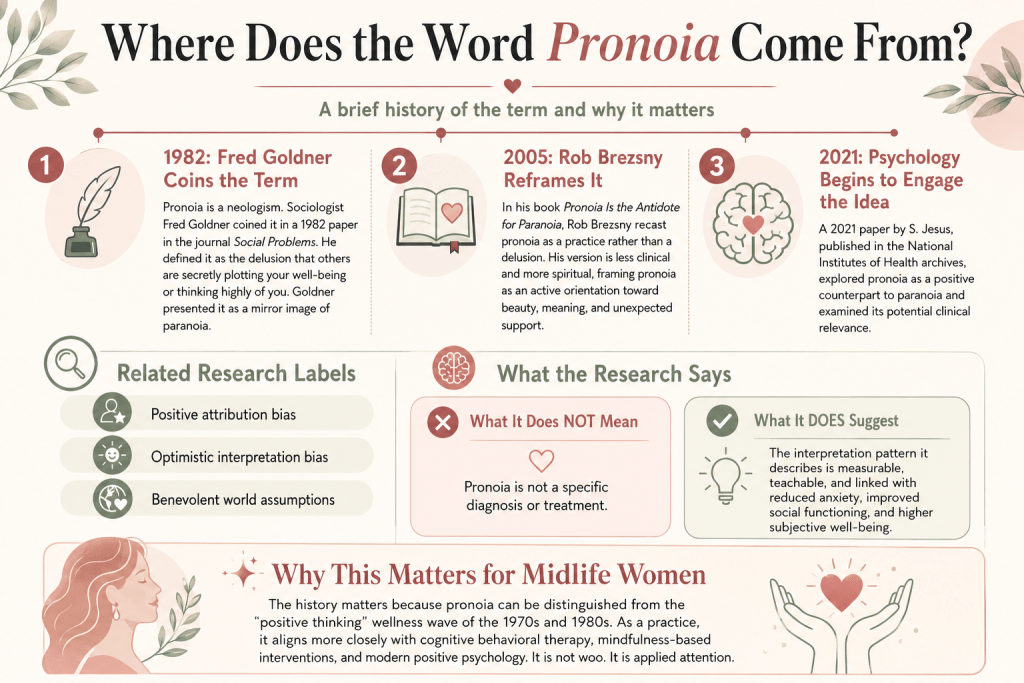
The word entered the broader wellness and psychology conversation through the work of astrologer and writer Rob Brezsny, whose 2005 book Pronoia Is the Antidote for Paranoia recast the term as a practice rather than a delusion. Brezsny’s version of pronoia is deliberately less clinical and more spiritual, framing pronoia as an active orientation toward beauty, meaning, and unexpected support.
The clinical psychology literature has been slower to engage the term, but a growing body of work now examines the phenomenon under related labels. A 2021 paper by S. Jesus, published in the National Institutes of Health archives, explored pronoia as a positive counterpart to paranoia and examined the potential clinical relevance of the pattern. Related research has appeared under labels including positive attribution bias, optimistic interpretation bias, and benevolent world assumptions.
None of this research suggests that pronoia is a specific diagnosis or treatment. What the research does show is that the pattern of interpretation the word describes is measurable, teachable, and connected to a range of outcomes including reduced anxiety, improved social functioning, and higher subjective well-being.
For midlife women, the historical framing matters because it helps distinguish this practice from the flavor of positive thinking that entered wellness culture in the 1970s and 1980s and has produced justifiable skepticism. Pronoia as an academic concept predates that wellness wave. Pronoia as a practice draws on the same cognitive science that underlies cognitive behavioral therapy, mindfulness-based interventions, and modern positive psychology. It is not woo. It is applied attention.
Free 28-Day Fascia Reset Email Course
Get our Free 28-day email course series to help with 1 or 2 exercises per day to release your fascia. One short lesson per day. Two minutes to read each.
What Does the Research Say About Pronoia?
The clinical research base on pronoia specifically is small compared to the research on paranoia. What exists, along with the substantially larger literature on adjacent constructs, points in a consistent direction.
Positive Attribution Bias and Mental Health
Research on positive attribution bias, the tendency to interpret ambiguous events in a positive rather than negative light, has documented associations with reduced anxiety, lower depression scores, better sleep quality, and improved social functioning.
This work draws heavily on the cognitive tradition established by Aaron Beck and expanded by researchers including Susan Nolen-Hoeksema.
Interpretation Bias Modification
Cognitive bias modification research has shown that interpretive bias can be intentionally shifted through targeted practice.
Studies by Andrew Mathews, Colin MacLeod, and others have demonstrated that repeated practice with ambiguous scenarios can produce measurable shifts in default interpretation, with downstream effects on mood and anxiety.
This body of research supports the specific claim that pronoia, as a pattern of interpretation, is teachable.
Benevolent World Assumptions
Ronnie Janoff-Bulman’s work on assumptive worlds documented that people hold implicit assumptions about the meaningfulness, benevolence, and self-worth dimensions of the world.
Higher benevolence assumptions correlate with better psychological well-being. The pronoia practice is one method for consciously working with these implicit assumptions.
Positive Psychology Interventions
Meta-analyses of positive psychology interventions have documented consistent small-to-moderate effects on well-being, life satisfaction, and depression symptoms.
Practices like gratitude journaling, three good things exercises, and best possible self writing overlap conceptually with pronoia practice, though pronoia specifically emphasizes interpretation of ambiguous events rather than counting existing positive events.
Neurological Substrates
Functional imaging studies have shown that interpretation of ambiguous social cues involves specific brain networks including the medial prefrontal cortex, the temporoparietal junction, and the amygdala. These networks are trainable.
Chronic negative interpretation strengthens the neural pathways that produce it. Chronic positive interpretation does the same in the opposite direction.
The 2021 Jesus Paper
The paper explored pronoia as a positive counterpart to paranoia and discussed the potential clinical relevance of the pattern. It noted that pronoia has been observed in some psychiatric populations as a positive delusion state, but that the broader concept of a mildly optimistic interpretation bias has clear potential value outside of any diagnostic frame.
The paper contributes to a growing conversation about whether cognitive interventions should focus not only on reducing negative bias but on cultivating positive bias.
Limitations
The specific research on pronoia is small. Most of the evidence for pronoia as a beneficial practice comes from the broader literature on interpretation bias, positive psychology, and cognitive therapy rather than from studies using the pronoia label directly.
This does not mean the practice is unsupported. It means the intellectual scaffolding comes from adjacent fields rather than from a dedicated pronoia research program.
Why Is Midlife the Hardest Time to Hold a Pronoia Mindset?
Pronoia is not equally difficult at every life stage. For midlife women specifically, several factors converge to make the pronoia orientation harder to maintain than at any other time in adult life.
- Cultural invisibility: Women in the perimenopause and menopause years experience a documented shift in cultural visibility. Marketing stops addressing them. Media stops centering them. Workplace dynamics quietly change. This is not paranoia. It is a real cultural pattern. And the mind naturally interprets ambiguous events through the frame of this real pattern, which makes negative interpretation feel like realism.
- Hormonal effects on interpretation: Estrogen has documented effects on serotonergic tone, mood regulation, and the amygdala’s response to ambiguous social cues. Estrogen decline during perimenopause and menopause can shift baseline emotional reactivity in ways that make negative interpretation feel more automatic. This is one of the reasons that women who have been consistently optimistic for decades sometimes describe midlife as the first time they have felt persistently negative about their circumstances.
- Accumulated pattern recognition: By midlife, a woman has decades of pattern recognition to draw on. She has seen how meetings go, how relationships work, how her body responds to stress. This pattern library is truly valuable. It can also become a filter that primarily notices what confirms existing patterns, which means that new evidence often reinforces the story she already tells herself.
- Sleep disruption and cognitive load: The sleep changes of perimenopause and menopause reduce the brain’s capacity for deliberate cognitive reappraisal. Tired brains default to their most practiced interpretation patterns. If those default patterns have drifted toward negative interpretation over years, sleep disruption makes the drift worse.
- Caregiving load: Many midlife women are carrying substantial caregiving load for children, aging parents, or both. Sustained caregiving under constrained resources tends to produce a mental model where every request is a threat to already-depleted capacity. This model makes it harder to interpret ambiguous events as benign.
- Legitimate accumulated grievance: Some midlife women have accumulated real, legitimate grievances over decades of navigating a world that has not treated them well. Pronoia is not asking anyone to pretend those grievances did not happen. It is asking whether the ambient interpretation of new ambiguous events needs to carry the weight of every past confirmed grievance, or whether new events can be evaluated on their own terms.
The convergence of these factors explains why midlife women often report that mindset practices that used to work for them (gratitude journaling, positive affirmations, general optimism) have stopped working. The mindset practices themselves may not have failed.
The context in which those practices operate has changed substantially. Pronoia is offered here as one intervention that specifically addresses the interpretation-of-ambiguous-events question that other mindset practices tend to sidestep.
“I did not know the word pronoia until my late forties. When I first read about it, my immediate response was defensive. I remember thinking that this sounded like exactly the kind of thing wellness culture invents to convince tired women that their real problems are actually mindset problems. I put the article down. Six months later, at a low point, I picked it up again. What I understood the second time was that pronoia is not asking me to pretend anything. It is asking me whether the story I am running in the background is helping me or hurting me. The story I was running was hurting me. Not because it was wrong about everything. Because it was applying old evidence to every new moment. Pronoia gave me a way to evaluate each new moment on its own terms without abandoning what I had learned. That distinction changed my whole relationship to my own attention.”
Terry Tateossian, Founder of The House of Rose
Free 28-Day Fascia Reset Email Course
Get our Free 28-day email course series to help with 1 or 2 exercises per day to release your fascia. One short lesson per day. Two minutes to read each.
How Does Low-Grade Threat Perception Affect the Nervous System?
The reason pronoia is not just a philosophical preference is that low-grade threat perception has a measurable nervous system cost. The body cannot distinguish between the threat of a lion in the grass and the threat of the boss overlooking your contribution again. The physiological response is the same: sympathetic activation, cortisol release, increased inflammation, reduced parasympathetic tone.
Sustained low-grade threat perception, running as background weather for years, produces specific downstream effects. Heart rate variability decreases. Sleep architecture degrades. Digestive function slows. Immune surveillance becomes less effective. Recovery from any acute stressor takes longer. Muscle tension patterns become entrenched. Small annoyances trigger disproportionately large physiological responses because the baseline is already primed.
For midlife women, this cost stacks on top of the hormonal shifts that already reduce nervous system resilience. Estrogen decline reduces the buffering capacity of the parasympathetic nervous system. Progesterone decline reduces the GABA-mediated calming that had been available during reproductive years. What was tolerable at thirty becomes exhausting at fifty because the physiological margin has shrunk.
Pronoia practice reduces this cost by intervening at the interpretation step. If ambiguous events are interpreted as neutral or benign rather than threatening, the sympathetic activation does not fire in the first place. The body remains in the calmer physiological state that supports repair, digestion, sleep, and immune function. Over time, the reduction in unnecessary threat activation accumulates into measurable improvements in the same downstream markers that suffer from chronic threat perception.
This is not hypothetical. Cognitive behavioral interventions that shift interpretation patterns have documented effects on heart rate variability, inflammatory markers, and sleep quality. The mechanism is understood. Pronoia is one method of accessing that mechanism through a practice that is more portable and less clinical than formal CBT.
Understanding the neurological side of midlife recovery also means considering how vagus nerve reset exercises can support parasympathetic activity and how the parasympathetic nervous system changes with aging, both of which provide useful context for regulating stress and supporting recovery.
How Does Pronoia Improve Self-Esteem?
Self-esteem is not a single trait. It is a set of interlocking beliefs about your own worth, competence, and value in the world, held mostly below conscious awareness and continuously updated by the interpretation of daily events. The mechanism by which pronoia influences self-esteem is direct and specific.
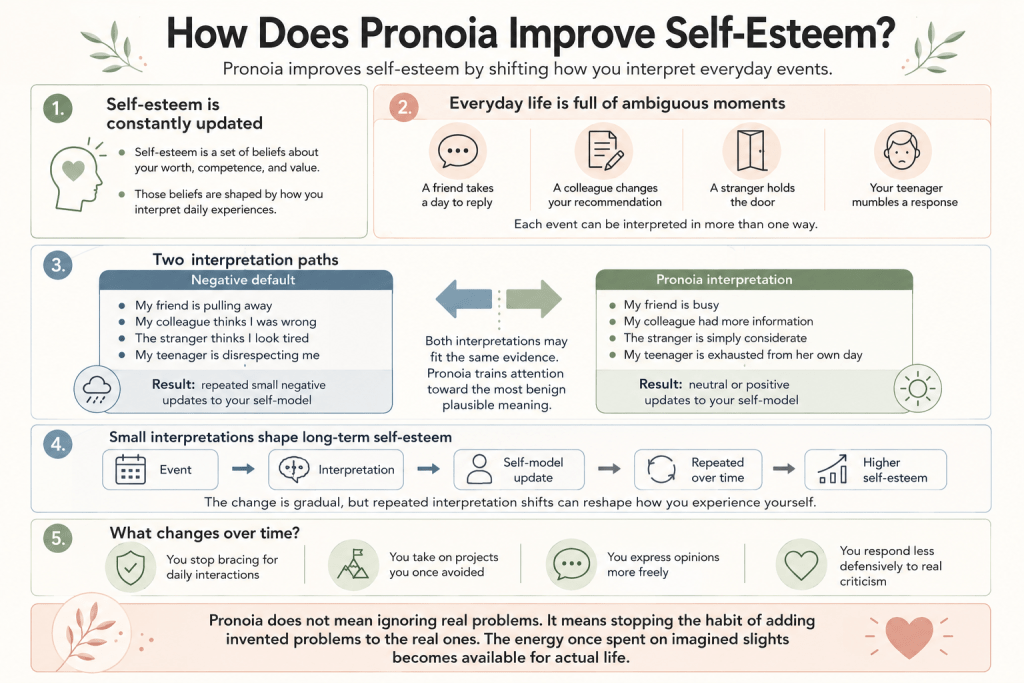
Every day contains dozens of ambiguous events that involve your relationship to other people or to the world. A friend takes a day to respond to your text. A colleague changes your recommendation without discussion. A stranger holds a door for you. Your teenager mumbles a response you cannot quite hear. Each of these events is interpretable in multiple ways. The interpretation you choose, mostly automatically, feeds into your ongoing self-model.
If the default interpretation is that the friend is pulling away, the colleague thinks your recommendation was wrong, the stranger holds the door because you look tired, and the teenager is disrespecting you, then your self-model receives dozens of small negative updates per day. Over years, these accumulate into a self-model that runs quietly negative about your worth, competence, and value.
If the default interpretation is that the friend is busy, the colleague had additional information you did not have, the stranger holds the door because that is what considerate people do, and the teenager is exhausted from her own day, then your self-model receives neutral or positive small updates. Over years, these accumulate into a self-model that runs quietly positive about your worth, competence, and value.
Neither interpretation is definitively true in any single case. Both are consistent with the same evidence. What differs is which interpretation your attention makes automatic. Pronoia practice deliberately shifts the automatic interpretation toward the benign end of the plausible range.
The self-esteem effect is not immediate. Individual interpretations do not change self-model dramatically. But sustained interpretation shifts over months and years produce measurable changes in how you experience yourself in the world.
Women who practice pronoia consistently report that they stop bracing for daily interactions, that they take on projects they used to avoid, that they express opinions they used to keep to themselves, and that they respond less defensively when actual criticism does arrive.
This is not because they have become blind to real problems. It is because they have stopped adding invented problems to the real ones. The energy that had been consumed maintaining the vigilance against imagined slights becomes available for actual life.
Free 28-Day Fascia Reset Email Course
Get our Free 28-day email course series to help with 1 or 2 exercises per day to release your fascia. One short lesson per day. Two minutes to read each.
How Does Pronoia Compare to Other Mindset Practices?
The table below places pronoia in context with other mindset and psychological practices.
|
Practice |
Core mechanism |
Best for |
Limitations |
Compatible with pronoia |
|
Pronoia |
Shifts interpretation of ambiguous events toward benign or positive |
Building baseline self-esteem, reducing chronic threat perception, midlife mindset work |
Small direct research base under this specific name |
(Itself) |
|
Gratitude Journaling |
Directs attention to specific positive events that have already happened |
Building appreciation, mood support, sleep quality |
Focuses on confirmed positives rather than reinterpreting ambiguous events |
Yes, highly complementary |
|
Cognitive Behavioral Therapy |
Identifies and disputes distorted thoughts through structured process |
Anxiety, depression, specific cognitive distortions |
Requires practice; often needs professional guidance |
Yes, pronoia is a specific CBT-adjacent practice |
|
Mindfulness Meditation |
Observes thoughts and sensations without automatic identification |
Anxiety reduction, present-moment awareness, emotional regulation |
Requires consistent practice; can feel abstract |
Yes, mindfulness supports the noticing step of pronoia |
|
Positive Affirmations |
Repeats desired self-statements |
Some applications for building specific beliefs |
Can backfire for people whose current self-model is very different from the affirmation |
Sometimes; pronoia is more subtle |
|
Self-Compassion Practice |
Directs kindness toward the self in moments of difficulty |
Reducing harsh self-criticism, emotional resilience |
Focused on inner speech rather than event interpretation |
Yes, highly complementary |
|
Journaling |
Externalizes thoughts and patterns |
Self-awareness, processing emotions |
Can reinforce negative patterns if not directed |
Yes, journaling can support pronoia practice |
|
Reframing |
Consciously restates a situation in different terms |
Specific stressful situations |
Can feel forced; single-event focus |
Yes, pronoia is a form of pattern-level reframing |
|
Best Possible Self Exercise |
Writes about desired future self |
Motivation, goal clarity |
Future-focused rather than present-focused |
Yes, complementary |
|
Toxic Positivity |
Insists that all events be reframed as positive; suppresses difficult feelings |
Nothing sustainable |
Suppresses legitimate distress; produces disconnection |
No, this is what pronoia is NOT |
Pronoia occupies a specific niche in this list. It is not about counting existing positives (that is gratitude). It is not about disputing specific distorted thoughts (that is CBT). It is not about repeating desired beliefs (that is affirmation). It is about the interpretation you assign to ambiguous events as they happen. It works well alongside almost every other item on this list.
Worked example. A woman in her early fifties has been practicing gratitude journaling for years. She writes three things she is grateful for each morning. She notices, however, that the list has become mechanical, and that her general mood and self-esteem have continued to slip despite the daily practice.
She adds pronoia practice by picking one ambiguous event from the day that had bothered her and asking herself, in writing, what the most benign plausible interpretation of that event might be. Not what the most positive interpretation would be, since forced positivity does not stick. Simply the most benign interpretation that is consistent with the evidence.
After two months of this addition, her general mood has not dramatically shifted, but her tendency to lie awake replaying the day’s small slights has substantially reduced. Sleep improves. Interactions with her adult daughter improve. The gratitude practice continues to run alongside the pronoia practice, and the combination works better than either alone.
What Does Pronoia Practice Look Like Compared With Positive Thinking?
Pronoia practice is not positive thinking. The difference becomes clearer when you compare how each approach responds to ordinary situations.
How Does Pronoia Respond to a Difficult Meeting?
- Positive thinking says: “That meeting went great! I contributed a lot. Everyone loved my ideas.”
- Pronoia says: “That meeting was mixed. I felt overlooked in the middle section. My interpretation may be accurate. It also may be that Rick was distracted by his own thing, Karen was tracking a different topic, or the pause I read as disapproval was actually people processing. I do not need to decide right now which interpretation is true. I can hold both possibilities and see what more information tells me.”
How Does Pronoia Respond to a Quiet Friend?
- Positive thinking says: “My friend loves me and everything is fine between us.”
- Pronoia says: “My friend has been quiet for two weeks. That could mean she is upset with me. It could also mean she is buried in work, her mother’s health has taken a turn, or she is going through something private that has nothing to do with me. I can send a short check-in message that assumes the second interpretation. If the first turns out to be right, I can address it then. Meanwhile, I do not need to spend the interim assuming rejection.”
How Does Pronoia Respond to Self-Criticism?
- Positive thinking says: “I look great for my age!”
- Pronoia says: “I look the way a woman my age with my life looks. Some of what I see in the mirror I do not love. Some of it I actually kind of like. The story that everyone else is judging me by the parts I do not love is a story I have been running for years without checking whether it is true. Today I am going to notice, once, whether the people I actually interact with give any indication that they are judging me the way I have been judging myself.”
What Do These Examples Have in Common?
The three examples follow the same pattern. Pronoia does not insist that a situation is better than it really is. Instead, it:
- Notices the story you are already telling yourself.
- Asks whether that story is clearly supported by the evidence.
- Considers whether the story is helping or harming you.
- Looks for another interpretation that is equally plausible.
- Leaves room for more information before reaching a final conclusion.
If your current story is painful and not clearly true, pronoia gives you permission to hold a different interpretation without pretending that everything is perfect.
Why Is Pronoia More Sustainable Than Positive Thinking?
Positive thinking often asks you to override your own perception. If something feels difficult, disappointing, or uncertain, you are encouraged to replace that experience with a reassuring statement whether or not you believe it. That creates internal conflict, which is one reason the practice can be difficult to sustain.
Pronoia works differently. It does not ask you to deny what you notice. It asks whether another interpretation is honestly available within the same evidence. You are not replacing reality with optimism. You are replacing an unverified negative assumption with openness.
That small difference is what makes pronoia portable. You can use it in relationships, work, body image, social situations, and everyday uncertainty without forcing yourself to believe something that does not feel true.
Free 28-Day Fascia Reset Email Course
Get our Free 28-day email course series to help with 1 or 2 exercises per day to release your fascia. One short lesson per day. Two minutes to read each.
How Can You Practice Pronoia in 5 Days?
This program builds a pronoia practice over five days, layering skills that support one another. It is designed for midlife women, requires no equipment, and takes 10 to 20 minutes per day.
|
Day |
Focus |
Practice |
Duration |
|
Day 1 |
Noticing the story |
List three ambiguous events from the past 48 hours. Write your automatic interpretation of each. |
15 minutes |
|
Day 2 |
Alternative interpretations |
For each of yesterday’s events, write two additional interpretations that are also consistent with the evidence. |
15 minutes |
|
Day 3 |
The benign plausible |
Pick one small ambiguous event from today. Write the most benign plausible interpretation. Sit with it. |
12 minutes |
|
Day 4 |
The self-esteem update |
Notice one small event today that could reasonably be read as evidence of your worth, competence, or value. |
10 minutes |
|
Day 5 |
Integration and repeat |
Full practice: notice an event, write an alternative interpretation, take in one worth-competence-value moment. |
20 minutes |
Day 1 Detail: Noticing the Story
Take a notebook. Sit somewhere quiet. Think back over the past 48 hours and list three specific events that were ambiguous, meaning they were interpretable in more than one way and involved your relationship to another person or the world.
Examples: a text that took longer to be returned than you expected, a comment from a family member that landed oddly, a facial expression from a stranger, a decision at work that did not go your way.
Write each event in one to two sentences. Then, honestly, write the interpretation that your mind automatically assigned to each event. Do not judge the interpretation. Do not try to change it. Just make it visible. Most days most of us have never actually looked at the interpretations our minds are quietly running.
Day 2 Detail: Alternative Interpretations
Return to yesterday’s list. For each of the three events, write two additional interpretations that are also consistent with the evidence available. These do not need to be positive. They need to be plausible and different from your default.
Example: Default interpretation is that a friend is pulling away because she took two days to reply.
- Alternative 1: She is dealing with something private.
- Alternative 2: Her phone has been buried in her bag and she has not seen the notification.
Notice that all three interpretations are consistent with the observable evidence (the two-day delay). The default is not more true than the alternatives. Your mind chose it for reasons that may or may not still serve you.
Day 3 Detail: The Benign Plausible
Today, pay light attention throughout the day for one small ambiguous event. Something small. A cashier who did not smile. An email that arrived without pleasantries. A driver who cut you off. At the end of the day, write the most benign plausible interpretation of that event. Not the most positive. Not a fantasy. The most benign reading that is honestly consistent with what you observed.
The cashier had been on her feet for six hours. The email sender was in the middle of forty other emails. The driver was distracted by a call from their sick parent. Sit with the benign interpretation for one full minute. Notice what your body does when you sit with it. Notice whether the tension you felt at the time softens.
Day 4 Detail: The Self-Esteem Update
Today, watch for one small moment that could reasonably be read as evidence of your worth, competence, or value. A colleague asking your opinion. A stranger holding a door. A partner reaching for your hand. A friend remembering something you told them. When you notice it, pause. Take a breath.
Let the moment register as what it actually is: evidence about you that your automatic self-model would not normally take in. Do not deflect it. Do not attribute it to luck or coincidence. Simply let it be an update to your ongoing self-model. This is the specific micro-practice by which pronoia rebuilds self-esteem.
Day 5 Detail: Integration and Repeat
Today, run the full practice. Notice an ambiguous event as it happens. Immediately, in your head or on paper, write the most benign plausible interpretation. Continue with your day. Also, notice one small event that supports your worth, competence, or value, and take it in.
In the evening, spend five minutes reflecting on how the week has felt. Notice whether you have slept differently. Notice whether interactions have felt slightly different. Notice whether the story running in the background has quieted at all.
Post-Program: Ongoing Maintenance
After completing the 5-day introduction, the practice becomes a light background activity rather than a scheduled exercise. Most women benefit from a five-minute weekly reflection where they revisit the past week for one ambiguous event that they defaulted to a harsh interpretation on. Rewrite that interpretation. Repeat. Over months, this accumulates.
Some women also benefit from adding pronoia journaling at times of specific difficulty. Sleepless nights are a common time. When the mind is running through the day’s evidence of grievance, deliberately writing alternative interpretations for two or three of the items often calms the loop enough to return to sleep.
How Can You Practice Pronoia Without Bypassing Real Problems?
Pronoia is not a bypass. It is a specific practice for specific circumstances. Understanding what it is not for is as important as understanding what it is for.
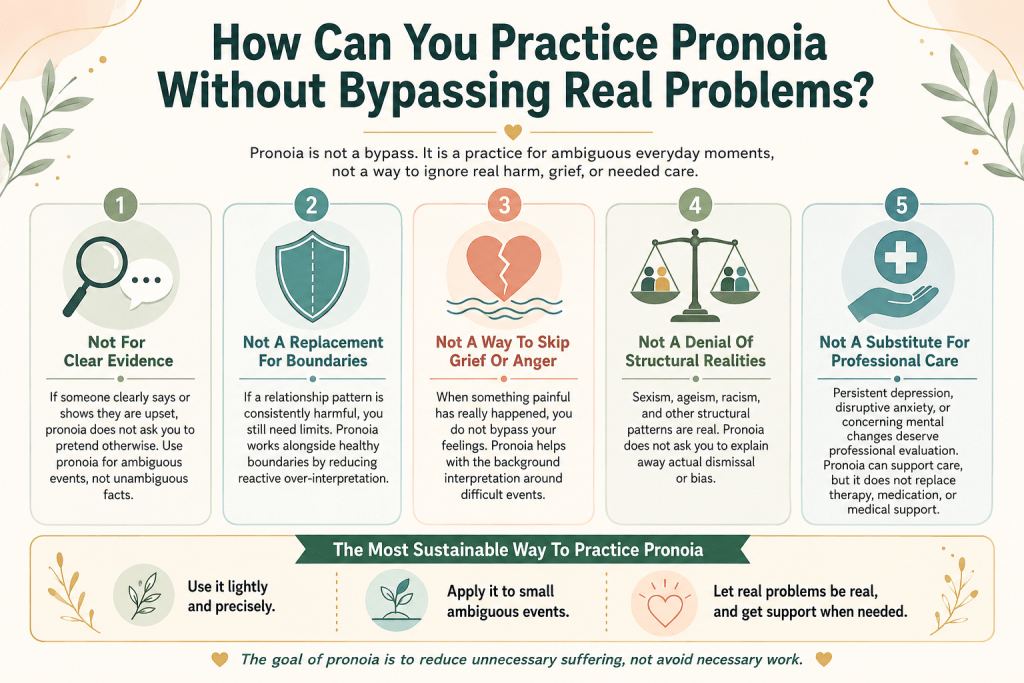
- Pronoia does not apply to unambiguous evidence: If someone tells you directly that they are angry with you, that is not ambiguous. Pronoia does not ask you to reinterpret it as friendliness. It asks you to reserve reinterpretation for the ambiguous events, which are actually the majority of daily interactions.
- Pronoia does not replace appropriate boundaries: If a relationship pattern is consistently harmful, pronoia does not require you to keep interpreting it charitably. Legitimate limits still apply. Pronoia is compatible with, and often supports, healthier boundaries because it reduces the reactive over-interpretation that leads to poorly-calibrated boundary responses.
- Pronoia does not replace processing legitimate grief or anger: If something painful has actually happened, pronoia is not asking you to skip past the feelings. It is offering an interpretive framework for the ambient background events that surround the difficult central event.
- Pronoia does not deny structural realities: Sexism, ageism, racism, and other structural patterns are real. Pronoia does not ask any woman to interpret away actual pattern-level dismissal. It asks whether every individual ambiguous event needs to carry the weight of the pattern, or whether individual events can be evaluated on their own terms.
- Pronoia is not a substitute for medical or mental health care: Persistent depressed mood, anxiety that interferes with function, or any change in mental status that concerns you warrants professional evaluation. Pronoia is one supportive practice inside a larger picture of mental health care, which may include therapy, medication, medical evaluation of hormonal or thyroid factors, and adequate attention to sleep, nutrition, and movement.
The women who practice pronoia most sustainably are the ones who hold it lightly and use it precisely. They apply the practice to the ambient interpretation of small ambiguous events. They allow themselves the full range of human response to real events. They combine pronoia with other forms of care as needed. And they treat the practice as a way of reducing unnecessary suffering rather than as a way of avoiding necessary work.
Free 28-Day Fascia Reset Email Course
Get our Free 28-day email course series to help with 1 or 2 exercises per day to release your fascia. One short lesson per day. Two minutes to read each.
What Are the 8 Common Pronoia Mistakes and How Can You Avoid Them?
Mistake 1: Confusing Pronoia With Positive Thinking
Pronoia does not insist that everything is good. It notices interpretations that are running automatically and considers alternatives. If the practice starts to feel like forced cheer, you have drifted into positive thinking. Return to the specific practice of noticing ambiguous events and considering alternative plausible interpretations.
Mistake 2: Applying Pronoia to Unambiguous Evidence
If someone has told you directly that they are angry, do not reinterpret that as friendliness. Pronoia is for the ambiguous majority of interactions, not for the unambiguous few. Trying to apply it universally will feel like denial and will not sustain.
Mistake 3: Using Pronoia To Avoid Legitimate Feelings
If you are grieving, angry, or hurt about something real, pronoia is not asking you to skip the feelings. It is offering an interpretive framework for the ambient events around the central difficulty. Feel what you feel about what actually happened. Use pronoia for the fifty small events surrounding the one big one.
Mistake 4: Expecting Immediate Results
Pronoia works through cumulative interpretation updates. Individual applications do not shift your self-model dramatically. Weeks and months of consistent application do. Expect a slow shift rather than a dramatic one.
Mistake 5: Practicing Pronoia Only About Others and Not About Yourself
Some women extend charitable interpretation to others while continuing to interpret their own behavior harshly. This produces asymmetry that eventually collapses. Extend the practice to yourself. Interpret your own ambiguous behavior with the same benign plausibility you extend to others.
Mistake 6: Journaling Pronoia the Way You Would Journal Gratitude
Gratitude journaling counts confirmed positives. Pronoia journaling reinterprets ambiguous events. If your pronoia journal starts looking like a gratitude list, you have drifted. Return to the specific format: name an ambiguous event, name the default interpretation, name at least one alternative interpretation that is also plausible.
Mistake 7: Sharing Your Pronoia Practice With People Who Will Mock It
The practice is quiet by design. Some people in your life will find the concept ridiculous. That is fine. You do not need to convince them. Practice it privately. The results will speak for themselves eventually if the people around you are paying attention.
Mistake 8: Abandoning the Practice After a Bad Day
The point of pronoia is not that you will never have a bad day. The point is that over time, the baseline settles into something less exhausting. A bad day is not a failure of the practice. It is a bad day. Return to the practice the next day.
What Can You Expect From Pronoia Practice Over Time?
Pronoia practice tends to create gradual changes in how you interpret everyday situations, respond to stress, and view yourself. The shift is usually subtle rather than dramatic, with repeated practice helping more balanced interpretations feel increasingly natural over time.
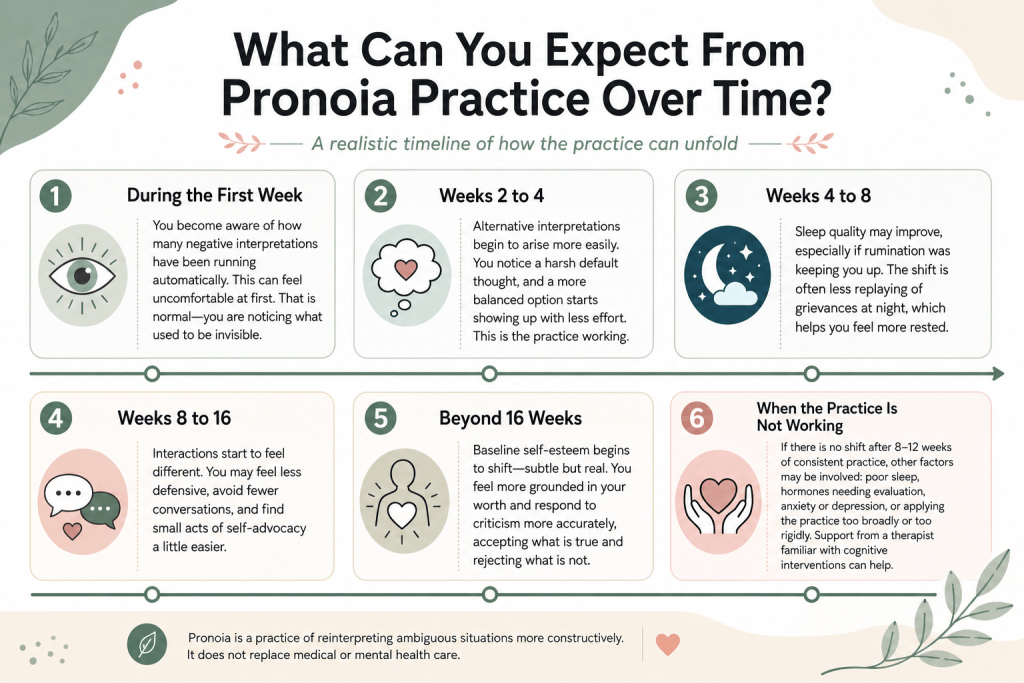
- During the first week: Awareness of how many negative interpretations you had been running automatically. Some women find this awareness uncomfortable initially. This is normal. You are seeing something that had been invisible.
- Weeks 2 to 4: The alternative interpretation exercise starts to become slightly more automatic. You notice a default harsh interpretation and, without effort, an alternative rises. This is the practice working.
- Weeks 4 to 8: Sleep quality often improves for women whose sleep had been disrupted by rumination. The specific improvement is not that you sleep more, but that you spend less of the night replaying grievances. This alone can shift how rested you feel.
- Weeks 8 to 16: Interactions with specific people start to feel different. You notice yourself less defensive in familiar interactions. You take on tasks or conversations you had been avoiding. Small acts of self-advocacy become slightly easier because the imagined pushback has less weight.
- Beyond 16 weeks: Baseline self-esteem shifts. Not dramatically. But measurably. You catch yourself acting from a slightly more grounded sense of your own worth. You take criticism more accurately, meaning you accept accurate criticism and reject inaccurate criticism, rather than absorbing all criticism as evidence against yourself.
- When the practice is not working: If after 8 to 12 weeks of consistent practice you notice no shift, several factors may be at play. Sleep may be disrupting cognitive capacity for reappraisal. Hormones may need medical evaluation. Depression or anxiety may need professional support. The practice may be being applied too broadly or too rigidly. Working with a therapist familiar with cognitive interventions can help identify what is limiting response.
“The specific shift I noticed in my own pronoia practice, and that I have seen in the women I coach, is not that life gets happier. It is that life stops feeling like something you have to brace against. The energy that had been going to bracing becomes available for other things. Creativity comes back. Sleep comes back. Small joys register more clearly because you are not spending them anticipating the next slight. This is what people mean when they say the practice changes their nervous system. It is not that anything about your circumstances changed. It is that your body stopped running a low-grade emergency response about circumstances that were, mostly, not emergencies. That reclaimed energy is worth more than any product or service on the market.”
Terry Tateossian, Founder of The House of Rose
Free 28-Day Fascia Reset Email Course
Get our Free 28-day email course series to help with 1 or 2 exercises per day to release your fascia. One short lesson per day. Two minutes to read each.
Frequently Asked Questions
What does pronoia mean?
Pronoia is a term coined in 1982 by sociologist Fred Goldner. It describes the working orientation that the world is quietly conspiring in your favor, the direct opposite of paranoia. As a practice, pronoia involves consciously choosing benign plausible interpretations of ambiguous events rather than automatically defaulting to interpretations that assume hostility or dismissal.
Is pronoia the same as positive thinking?
No. Positive thinking asks you to override your perception and insist that events are better than they seem. Pronoia asks you to notice the interpretation your mind is running automatically and consider alternative interpretations that are also consistent with the evidence. The distinction matters because positive thinking often produces internal conflict, while pronoia does not.
Is pronoia a scientific concept?
The word pronoia specifically has a small direct research base. However, the practice draws on the substantial cognitive science literature on interpretation bias, cognitive behavioral therapy, and positive psychology, which is well-established. A 2021 paper by S. Jesus in the NIH archives explored pronoia as a positive counterpart to paranoia in clinical contexts.
How is pronoia different from toxic positivity?
Toxic positivity insists that painful feelings should be suppressed or reframed. Pronoia allows painful feelings to be fully present while quietly changing the interpretation of ambient ambiguous events. You can grieve, rage, or worry with a fully pronoic orientation. What changes is the story you tell yourself about the neutral events in the background.
Can pronoia help with perimenopause and menopause mood changes?
Pronoia can support the psychological dimension of midlife mood changes but should not be considered a treatment for clinically significant depression or anxiety. Perimenopause and menopause include real hormonal effects on mood that may benefit from medical evaluation. Pronoia is a supportive practice inside a broader picture of care.
How long does it take to see results from pronoia practice?
Awareness of your default interpretations often develops in the first week. Slight shifts in how automatically alternative interpretations arise usually appear by weeks 2 to 4. Sleep quality improvements often follow by weeks 4 to 8. Baseline self-esteem shifts typically require 3 to 6 months of consistent practice.
Can I do pronoia practice while going through a hard time?
Yes. Pronoia is designed to reduce the ambient interpretation cost of ordinary ambiguous events, not to override legitimate feelings about hard events. Apply the practice to the fifty small ambiguous events that surround the one central difficulty. Let yourself feel what you feel about the central difficulty.
Do I need a therapist to practice pronoia?
No, though a therapist familiar with cognitive behavioral or positive psychology approaches can support the practice. The 5-day program in this article is designed to be done alone. If you have significant mental health concerns, work with a professional in addition to any self-directed practice.
Is there a book about pronoia?
Rob Brezsny’s Pronoia Is the Antidote for Paranoia, published in 2005, is the most widely known book on the topic. It approaches pronoia as a spiritual and creative practice rather than a clinical intervention. It is engaging and idiosyncratic in style, and readers coming from a clinical or psychological framing may prefer the academic literature on interpretation bias instead.
Can pronoia hurt me if I overuse it?
The main risk of pronoia practice is applying it to unambiguous evidence, which can shade into denial. Reserve the practice for ambiguous events. Do not use it to reinterpret direct statements or clearly harmful patterns. If a relationship or situation is truly dangerous or dismissive, pronoia is not asking you to stay in it.
What if I have real reasons for a negative interpretation?
Pronoia does not deny that any specific negative interpretation could be accurate. It notices that most ambiguous events are truly ambiguous, and that the practice of automatically defaulting to the harsher interpretation accumulates a nervous system and self-esteem cost that is not always justified by the actual evidence. Individual negative interpretations may be right. The pattern of automatic negative interpretation is worth examining.
Does pronoia change my personality?
Pronoia is a practice, not a personality transplant. It changes the interpretation habit that runs mostly below conscious awareness. Over time, this can shift your baseline mood and self-esteem. Your fundamental temperament, values, and preferences remain.
Can men practice pronoia?
Yes. Pronoia is not gender-specific. This article is written for midlife women because the specific application to midlife self-esteem work is under-served. The practice itself applies to any adult.
Can I combine pronoia with cognitive behavioral therapy?
Yes. Pronoia is compatible with and can be understood as a specific form of cognitive reappraisal, which is a core CBT technique. Working with a CBT-trained therapist can strengthen the practice.
Is pronoia a religious or spiritual practice?
Pronoia can be practiced in a secular framework or integrated with religious or spiritual practice. The academic literature is secular. Rob Brezsny’s popular writing has spiritual overtones. The 5-day program in this article is secular. You can integrate the practice with whatever meaning framework you already hold.
What if I try the 5-day program and it does not work?
Give it more time. Meaningful shifts in interpretation habits typically require weeks to months, not days. If after 8 to 12 weeks of consistent practice you notice no benefit, consider whether sleep, hormones, or other factors may need attention, and consider working with a mental health professional who can help identify what is limiting response.
References
- Goldner, F. H. (1982). Pronoia. Social Problems, 30(1), 82-91.
- Jesus, S. (2021). Pronoia or reverse paranoid delusion: A brief exploration into a positive delusion. Available via the National Center for Biotechnology Information (PubMed Central).
- Brezsny, R. (2005). Pronoia Is the Antidote for Paranoia: How the Whole World Is Conspiring to Shower You With Blessings. Frog Books.
- Mathews, A., & MacLeod, C. (2005). Cognitive vulnerability to emotional disorders. Annual Review of Clinical Psychology, 1, 167-195.
- Hirsch, C. R., Meeten, F., Krahé, C., & Reeder, C. (2016). Resolving ambiguity in emotional disorders: The nature and role of interpretation biases. Annual Review of Clinical Psychology, 12, 281-305.
- Janoff-Bulman, R. (1989). Assumptive worlds and the stress of traumatic events: Applications of the schema construct. Social Cognition, 7(2), 113-136.
- Sin, N. L., & Lyubomirsky, S. (2009). Enhancing well-being and alleviating depressive symptoms with positive psychology interventions: A practice-friendly meta-analysis. Journal of Clinical Psychology, 65(5), 467-487.
- Emmons, R. A., & McCullough, M. E. (2003). Counting blessings versus burdens: An experimental investigation of gratitude and subjective well-being in daily life. Journal of Personality and Social Psychology, 84(2), 377-389.
- Neff, K. D. (2003). Self-compassion: An alternative conceptualization of a healthy attitude toward oneself. Self and Identity, 2(2), 85-101.
- Beck, A. T. (1976). Cognitive Therapy and the Emotional Disorders. International Universities Press.
- Nolen-Hoeksema, S. (2000). The role of rumination in depressive disorders and mixed anxiety/depressive symptoms. Journal of Abnormal Psychology, 109(3), 504-511.
- Kok, B. E., Coffey, K. A., Cohn, M. A., Catalino, L. I., Vacharkulksemsuk, T., Algoe, S. B., Brantley, M., & Fredrickson, B. L. (2013). How positive emotions build physical health: Perceived positive social connections account for the upward spiral between positive emotions and vagal tone. Psychological Science, 24(7), 1123-1132.
- Ochsner, K. N., Silvers, J. A., & Buhle, J. T. (2012). Functional imaging studies of emotion regulation: A synthetic review and evolving model of the cognitive control of emotion. Annals of the New York Academy of Sciences, 1251(1), E1-E24.
- Cohen, S., Alper, C. M., Doyle, W. J., Treanor, J. J., & Turner, R. B. (2006). Positive emotional style predicts resistance to illness after experimental exposure to rhinovirus or influenza A virus. Psychosomatic Medicine, 68(6), 809-815.
- Diener, E., & Chan, M. Y. (2011). Happy people live longer: Subjective well-being contributes to health and longevity. Applied Psychology: Health and Well-Being, 3(1), 1-43.
- Wright, K. E., Skinner, S., & Zhu, S. (2023). The musculoskeletal syndrome of menopause. Climacteric, 26(4), 366-371.
- Freeman, E. W., Sammel, M. D., Boorman, D. W., & Zhang, R. (2014). Longitudinal pattern of depressive symptoms around natural menopause. JAMA Psychiatry, 71(1), 36-43.
- Bromberger, J. T., & Kravitz, H. M. (2011). Mood and menopause: Findings from the Study of Women’s Health Across the Nation (SWAN) over 10 years. Obstetrics and Gynecology Clinics of North America, 38(3), 609-625.
- Lyubomirsky, S., & Della Porta, M. D. (2010). Boosting happiness, buttressing resilience: Results from cognitive and behavioral interventions. In J. W. Reich, A. J. Zautra, & J. S. Hall (Eds.), Handbook of Adult Resilience (pp. 450-464). Guilford Press.
- Fredrickson, B. L. (2001). The role of positive emotions in positive psychology: The broaden-and-build theory of positive emotions. American Psychologist, 56(3), 218-226.
Disclaimer: This article is educational and does not constitute medical or mental health advice, diagnosis, or treatment. Pronoia and the mindset practices described here are intended to support self-reflection and well-being, not replace therapy, medical care, appropriate boundaries, or action in response to genuine problems. If you are experiencing persistent anxiety, depression, paranoia, significant emotional distress, or symptoms that interfere with daily life, consult a qualified healthcare or mental health professional before relying on these practices.
Free 28-Day Fascia Reset Email Course
Get our Free 28-day email course series to help with 1 or 2 exercises per day to release your fascia. One short lesson per day. Two minutes to read each.

Terry Tateossian is a Menopause Lifestyle Medicine Coach, Certified Personal Trainer & Nutritionist and the Founder of THOR: The House of Rose, a wellness brand serving women over 40 through retreats, coaching, macro-nutrition and community. As 25-year founder and entrepreneur, Terry spent two and a half decades building and running successful start-up businesses, an experience that put her on the front line of founder burnout long before she could name it. After facing serious health challenges, early onset menopause, and emotional eating while running her agency and raising two children, Terry rebuilt her health in her 40s and lost more than 80 pounds through evidence-based nutrition, training, and mindset work. Today, she helps women get strong, improve confidence, support hormone health, and create a stronger second half of life. Terry has been featured in major media outlets and is available for podcasts, expert commentary, brand collaborations, and speaking engagements on midlife health, reinvention, emotional eating, menopause wellness, and strength training for longevity. Get her free macro calculator (her cookbook companion) to start your journey to back to health.