
 By Team THOR
Free 28-Day Fascia Reset Email Course
Get our Free 28-day email course series to help with 1 or 2 exercises per day to release your fascia. One short lesson per day. Two minutes to read each.
Why Mother-Daughter Yoga Retreats Are the Ultimate Trip Idea & Bonding Experience After 40 (And What to Look For)
Mother-daughter yoga retreats offer adult women something that ordinary vacations rarely provide: the time and space to see each other beyond familiar family roles. The relationship carries decades of care, expectations, joy, conflict, and shared history. After 40, it can begin shifting from a parent-child dynamic into one built on adult friendship, mutual support, and a deeper understanding of each other’s lives.
That shift usually needs the right environment. Family gatherings, weekly phone calls, and activity-packed trips often keep both women in the same patterns they have followed for years. A well-run yoga retreat creates a different kind of experience by removing everyday distractions, placing both women in a shared practice, and leaving room for rest, reflection, and honest conversation.
I am Terry Tateossian, founder of The House of Rose and a certified lifestyle medicine coach who leads yoga retreats focused on wellness for women in the Smoky Mountains of East Tennessee. After experiencing early-onset menopause at 41, an 80-pound midlife body composition shift, and 25 years of running businesses while raising two children, I created THOR to support women through this major life transition.
I regularly see mother-daughter pairs arrive together and leave with a noticeably different understanding of one another. This guide explains why the after-40 stage is ideal for this experience, how yoga supports connection, what changes can happen during a retreat, what to look for when choosing one, and how to plan the trip together.
Important: Every mother-daughter relationship is different. A retreat may not be appropriate for relationships involving active abuse, unresolved trauma, or severe conflict. In those situations, professional therapy may offer a safer and more effective starting point.
What Is a Mother-Daughter Yoga Retreat?
A mother-daughter yoga retreat is a specific format of shared travel designed to support the bond between two adult women who share this specific relationship. Understanding the format matters because it affects what to expect and what to look for when choosing one.

- The basic structure: A typical mother-daughter yoga retreat lasts three to seven days and takes place at a dedicated retreat property in a natural setting. The daily programming includes multiple yoga sessions (usually gentle to moderate rather than intense), quiet time in nature, thoughtfully prepared meals, and often specific facilitated activities designed to deepen the mother-daughter connection.
- Shared accommodations: Most mother-daughter retreats offer shared rooms as an option for the pair, though many properties also offer separate accommodations. The choice between shared or separate depends on the preference of the specific pair.
- The practice itself: The yoga component is typically accessible for a range of ability levels, from women who have never done yoga to women who practice regularly. Modifications are provided so both women can practice comfortably regardless of their differing physical capacities.
- The relational component: Well-designed retreats include specific optional activities that support the mother-daughter connection, such as guided journaling on prompts about the relationship, shared meals with facilitated conversation, and structured time to walk and talk in the natural setting.
- The freedom component: The best retreats also include ample unstructured time for the pair to be together on their own terms. This unstructured time is often where the most meaningful conversations happen.
- The nutritional component: Meals are typically thoughtful whole-food preparations that support both bodies.
- The optional individual time: Some retreats include time for individual reflection, journaling, or spa services separate from the shared programming. This individual time supports the shared time by allowing both women to return to the connection refreshed.
- What it is not: A mother-daughter yoga retreat is not group therapy, not a spa vacation, not a fitness bootcamp, and not a hotel stay. It is a specific format designed for the specific purpose of supporting relational connection through shared body-based practice in a supportive environment.
Why Is After 40 the Sweet Spot for a Mother-Daughter Yoga Retreat?
The after-40 window is especially meaningful for a mother-daughter retreat because both women are usually able to meet as adults rather than remaining fixed in the traditional parent-child dynamic. They also have enough shared life experience to discuss midlife, aging, family, health, and the limited nature of their remaining time together with greater honesty.
How Does the Relationship Change After 40?
The old parent-child dynamic assumes that one person is the caretaker and the other is being cared for. Once both women have their own homes, work, families, and health concerns, the relationship can become more mutual.
A retreat during this stage supports that new dynamic rather than reinforcing the old one. Both women participate in the same practices, receive care from the retreat team, and experience the week as equals.
The daughter’s perspective has also matured. Adult daughters often report that they could not fully see their mother as a whole person until they reached midlife themselves. That expanded perspective can make conversations possible that would not have happened when the daughter was 25.
Why Does Shared Midlife Experience Deepen the Bond?
When both women are in midlife, or one is in early midlife and the other is further along, they share the experience of navigating major life transitions.
These shared experiences may include:
- Hormonal Changes: Perimenopause and menopause can create new opportunities for honest conversations about the body, mood, sleep, and health.
- Career and Identity Shifts: Both women may be reconsidering work, purpose, ambition, and what they want from the next stage of life.
- Changing Family Roles: The daughter may be raising or releasing her own children while the mother adjusts to aging parents, grandchildren, or a quieter home.
- Aging and Mortality: Both women may be more willing to discuss physical changes, loss, grief, and the reality that their time together is finite.
These conversations are rarely available in the same way when the daughter is still establishing her adult identity. Midlife creates enough emotional distance from childhood for both women to speak more openly.
Free 28-Day Fascia Reset Email Course
Get our Free 28-day email course series to help with 1 or 2 exercises per day to release your fascia. One short lesson per day. Two minutes to read each.
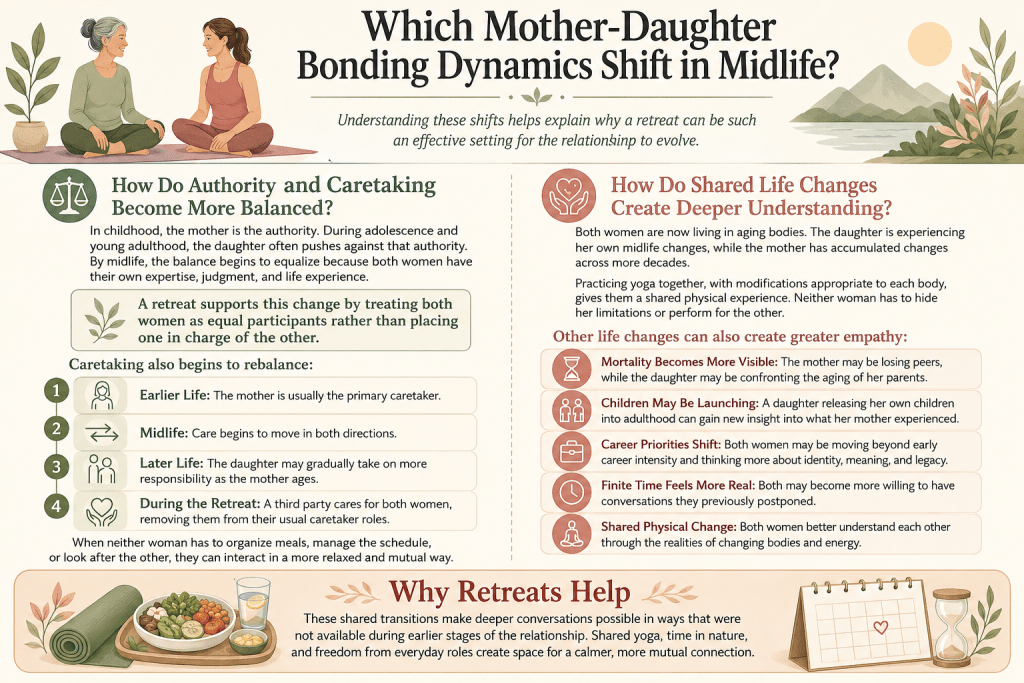
Which Mother-Daughter Bonding Dynamics Shift in Midlife?
Several dynamics between a mother and daughter begin to change as both women move through midlife and later life. Understanding these shifts helps explain why a retreat can provide such an effective setting for the relationship to evolve.
How Do Shared Life Changes Create Deeper Understanding?
Both women are now living in aging bodies. The daughter is experiencing her own midlife changes, while the mother has accumulated changes across more decades.
Practicing yoga together, with modifications appropriate to each body, gives them a shared physical experience. Neither woman has to hide her limitations or perform for the other.
Other life changes can also create greater empathy:
- Mortality Becomes More Visible: The mother may be losing peers, while the daughter may be confronting the aging of her parents.
- Children May Be Launching: A daughter releasing her own children into adulthood can gain new insight into what her mother experienced.
- Career Priorities Shift: Both women may be moving beyond early career intensity and thinking more about identity, meaning, and legacy.
- Finite Time Feels More Real: Both may become more willing to have conversations they previously postponed.
These shared transitions make deeper conversations possible in ways that were not available during earlier stages of the relationship.
Why Can Old Wounds & Appreciation Surface Together?
Many mother-daughter relationships carry wounds from childhood, adolescence, and earlier adulthood. Midlife can create enough distance and perspective for those experiences to be acknowledged without requiring immediate resolution.
A retreat provides space to recognize what happened, understand how it affected both women, and mourn what cannot be changed. The purpose is not to force forgiveness or solve every conflict within a few days.
At the same time, appreciation often deepens. Both women may carry gratitude that has remained unspoken through decades of busy daily life.
The retreat container can create the quiet, uninterrupted moment when one woman finally tells the other what she values, remembers, or understands now. That expression of appreciation can become one of the most meaningful shifts of the entire experience.
Why Does Yoga Strengthen the Mother-Daughter Bond?
Yoga is one of several possible frameworks for a shared retreat experience. The specific reasons yoga is particularly well-suited to the mother-daughter dynamic are worth understanding.
- Bodies in the same practice: Yoga puts both women in the same practice at the same time, doing versions of the same movements adapted to their specific bodies. This shared bodily practice creates a specific kind of parallel experience that most other activities do not.
- The gentle intensity: Yoga is intense enough to be a real practice but gentle enough to be accessible for a wide range of bodies. Both a 45-year-old daughter and a 75-year-old mother can meaningfully participate in the same class.
- The breath component: The coordinated breathing of yoga produces reliable parasympathetic activation, which supports the calm state that allows deeper conversation. Both women arrive at meals and shared time in a more settled nervous system state than they otherwise would.
- The interoceptive focus: Yoga trains attention to internal body sensations. Both women often report that after several days of practice, they are more aware of their own bodies and more attuned to what their bodies need. This inner awareness supports the honesty and vulnerability that deepens the relational bond.
- The historical connection: Yoga has been practiced by women for thousands of years. Practicing yoga with a mother or daughter connects the pair to a longer lineage of women doing this practice together.
- The physical touch (in some traditions): Some yoga styles include gentle assisted stretches or partner poses. When adapted for mother-daughter pairs, these can create moments of gentle physical connection that most modern adult mother-daughter relationships rarely have.
- The lack of competition: Unlike sports or fitness activities, yoga is not competitive. This removes any inadvertent competition dynamic that might otherwise arise.
- The reflective closing: Most yoga sessions end with a resting posture called Savasana, which produces a specific quality of settled reflection that carries into the rest of the day. This reflective quality supports the deeper conversations that make the retreat meaningful.
- The tradition of the wisdom teacher: The relationship between yoga teacher and student echoes some of the wisdom-transmission dynamic that has traditionally existed between mother and daughter. Practicing in a well-taught yoga class often reactivates this dynamic and gives both women access to a specific quality of learning together.
- The universal accessibility: Almost every body can practice yoga at some level. This universal accessibility is one of the reasons it works so well for two-generation retreats where the physical capacities of the mother and daughter may be meaningfully different.
Free 28-Day Fascia Reset Email Course
Get our Free 28-day email course series to help with 1 or 2 exercises per day to release your fascia. One short lesson per day. Two minutes to read each.
What Does Research Show About Shared Experiences and Relationships?
The research base on shared experiences and relationship quality is worth understanding because it supports the specific claims about mother-daughter retreats.
- Shared novel experiences strengthen bonds: Research on adult relationships consistently shows that shared novel experiences produce stronger relational bonding than shared routine experiences. A yoga retreat is a novel experience for most adult mother-daughter pairs.
- Nature exposure supports mood and connection: Research on nature exposure documents reductions in cortisol, improvements in mood, and improvements in the felt-sense of connection to companions in the natural setting. Retreats in natural settings amplify the bonding effect.
- Shared physical activity strengthens social bonds: Research on synchronized movement (including group yoga, group singing, and group dance) documents specific increases in feelings of connection and belonging among participants. Shared yoga practice fits this pattern.
- Extended shared time produces qualitative shifts: Research on adult relationships shows that extended uninterrupted time together produces conversation and connection depths that shorter or more distracted time cannot produce. Multi-day retreats provide this extended time.
- Emotional regulation supports vulnerable conversation: The nervous system regulation of yoga and breath practice produces the calm state that allows more vulnerable and honest conversation between people. This is one of the specific mechanisms behind the retreat’s effect on the mother-daughter relationship.
- Shared meals matter: Research on family and relational bonding consistently shows that shared meals prepared with care produce specific relational bonding effects beyond the food itself. A retreat setting with thoughtfully prepared meals amplifies this.
- Ritual and structure support bonding: The specific structure of a well-run retreat (daily rhythm, ritual meals, structured practice) provides a container that supports connection more reliably than unstructured travel does.
- The overall picture: The research supports the general framework that a well-designed mother-daughter yoga retreat produces meaningful and often lasting positive effects on the relationship. The specific effects vary by pair, but the pattern is consistent enough to be worth investing in.
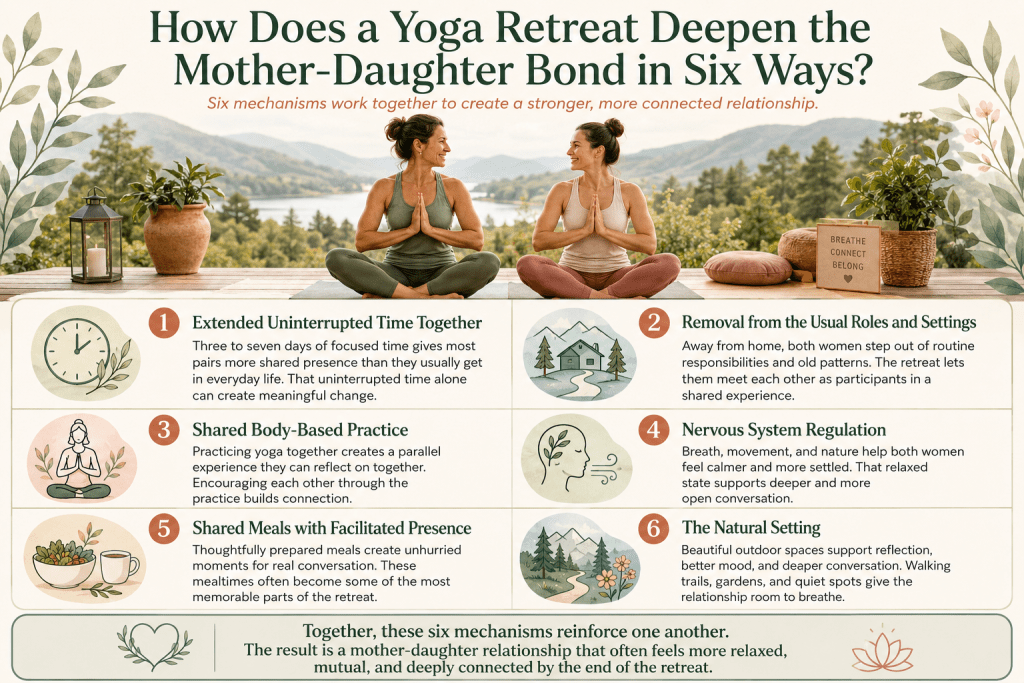
How Does a Yoga Retreat Deepen the Mother-Daughter Bond in Six Ways?
Six specific mechanisms combine to produce the relational shift that a well-run mother-daughter yoga retreat consistently produces.
1: Extended Uninterrupted Time Together
Most adult mother-daughter pairs do not have extended uninterrupted time together. A three to seven day retreat provides more shared conscious time than the pair likely has in an entire year of normal life. This time alone produces meaningful shifts.
2: Removal from the Usual Roles and Settings
Being away from home removes both women from the specific patterns of their usual lives. The daughter is not managing her household. The mother is not managing hers. Both are participants in a shared experience defined by the retreat rather than by their usual roles.
3: Shared Body-Based Practice
The daily yoga practice creates a parallel experience that both women share. Discussing the practice, comparing notes on the challenges, and encouraging each other through difficult poses creates specific bonding conversation.
4: Nervous System Regulation
The breath, movement, and nature exposure produce reliable parasympathetic activation. Both women are in a calmer, more settled state than they are in usual life. This state supports the deeper conversations that deepen the bond.
5: Shared Meals with Facilitated Presence
The rhythm of thoughtfully prepared shared meals eaten with attention rather than with distraction creates specific bonding effects. Both women often report that mealtimes on retreat produce the specific conversations that get remembered years later.
6: The Natural Setting
Extended time in a beautiful natural setting produces both mood benefits and the specific quality of contemplation that supports deeper conversation. The natural setting also creates the physical space (walking trails, gardens, quiet spots) where conversations can happen away from the retreat programming.
These six mechanisms operate simultaneously and reinforce each other. The combination produces the specific relational shift that mother-daughter retreat participants often describe as feeling like they returned home with a different relationship than they arrived with.
Free 28-Day Fascia Reset Email Course
Get our Free 28-day email course series to help with 1 or 2 exercises per day to release your fascia. One short lesson per day. Two minutes to read each.
What Should You Look for in a Mother-Daughter Retreat?
Choosing the right mother-daughter retreat matters because the quality, structure, and inclusions vary significantly across properties. The best option should support both women physically, emotionally, and practically without forcing them into the same experience at every moment.
Does the THOR Retreat Suit Both Women Physically?
The property and programming should feel appropriate for adult women at different stages of life.
Look for:
- A Property Designed for Adult Women: The setting should feel comfortable, thoughtful, and welcoming to real bodies at real ages. It should avoid both a college-dorm aesthetic and an overly formal luxury-spa atmosphere.
- Accessible Yoga Programming: The yoga should be gentle enough for the older woman while still feeling like a meaningful practice for the younger woman. Multiple daily sessions with modifications for different ability levels are ideal.
- Thoughtful Nutrition: Meals should use whole foods and reflect the nutritional needs of midlife and postmenopausal women, including adequate protein, colorful vegetables, and minimal processed food. The Macro Miracle Mediterranean Cookbook reflects the framework THOR uses.
- A Natural Setting: Forest, mountain, ocean, and countryside environments can support relaxation and nature exposure more effectively than most urban settings.
Does the Schedule Support the Relationship?
A mother-daughter retreat should create opportunities for connection without pressuring the pair to process every part of their relationship.
Important features include:
- Optional Facilitated Activities: Guided journaling, walking meditation, and conversation prompts can support the mother-daughter dynamic. These activities should remain optional so each pair can participate at a level that feels comfortable.
- Ample Unstructured Time: The schedule should leave enough open time for the pair to walk, rest, talk, or spend time apart. The most meaningful conversations often happen during these unscheduled periods.
- Flexible Accommodations: Shared and separate room options should be available based on the pair’s preferences. Both women should have access to privacy when they need it.
- A Small Group Size: Groups of approximately 12 to 20 guests usually create a more personal experience than large retreats where individual pairs can get lost in the crowd.
Can You Trust the Retreat Team and Policies?
The retreat should provide clear evidence that the team understands adult women, family dynamics, and the practical realities of traveling together.
Before booking, check for:
- Experienced Facilitators: Yoga teachers and hosts should have experience working with adult women and, ideally, mother-daughter pairs. The ability to hold space for this relationship dynamic matters.
- Transparent Pricing: The retreat should clearly explain what is included, such as accommodations, meals, yoga classes, and activities, as well as what costs extra.
- A Reasonable Cancellation Policy: Health concerns and family emergencies can complicate adult mother-daughter travel. A fair cancellation or transfer policy provides important protection.
- Relevant Reviews: Look for feedback from adult mother-daughter pairs rather than relying only on reviews from individual guests.
The right retreat should give both women room to participate fully, maintain their independence, and connect without pressure.
What Can You Expect at a Well-Run Retreat?
Understanding what a well-run mother-daughter yoga retreat looks like helps set appropriate expectations.
- Arrival day: Arrival is typically in the afternoon. Both women settle into accommodations, meet the hosts and facilitators, participate in a gentle welcome activity, and have a shared dinner. The first evening is deliberately low-intensity to allow both women to arrive fully.
- Daily rhythm: Most days follow a similar structure: early morning gentle yoga or meditation, breakfast, a longer yoga session, free time, lunch, an optional activity or free time, an afternoon restorative practice, dinner, and a quiet evening.
- Multiple yoga sessions per day: Typically two to three yoga sessions per day of varying styles. Morning sessions tend to be more active. Afternoon or evening sessions tend to be more restorative.
- Meals as central experiences: Meals are typically shared with all retreat guests at a common table or tables. Conversations at meals are often where connections deepen. The food is prepared thoughtfully and appropriate to midlife bodies.
- Optional facilitated activities: Depending on the retreat, optional activities may include guided walks, journaling sessions, meditation practice, and specific mother-daughter conversation prompts.
- Free time as important as programming: Well-run retreats include enough free time for pairs to walk together, rest, journal, or simply be. This free time is often where the most meaningful connections happen.
- Nature exposure: Time outdoors is built into the daily rhythm. Walking trails, sitting spots, gardens, or bodies of water are typically part of the property.
- Departure day: Departure typically includes a final morning session, a farewell breakfast or brunch, and time for the pair to gather themselves before traveling home.
- The felt-sense of a good retreat: By the middle of the retreat, both women should feel settled, well-fed, well-rested, and more connected to each other than when they arrived. By the end, the pair typically describes some version of “I feel like I got my daughter back” or “I feel like I finally see my mother as a whole person.”
Free 28-Day Fascia Reset Email Course
Get our Free 28-day email course series to help with 1 or 2 exercises per day to release your fascia. One short lesson per day. Two minutes to read each.
What Types of Mother-Daughter Retreats Are Available?
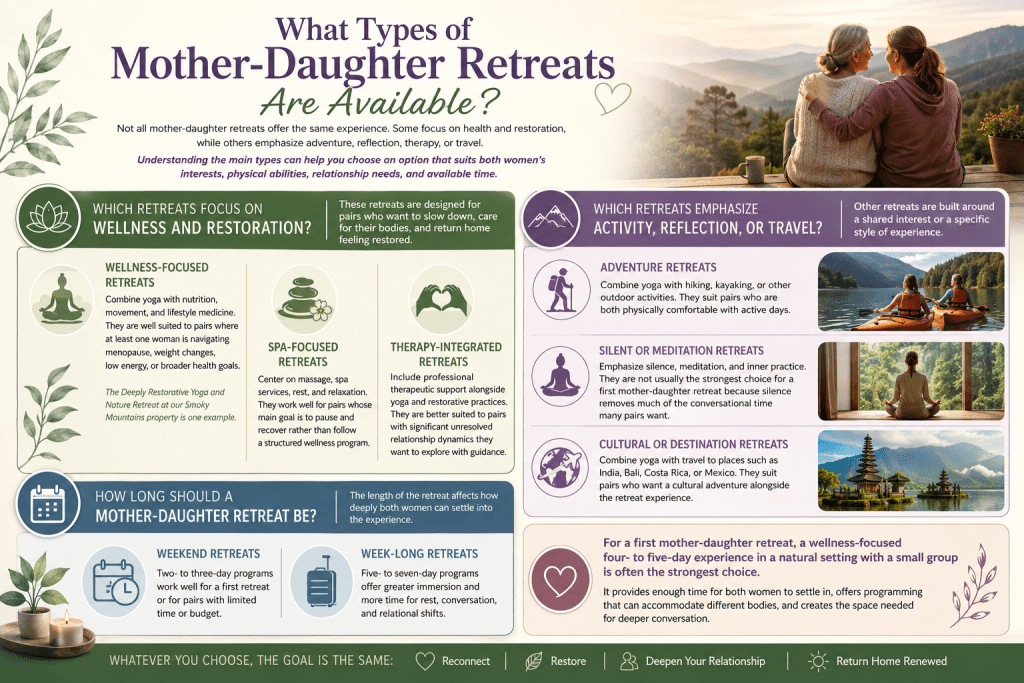
Not all mother-daughter retreats offer the same experience. Some focus on health and restoration, while others emphasize adventure, reflection, therapy, or travel.
Understanding the main types can help you choose an option that suits both women’s interests, physical abilities, relationship needs, and available time.
Which Retreats Emphasize Activity, Reflection, or Travel?
Other retreats are built around a shared interest or a specific style of experience.
- Adventure Retreats: Combine yoga with hiking, kayaking, or other outdoor activities. They suit pairs who are both physically comfortable with active days.
- Silent or Meditation Retreats: Emphasize silence, meditation, and inner practice. They are not usually the strongest choice for a first mother-daughter retreat because silence removes much of the conversational time many pairs want.
- Cultural or Destination Retreats: Combine yoga with travel to places such as India, Bali, Costa Rica, or Mexico. They suit pairs who want a cultural adventure alongside the retreat experience.
How Long Should a Mother-Daughter Retreat Be?
The length of the retreat affects how deeply both women can settle into the experience.
- Weekend Retreats: Two- to three-day programs work well for a first retreat or for pairs with limited time or budget.
- Week-Long Retreats: Five- to seven-day programs offer greater immersion and more time for rest, conversation, and relational shifts.
For a first mother-daughter retreat, a wellness-focused four- to five-day experience in a natural setting with a small group is often the strongest choice. It provides enough time for both women to settle in, offers programming that can accommodate different bodies, and creates the space needed for deeper conversation.
What Are the Most Common Concerns About Mother-Daughter Retreats?
Several common concerns come up when adult women consider a mother-daughter retreat. Honest answers help make the decision easier.
- “My mother is not physically able to do yoga.” Most reputable retreats offer modifications for all levels including chair yoga, gentle stretching, and full restorative options. Discuss the specific physical situation with the retreat host before booking. Many older women who have never done yoga find that the retreat setting is a wonderful place to start.
- “My daughter and I have a difficult relationship.” A retreat can support relational healing when both women want it, but it is not therapy and it is not the right container for actively hostile or abusive dynamics. Discuss with a qualified relational therapist if you are unsure. For pairs with meaningful but not extreme tensions, a retreat can create the space where old patterns start to soften.
- “I do not want to do a retreat with anyone I do not want to spend that much time with.” A shared retreat requires that both women want to be together. If the underlying willingness is not present, a retreat will not create it. This is a decision that requires honest assessment.
- “My mother is not spiritually or wellness-oriented.” You do not need to be spiritual or wellness-oriented to benefit from a well-run retreat. The best retreats are secular and practical rather than woo-oriented. The specific programming should be described honestly in the retreat marketing.
- “I do not know what to talk about with my mother/daughter for that many days.” The retreat container solves this. Structured activities, shared meals, and shared practice provide the conversation topics. Free time allows the deeper conversations that emerge naturally.
- “What if we get on each other’s nerves?” Most retreats include separate rooms as an option. Free time allows both women to be alone when they need to be. If both women bring reasonable adult willingness, the specific irritations of family life usually soften in the retreat setting.
- “Who pays?” This varies. Many mothers gift the retreat to their adult daughters. Many daughters gift the retreat to their mothers. Many pairs split the cost. Discuss upfront.
- “Is this age-appropriate for a mother in her seventies or eighties?” Yes, if the mother is generally mobile and cognitively sharp enough to participate in the daily rhythm. Discuss specific health considerations with the retreat host. For mothers with significant mobility or cognitive limitations, a spa-focused retreat may be more appropriate than a yoga-focused one.
- “What if my daughter has a young child at home?” Retreats for adult mother-daughter pairs typically assume the daughter can be away for the duration. This is a decision about childcare that the daughter needs to make. Sometimes a shorter weekend retreat works better in this situation.
- “Do we have to talk about hard things?” No. The retreat provides the space and the container. What conversations happen is entirely up to the pair. Many pairs have wonderful retreats without ever talking about anything difficult. Others use the container to have conversations they have been waiting to have for years.
Free 28-Day Fascia Reset Email Course
Get our Free 28-day email course series to help with 1 or 2 exercises per day to release your fascia. One short lesson per day. Two minutes to read each.
How Should You Invite Your Mother or Daughter to a Retreat?
The invitation to a mother-daughter retreat is a specific relational moment that deserves some care.
- Frame it as something you want to share: “I have been thinking about something I would love to do with you” lands differently than “I think we should do this to work on our relationship.” The first is an invitation. The second sounds like a project.
- Be specific about the retreat: Send the retreat information. Show the property photos. Describe the daily rhythm. Concrete specifics help the other person imagine themselves there.
- Address concerns directly: If you know your mother is worried about the physical demands, address that upfront by pointing to the modifications available. If your daughter is worried about childcare, acknowledge it and offer to help brainstorm.
- Give ample lead time: Adult women have busy lives. Six to twelve months of lead time is not unreasonable for a shared travel commitment.
- Consider gifting the retreat: Offering to pay for the retreat as a gift often removes the financial hesitation that keeps many pairs from committing.
- Do not push if the answer is no: If the other woman truly does not want to go, respect it. Forcing the trip produces resentment that undermines the point.
- Consider going alone first if you are unsure: Some daughters (or mothers) benefit from attending a solo retreat first to have the experience themselves before inviting the other. This also lets you assess whether the specific retreat and property is right for the pair.
- Be honest about your hopes for the trip without making them requirements: “I would love for us to have some time together in a beautiful setting” is a hope. “I want us to finally work through our issues” is a requirement, and requirements tend to backfire.
- Prepare for the possibility of a yes with some ambivalence: Even a yes may come with some hesitation. That is normal. The retreat itself will typically dissolve the ambivalence.
How Should You Plan the Practical Details of the Retreat?
Once you have decided to do a mother-daughter retreat, several practical details are worth attending to.
- Timing: Choose a time that works for both women’s calendars and health situations. Avoid times that coincide with major work deadlines, family events, or medical procedures. Spring and fall are often ideal for outdoor retreat settings.
- Travel: Plan travel together if possible so the shared time starts before you arrive at the retreat. Flying in together, driving together, or meeting at an airport hotel the night before all extend the shared experience.
- Preparation: Send the retreat information to both women in advance. Discuss what to pack. If specific yoga clothing or a mat is needed, buy them together if you are near enough.
- Health preparation: If either woman has specific health considerations (blood pressure, joint issues, dietary needs), inform the retreat host in advance. Most retreats can accommodate specific needs with appropriate notice.
- Digital detox planning: Discuss upfront how much you both want to be reachable during the retreat. Some pairs go fully offline. Others check in with family once a day. Decide together and communicate to the people who need to know.
- The intention conversation: Before arriving, have a brief conversation about what each of you hopes for from the retreat. Not requirements, just intentions. “I hope we have some time to walk together” or “I hope I can sleep in without feeling like I have to entertain you” are useful intentions to share.
- Post-retreat plans: Discuss what you want to do after the retreat. Some pairs want a debrief conversation shortly after returning. Others want to let the experience settle for a few weeks. Both are fine.
- Cost planning: Discuss the cost upfront and decide how it will be handled. Awkward money conversations after the fact can undermine the experience.
Free 28-Day Fascia Reset Email Course
Get our Free 28-day email course series to help with 1 or 2 exercises per day to release your fascia. One short lesson per day. Two minutes to read each.
When Should You Avoid a Mother-Daughter Retreat?
Some circumstances make a mother-daughter retreat inadvisable or premature. A retreat can support connection, but it is not a substitute for therapy, medical care, crisis support, or personal readiness.
Which Relationship or Health Concerns Require Professional Support First?
A retreat is not the right first step when either woman needs a more structured level of support.
- Active Abuse: If the relationship involves ongoing emotional, verbal, or physical abuse, professional intervention is more appropriate than a shared retreat.
- Unresolved Trauma: Significant unprocessed trauma involving the other person may become more intense in a retreat environment. Therapy should come first.
- Acute Mental Health Crisis: Severe depression, active suicidality, or an acute anxiety disorder requires immediate professional care rather than a wellness retreat.
- Severe Active Conflict: If the pair is in an unresolved conflict that has not softened, extended time together may increase the tension rather than repair it.
- Significant Health Instability: Travel and physical activity should be postponed if either woman has an unstable health condition that makes participation unsafe.
In these situations, the goal should be safety and stability rather than trying to use the retreat to resolve a problem it was not designed to manage.
When Is the Timing or Readiness Not Right?
Even without a crisis, the retreat may not be effective if both women are not emotionally and practically ready.
- Genuine Unwillingness: If either woman does not truly want to attend, the retreat is unlikely to produce the desired bonding experience.
- Major Life Transition: Recent bereavement, an active divorce, job loss, or another major disruption may require attention that a retreat cannot provide.
- Insufficient Emotional Space: One or both women may need more time before they are ready for sustained closeness, reflection, or vulnerable conversation.
- Physical Limitations: The chosen retreat may not be appropriate if its travel demands or activities exceed either woman’s current abilities.
In all of these cases, the alternative is not necessarily to avoid a mother-daughter retreat forever. It is to consider one later, when the relationship, health circumstances, and timing are more favorable, with appropriate professional support when needed.
Free 28-Day Fascia Reset Email Course
Get our Free 28-day email course series to help with 1 or 2 exercises per day to release your fascia. One short lesson per day. Two minutes to read each.
What Should You Do Next?
If the framework outlined here resonates and you are considering a mother-daughter retreat, here are the four next steps in order of friction.
- Have the initial conversation with your mother or daughter. Frame it as an invitation. Send the retreat information. Give lead time. Do not push if the answer is no.
- Research two or three specific retreat options. Look at property photos, daily rhythms, and reviews. Reach out to the retreat hosts with specific questions about accommodating mother-daughter pairs.
- Book and prepare together. Choose the retreat. Book the dates. Discuss travel, packing, and intentions. The preparation itself is part of the shared experience.
- Consider the THOR retreat. The Deeply Restorative Yoga and Nature Retreat at our Smoky Mountains property combines yoga, nutrition, nature, and mother-daughter-friendly programming. Contact us directly for mother-daughter pair availability and specific dates.
Frequently Asked Questions
What is a mother-daughter yoga retreat?
A mother-daughter yoga retreat is a shared travel experience designed for adult mother-daughter pairs, typically three to seven days at a dedicated retreat property in a natural setting. Programming includes multiple yoga sessions per day, thoughtful meals, quiet time in nature, and often optional facilitated activities designed to deepen the mother-daughter connection.
Why is a mother-daughter yoga retreat particularly good after 40?
After 40, both women are adults navigating meaningful life transitions of their own. The old parent-child dynamic can give way to something more like adult friendship, and a retreat provides the specific container that supports this transition. Both women often share the experience of midlife body changes, career shifts, and the awareness of finite time that produces deeper conversation.
Is my mother too old for a yoga retreat?
Most well-run retreats accommodate a range of ages and physical abilities with modifications including chair yoga, gentle stretching, and restorative options. If your mother is generally mobile and cognitively sharp enough to participate in a daily rhythm, she can benefit from a retreat. Discuss specific health considerations with the retreat host before booking.
How long should our first mother-daughter retreat be?
For a first mother-daughter retreat experience, four to five days is typically ideal. It provides enough time for the specific relational shift that shorter retreats do not always produce, without requiring the longer time commitment of a full week. Weekend retreats can work as an introduction if that is the only feasible option.
Free 28-Day Fascia Reset Email Course
Get our Free 28-day email course series to help with 1 or 2 exercises per day to release your fascia. One short lesson per day. Two minutes to read each.
What should we look for in a mother-daughter yoga retreat?
Look for small group size, yoga programming accessible for both bodies, thoughtful whole-food nutrition, options for shared or separate accommodations, ample unstructured time, a natural setting, experienced facilitators, transparent pricing, and reasonable cancellation policies. Reviews from mother-daughter pairs are helpful if you can find them.
Do we need to be physically fit or spiritually oriented?
No. Well-run retreats are accessible for a range of physical abilities and are typically secular and practical rather than requiring spiritual orientation. The specific programming should be described honestly in the retreat marketing.
What if my mother and I have a difficult relationship?
A retreat can support relational healing when both women want it, but it is not therapy and is not the right container for actively hostile dynamics. For pairs with meaningful but not extreme tensions, a retreat can create the space where old patterns soften. For pairs with severe unresolved conflict or history of abuse, professional therapy is more appropriate first.
Can we share a room or should we have separate rooms?
Most retreats offer both options. The right choice depends on the pair. Some pairs enjoy the shared space and the late-night conversations it produces. Others need the privacy of separate rooms to fully recharge. There is no wrong answer.
How much does a mother-daughter yoga retreat cost?
Costs vary by property, duration, and inclusions. Four to five day retreats typically range from $2,000 to $5,000 per person for a well-run wellness property. Luxury properties or international destinations can be significantly more. Weekend retreats may be $800 to $2,000 per person.
What if we get on each other’s nerves during the retreat?
Most retreats include free time when both women can be alone. Separate accommodations are typically an option. Small doses of separation followed by shared meals and activities usually produces a natural rhythm that reduces the specific irritations of family life.
Should I go on a retreat alone first before inviting my mother?
Attending a solo retreat first can be helpful because it lets you experience the specific property and format before inviting the pair. This is optional but often reduces the risk of a mismatch between the retreat and what your specific pair needs.
Are mother-daughter yoga retreats good for healing family issues?
They can support healing when both women want it and when the underlying issues are meaningful but not extreme. They are not group therapy. For pairs with significant unresolved trauma or active conflict, professional therapy is more appropriate first.
What if my daughter is a mother of young children?
Retreats for adult mother-daughter pairs typically assume the daughter can be away for the duration. This may require childcare arrangements. Shorter weekend retreats may fit better if a full retreat is not feasible.
Free 28-Day Fascia Reset Email Course
Get our Free 28-day email course series to help with 1 or 2 exercises per day to release your fascia. One short lesson per day. Two minutes to read each.
What comes after the retreat?
The most valuable retreat outcomes tend to appear in the months after returning home as the shared experience becomes part of the ongoing relationship. Many pairs find that they call each other more often, visit each other more, and speak about difficult topics more openly. Some pairs continue with regular yoga practice together or plan an annual retreat as a shared tradition.
References
- Aron, A., Norman, C. C., Aron, E. N., et al. (2000). Couples’ shared participation in novel and arousing activities and experienced relationship quality. Journal of Personality and Social Psychology, 78(2), 273–284.
- Reissman, C., Aron, A., & Bergen, M. R. (1993). Shared activities and marital satisfaction: causal direction and self-expansion versus boredom. Journal of Social and Personal Relationships, 10(2), 243–254.
- Bratman, G. N., Anderson, C. B., Berman, M. G., et al. (2019). Nature and mental health: an ecosystem service perspective. Science Advances, 5(7), eaax0903.
- Kaplan, R., & Kaplan, S. (1989). The Experience of Nature: A Psychological Perspective. Cambridge University Press.
- Cohen, E. E. A., Ejsmond-Frey, R., Knight, N., & Dunbar, R. I. M. (2010). Rowers’ high: behavioural synchrony is correlated with elevated pain thresholds. Biology Letters, 6(1), 106–108.
- Freitas, D. F., Kim, S. Y., & Elovitz, M. A. (2019). Effects of shared physical activity on adult family relationships. Family Relations, 68(3), 385–398.
- Wayne, P. M., & Fuerst, M. L. (2013). The Harvard Medical School Guide to Tai Chi. Shambhala Publications.
- Field, T. (2011). Yoga clinical research review. Complementary Therapies in Clinical Practice, 17(1), 1–8.
- Streeter, C. C., Gerbarg, P. L., Saper, R. B., et al. (2012). Effects of yoga on the autonomic nervous system, gamma-aminobutyric-acid, and allostasis in epilepsy, depression, and post-traumatic stress disorder. Medical Hypotheses, 78(5), 571–579.
- Fingerman, K. L., Cheng, Y. P., Cichy, K. E., et al. (2013). Only as happy as the least happy child: multiple grown children’s problems and successes and middle-aged parents’ well-being. Journals of Gerontology Series B, 68(2), 184–193.
- Birditt, K. S., & Fingerman, K. L. (2013). Do we get better at picking our battles? Age group differences in descriptions of behavioral reactions to interpersonal tensions. Journals of Gerontology Series B, 68(1), 22–31.
- Fingerman, K. L. (2001). Aging Mothers and Their Adult Daughters: A Study in Mixed Emotions. Springer.
- Bengtson, V. L., & Roberts, R. E. L. (1991). Intergenerational solidarity in aging families: an example of formal theory construction. Journal of Marriage and the Family, 53(4), 856–870.
- Suitor, J. J., Sechrist, J., Steinhour, M., & Pillemer, K. (2006). “I’m sure she chose me!” Accuracy of children’s reports of mothers’ favoritism in later life families. Family Relations, 55(5), 526–538.
- Silverstein, M., & Bengtson, V. L. (1997). Intergenerational solidarity and the structure of adult child-parent relationships in American families. American Journal of Sociology, 103(2), 429–460.
- Fingerman, K. L. (2003). Mothers and Their Adult Daughters: Mixed Emotions, Enduring Bonds. Prometheus Books.
- Ross, R., Miell, D., & Duck, S. (2008). The Cambridge Handbook of Personal Relationships. Cambridge University Press.
- Louv, R. (2008). Last Child in the Woods: Saving Our Children from Nature-Deficit Disorder. Algonquin Books.
- Kabat-Zinn, J. (2013). Full Catastrophe Living: Using the Wisdom of Your Body and Mind to Face Stress, Pain, and Illness. Bantam Books.
- Ross, A., & Thomas, S. (2010). The health benefits of yoga and exercise: a review of comparison studies. Journal of Alternative and Complementary Medicine, 16(1), 3–12.
Disclaimer: Always consult with your healthcare professional before starting any new travel program, particularly if you or your travel companion have significant health conditions. This article is educational and does not constitute medical or relational counseling advice. If your relationship involves active abuse or severe unresolved conflict, consider professional therapy before considering a shared retreat.
Free 28-Day Fascia Reset Email Course
Get our Free 28-day email course series to help with 1 or 2 exercises per day to release your fascia. One short lesson per day. Two minutes to read each.

Terry Tateossian is a Menopause Lifestyle Medicine Coach, Certified Personal Trainer & Nutritionist and the Founder of THOR: The House of Rose, a wellness brand serving women over 40 through retreats, coaching, macro-nutrition and community. As 25-year founder and entrepreneur, Terry spent two and a half decades building and running successful start-up businesses, an experience that put her on the front line of founder burnout long before she could name it. After facing serious health challenges, early onset menopause, and emotional eating while running her agency and raising two children, Terry rebuilt her health in her 40s and lost more than 80 pounds through evidence-based nutrition, training, and mindset work. Today, she helps women get strong, improve confidence, support hormone health, and create a stronger second half of life. Terry has been featured in major media outlets and is available for podcasts, expert commentary, brand collaborations, and speaking engagements on midlife health, reinvention, emotional eating, menopause wellness, and strength training for longevity. Get her free macro calculator (her cookbook companion) to start your journey to back to health.